


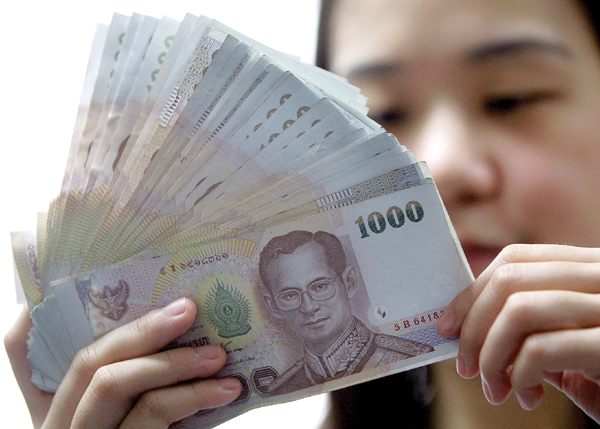
BANGKOK, July 7 — Thailand's growth rate remains frustratingly low, pivotal exports keep falling and further cuts in the already-low key interest rate seem unlikely to help much. What's a central bank to do?
Analysts say they expect the Bank of Thailand (BOT), which will soon get a new governor, to keep doing what it began recently: Communicate that a weak baht is good, and may be the best chance to lift the economy by boosting exports.
After Singapore, Thailand is the most export-dependent economy in Southeast Asia. But January-May shipments fell 4.2 per cent in US dollar terms from a year earlier, and the BOT now sees a third year of falling exports in 2015.
The central bank “is deliberately allowing baht weakness to augment the traditional interest rate channel which has clearly lost traction in Thailand,” said ANZ bank economist Weiwen Ng.
The baht has weakened 3.6 per cent against the dollar since April 29, when the central bank said it would announce measures making it easier for Thais to move money overseas. That is less than the ringgit has depreciated, but more than the rupiah, Philippine peso and Singapore dollar have slipped during the same period.
April also brought a second straight 25 basis point cut for Thailand's benchmark interest rate, taking it to 1.50 per cent, just above the record low of 1.25 per cent.
Minutes from the central bank's June 10 meeting, when interest rates were held steady, show policymakers thought further cuts would have a “lesser” impact.
Getting 'more conducive'
With household debt at record highs and low interest rates not boosting credit growth, the BOT hopes a cheaper currency will lift exports.
By law, the central bank's only target is inflation, and that will not change to include an exchange rate.
But in a change, the BOT has linked a weaker baht to recovery prospects.
In June, the central bank noted the baht has become “more conducive” to economic recovery, and Deputy Governor Paiboon Kittisrikangwan said he would be “comfortable” if the market took the baht lower.
Yesterday, he told Reuters that Thailand's short-term interest rate remains the main instrument of monetary policy “but the policy impact can be transmitted to the economy through many different channels — one of which is the exchange rate.”
“As long as exchange rate adjustments are orderly and in line with economic fundamentals or what the economy needs, there is no reason for the central bank to take any action,” Paiboon added.
Credit Suisse economist Santitarn Sathirathai predicts the BOT “will seek to keep the baht weak by giving some dovish guidance such as indicating there is room to adjust monetary policy if needed and perhaps highlighting the sluggish recovery.”
Inflation not a risk
Normally, central banks might worry that a weaker currency would import inflation. But, with consumer prices falling by 1.1 per cent from a year earlier in June, that's not an overriding concern in Thailand.
A weaker currency might even help Southeast Asia's second-largest economy shake deflation and steer inflation back towards this year's 1-4 per cent effective target range.
But to keep the baht competitive when many other emerging-market currencies are under pressure before the US Federal Reserve hikes rates, economists say the BOT may still cut rates again to spur capital outflows.
“We suspect keeping the baht weak will be a challenge given the large current account surplus and hence the risk of further rate cut is still very much alive,” said Santitarn of Credit Suisse.
In January-March, Thailand's current-account surplus equalled 7.9 per cent of gross domestic product, the largest in Southeast Asia after Singapore, and foreign ownership of its bonds is relatively low at about 18 per cent.
Any growth boost would be welcome. The Bank of Thailand has cut its 2015 forecast to three per cent from 3.8 per cent. Growth last year was just 0.9 percent.
But whether a weaker currency can sustainably spur export growth in the absence of a recovery in global manufacturing or commodity prices is unclear.
"We are sceptical that it will provide a lasting boost to exports," said JP Morgan economist Benjamin Shatil. — Reuters


