













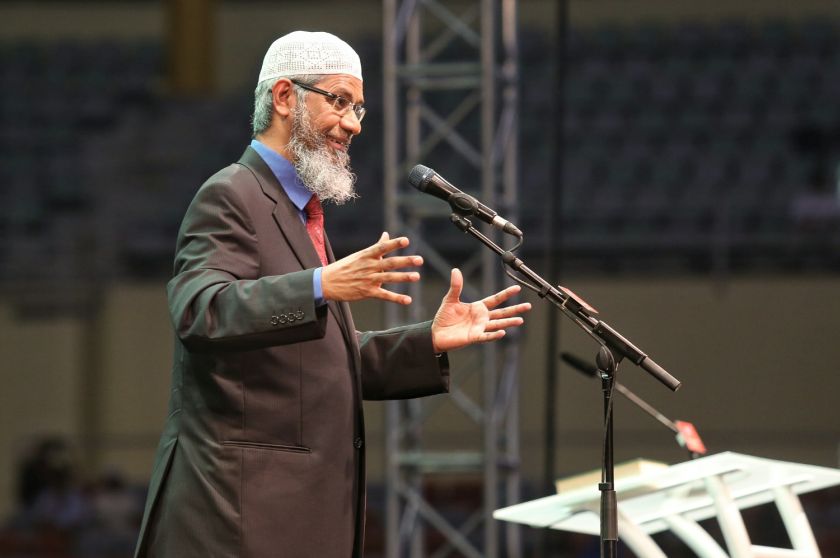


KUALA LUMPUR, April 20 — It was inappropriate for non-Muslims to convert to Islam publicly at Dr Zakir Naik’s talks, given the tensions sparked by the Indian Muslim preacher’s arrival here, a local Muslim missionary said.
Abdul Naser Tun Rahman, chairman of missionary group Skuad Mubaligh Selangor (Smash), pointed out that Dr Zakir had already caused much controversy ahead of his talks in Malaysia, with Indian rights group Hindraf and politicians from MCA, MIC and DAP voicing their objections to the Mumbai-based televangelist.
“Even before Zakir Naik came to Malaysia, already very heated [sic]. So in this context, I think it’s not appropriate,” Abdul Naser, a Chinese-Melanau Muslim known as Xifu Naser, told Malay Mail Online when contacted.
“The condition now is not suitable. We are human beings. Religion is a very sensitive thing. Islam itself doesn’t want us to portray [sic] we are insulting other religions,” he said.
Abdul Naser noted that the public conversions were done in front of a huge crowd that was highly emotional and where “anything” could happen.
He also said the decision to embrace Islam is a private matter of the heart — between the individual and God — adding that it does not have to be publicised.
“If a person wants to be Muslim, he can go to the Islamic department and be (a) Muslim. Ninety-nine per cent are Muslims in the stadium. The person can be a Muslim by asking any Muslim [sic] and why is it the person has to recite in front of Zakir Naik? He could have done it quietly,” he said, adding that it was possible for a person to be “enticed” by the glamour and media attention to convert publicly before later regretting it.
He also expressed concern about how family members would take one’s public decision to convert to Islam, advising those seeking to become Muslims to first speak to their families.
“If I become a Muslim, if I don’t announce to public, still I am a Muslim. It’s for God to know, not for other people to know. When it involves other people, then we must make sure we must minimise hurting people, harming other people,” he said, adding that the public conversions could even cause family members to misunderstand Islam as an “insensitive” religion.
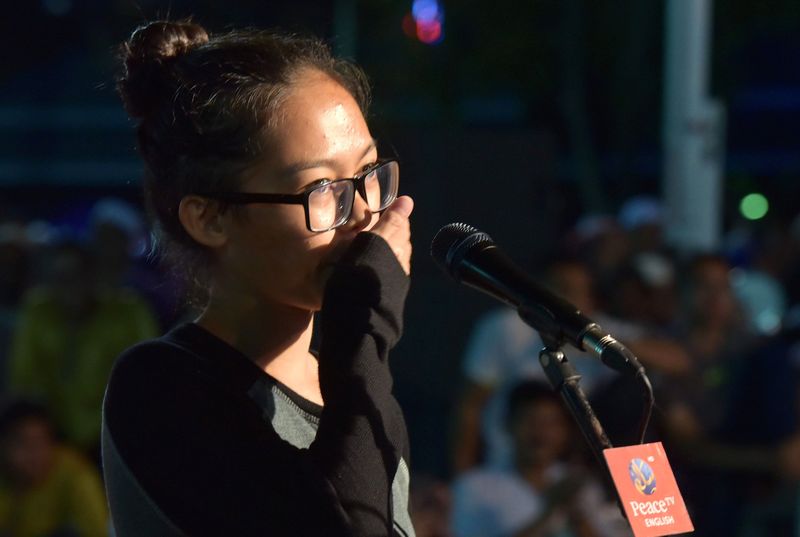
Highlighting the case of 19-year-old Woo Nina Grace’s conversion to Islam last Thursday at a Dr Zakir talk, Abdul Naser noted that she had, after claiming to be a Christian, immediately rejected the Christian belief of Jesus Christ as God — a move which he said “sounds fishy”.
"I can imagine how would people feel, a person who says I'm a Christian and next sentence said I believe Muhammad is a messenger (of God), people would regard it as a gimmick," he said, referring to Woo’s conversion.
Woo said last Saturday that both her parents were shocked upon discovering her conversion which was highlighted in the media. According to the young woman, her mother could accept her decision but her father was not ready to do so.
Malaysian Chinese Muslim Association (Macma) president Prof Taufiq Yap Yun Hin acknowledged that the decision to convert is a “private choice”, but said the individuals who chose to convert publicly at Dr Zakir’s talks would have known and accepted that they would receive public attention.
“If they feel they want to convert based on the answers from Dr Zakir Naik, which he or she feels answers all the arguments, questions, and it’s his right to accept Islam — it’s his right. He made the decision, he wants to convert, then it’s up to him,” he told Malay Mail Online when contacted.
He also advised those wishing to convert to Islam to first talk to their family members, saying that respect and tolerance for other religions is important.
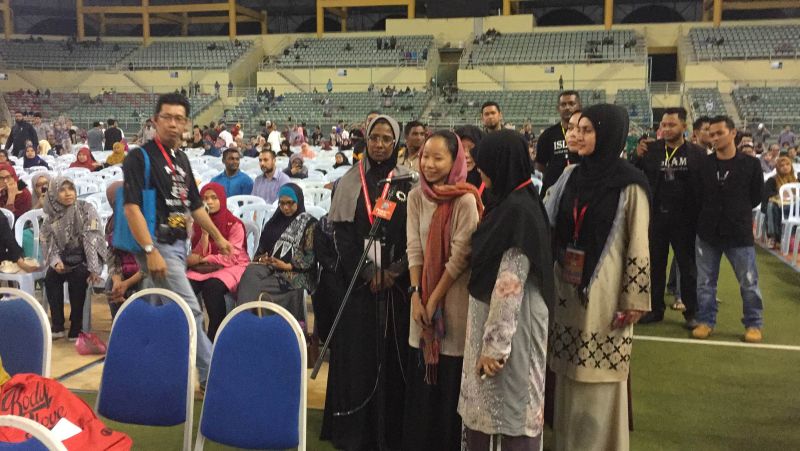
“These type of things (conversions) is very personal. The person has to understand that these type of things is very sensitive to others. But I would say sensitivity must come with tolerance. It’s their right actually to believe in any religion, it’s the right of the individual, so we have to respect their right,” he said.
For those whose parents do not allow or accept their decision to convert, they will have to convert “privately” and slowly persuade their parents to help them understand their choice, he said.
“To be a Muslim doesn’t mean (to) separate from the family. Some of the misunderstanding by the public — they thought being Muslim is being separated, to be a Malay.
“Most of our conversions are done in our office, not publicised everywhere. Sometimes it’s not appropriate to be publicised, unless they have no problems,” he said.
Nicholas Sylvester, the founder and chairman of Hidayah Centre Foundation (HCF), said that publicly declaring one’s decision to become a Muslim is a personal choice that is permissible in Islam.
“We are not worried that it would appear as if their conversions were exploited, because what is important is that we are not exploiting anyone.
“We are also not concerned that critics will see it as a gimmick, because they are genuine and not staged or pre-planned,” he told Malay Mail Online when commenting on the recent public conversions.
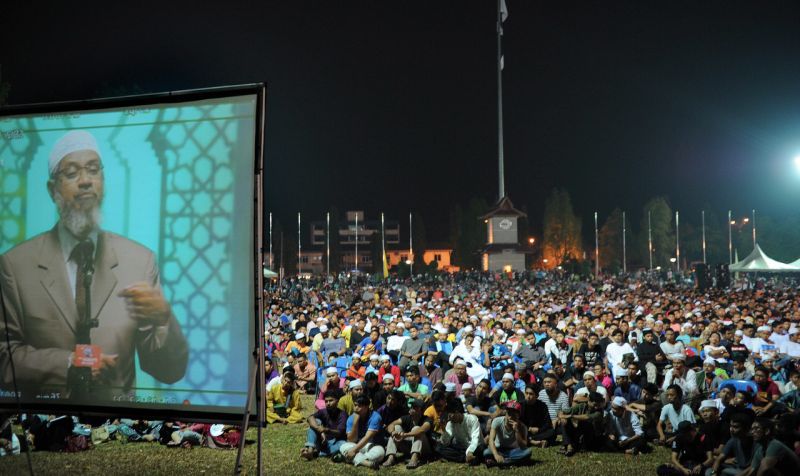
Nicholas said HCF had, along with 10 other groups, jointly organised Dr Zakir’s talk at Bukit Jalil here last Saturday, where four people had announced their decision to become Muslims.
According to Nicholas, HCF had organised Dr Zakir’s Bukit Jalil appearance together with 10 other groups, namely the Islamic Research Foundation, Malaysian Reverted Muslims, the Muslim Welfare Organisation Malaysia (Perkim), Macma, Skuad Mubaligh, Persatuan Iqrak Malaysia, the Allied Coordinating Committee of Islamic NGOs (Accin), the Islamic Propagation Society International, the Global Unity Network and Skuad Kader.
At Dr Zakir’s sixth and final talk during his tour of Malaysia, a 24-year-old Hindu-born university student reportedly declared in Malacca on Sunday that he wanted to convert to Islam.