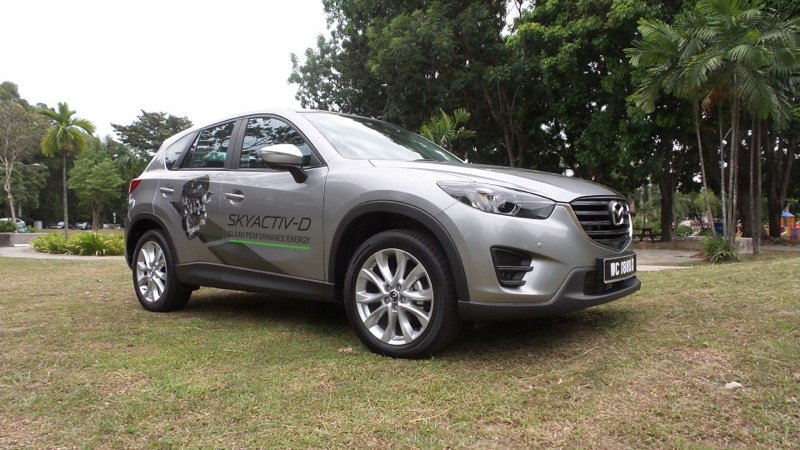
KUALA LUMPUR, Oct 31 — We have tested the Australian version of the Mazda CX-5 SKYACTIV-D, which has the same 2.2 litre diesel engine as the locally assembled version available here in Malaysia, and found it to be a great vehicle. This time, we got our hands on the local model, courtesy of Bermaz Motor Trading, the local distributors, and gave it a go too.
The main difference between the two is that the Malaysian CKD (locally assembled) model is only available in Front-Wheel Drive (FWD) configuration — in comparison, the Australian model I tested in Australia earlier in the year was an All-Wheel Drive (AWD) model. Although the two look exactly the same, the FWD model has drive only to the front axle — as a result, there are less drive train components, and the vehicle is lighter.
So why would a manufacturer want to have two drive train configurations, you may ask. Well, it is to cater for different needs. Some SUV users need to travel to off-road sites occasionally, and need the additional traction that all-wheel drive vehicles offer, while others just require the higher ground clearance, but remain on tarmac all of the time, so require only one axle to be driven. With a lighter overall weight and less drive components, the FWD Mazda CX-5 SKYACTIV-D is more fuel efficient. Finally, the FWD version costs less than the AWD version.
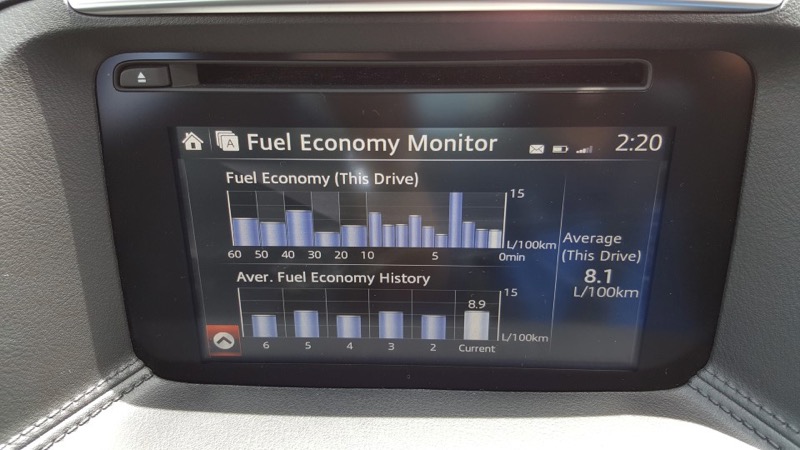
The CX-5 AWD model in Australia yielded 7.2 litres per 100 kilometres, which was an average figure, garnered over 1,200 kilometres of driving. For the Malaysian model, we did not have the same luxury of time, so our drive covered a little over 200 kilometres only — the results were also very good — in a matter of a few minutes after resetting the average fuel consumption monitor, the CX-5 Diesel started showing a average of 6.6 litres per 100 kilometres. Starting off in Petaling Jaya and moving onto the North Klang Valley Expressway, we kept the speed just under the legal speed limit, and to our surprise, the average consumption started to drop down, by 0.1 of a litre every few minutes, until it steadied at 5.5 litres per 100 kilometres. The fact that it was dropping all the time denotes that the average fuel consumption whilst on a steady throttle at around 100 km/h is around or slightly below 5.5 litres per 100 kilometres. This is a really incredible figure — a tribute to the SKYACTIV-D.
The above fuel consumption figure is applicable to driving at the normal speed limits on the highway — therefore if you are this sort of driver, this is what you are likely to get. Then we move on to the next phase of our testing: high speed driving. We pushed the CX-5 diesel up to speeds of between 140 km/h to 180 km/h (where it was safe to do so), and generally drove it heavy footedly; the result was 8.1 litres per 100 km, which is still a very respectable figure. For a vehicle this size and weight, anything up to 10 litres per 100 kilometres is acceptable. All this is possible because of the SKYACTIV technology built into the vehicle.
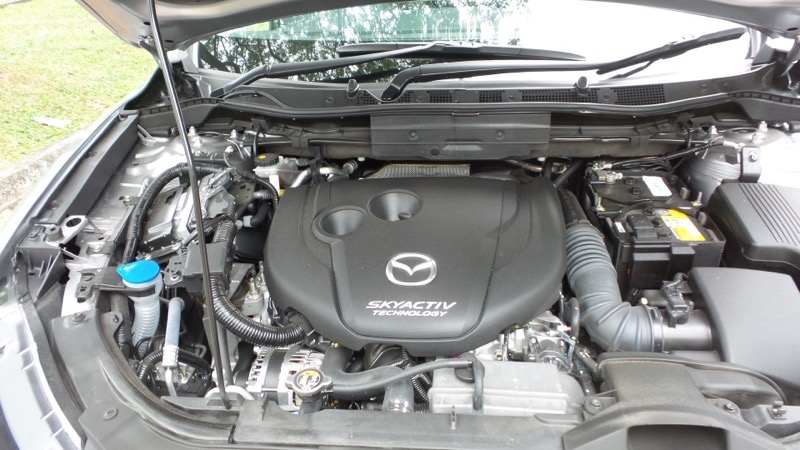
I am going to try to explain SKYACTIV-D in as simple a manner as possible here: When Mazda started development on their next generation of Mazda cars some years back, the people in Mazda believed that there was more potential in the internal combustion engine (ICE) to be extracted, so they threw aside all convention, and started with a blank piece of paper. The engineers questioned everything, including compression ratio — and ended up developing a gasoline engine that had a high compression ratio of 14:1 and a diesel engine what had the world’s lowest compression ratio of 14:1. This revolutionary approach resulted in a new generation of SKYACTIV engines that not only delivered great power but were fuel-efficient as well.
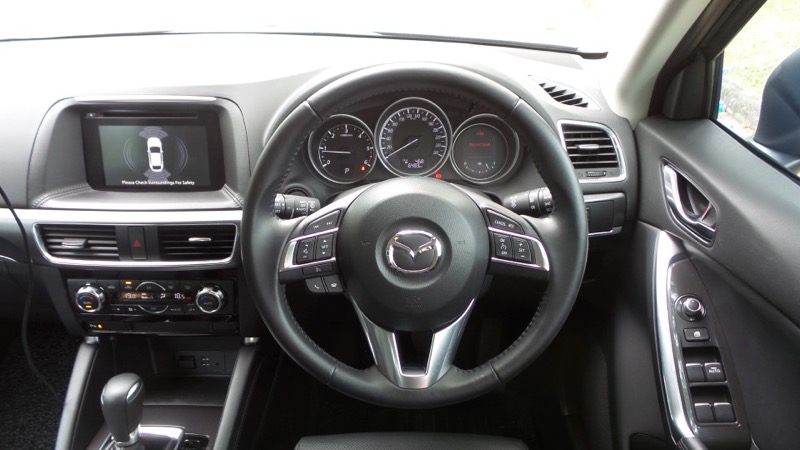
Mazda also worked on the transmission and chassis components in the new designs for Mazda vehicles, in addition to many other ground-breaking features — and put them together to form the new generation SKYACTIV, technologically advanced Mazda vehicles, of which the CX-5 is one.
With a lighter load, the 2.2 litre SKYACTIV-D diesel engine, with its 173 horses and 420Nm torque makes the CX-5 a very pleasant SUV to drive — there is plenty of power or Zoom-Zoom, as the Mazda people say, for quick and effortless acceleration, for overtaking, and generally makes one ‘feel good’ driving it. The massive torque from the twin turbo-chargers makes all the difference – no longer does anyone have to suffer sluggish acceleration when driving a SUV.
Despite it being diesel-powered, the CX-5 SKYACTIV-D is relatively quiet during operation — it is not any louder than a petrol engine, and good sound-proofing isolates the noise from the passengers in the cabin. It is still possible to carry out an intelligent conversation in the cabin whilst the vehicle is travelling.
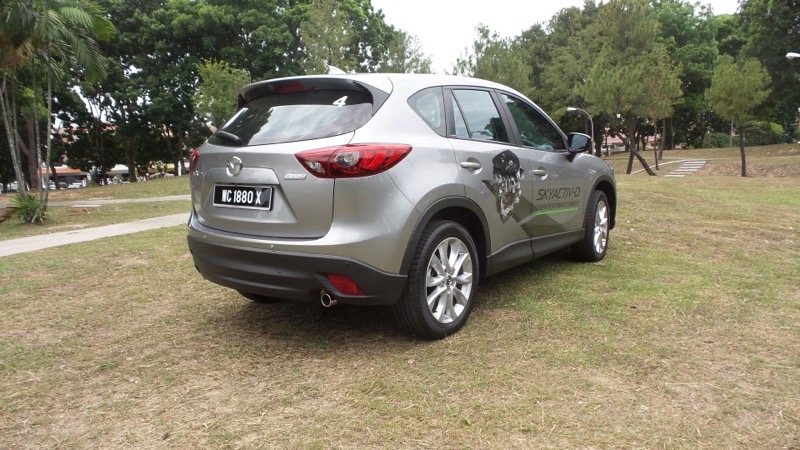
Handling is very ‘car-like’, despite the fact that the CX-5 sits higher than a normal sedan or hatch. The ride is on the firm side of comfortable, and is pleasant. I found it to be well balanced.
Lastly, there is the question of whether one should go for AWD or FWD. For Malaysians, at least in the short term, there is no choice as only the FWD version is available — whether the AWD version will be available will depend on market demand, and Bermaz Motor Trading. To most people, just FWD would be enough; the higher ground clearance itself would allow you to go into ‘rough’ places, and as long as the weather is dry, and the ground conditions are not too bad, you would be able to make it through most of the time. The only times you might need AWD would be if the ground conditions becomes slippery because of deep mud or if the surface was clay, especially if it rains. As a point in passing, many automotive makers offer FWD or 2WD versions of SUVs, and these are catching on fast because they are more affordable.