


JANUARY 10 — The United Nations Working Group on Arbitrary Detention (UNWGAD) has come into prominence again among the Malaysian public following former prime minister Datuk Seri Najib Razak’s petition to the group seeking his release from prison or a retrial of his SRC International Sdn Bhd case.
The UNWGAD was established by resolution 1991/42 of the former Commission on Human Rights — now replaced by tshe UN Human Rights Council (UNHRC) by resolution 60/251.
The UNWGAD has the mandate to investigate cases of deprivation of liberty imposed arbitrarily or inconsistently with the international standards set forth in the Universal Declaration of Human Rights (UDHR), or the international legal instruments accepted by the States concerned.
The UNWGAD investigates alleged cases of arbitrary detention by sending urgent appeals and communications to concerned Governments to clarify and/or bring their attention to these cases. It also considers individual complaints like that of Najib’s.
This makes the UNWGAD the only non-treaty-based mechanism whose mandate expressly provides for consideration of individual complaints. This means that its actions are based on the right of petition of individuals anywhere in the world.
Acting on the information in the petition, the UNWGAD will transmit the allegation(s) to the Government concerned through diplomatic channels with an invitation to reply to the group within 60 days with the Government’s comments and observations on the allegations made.
The Government concerned should respond to the facts presented, any relevant legislation and the progress/outcome of any investigations that may have been initiated.
The Government’s reply to the group is sent to the source of the allegation(s) for any final comments or observations.
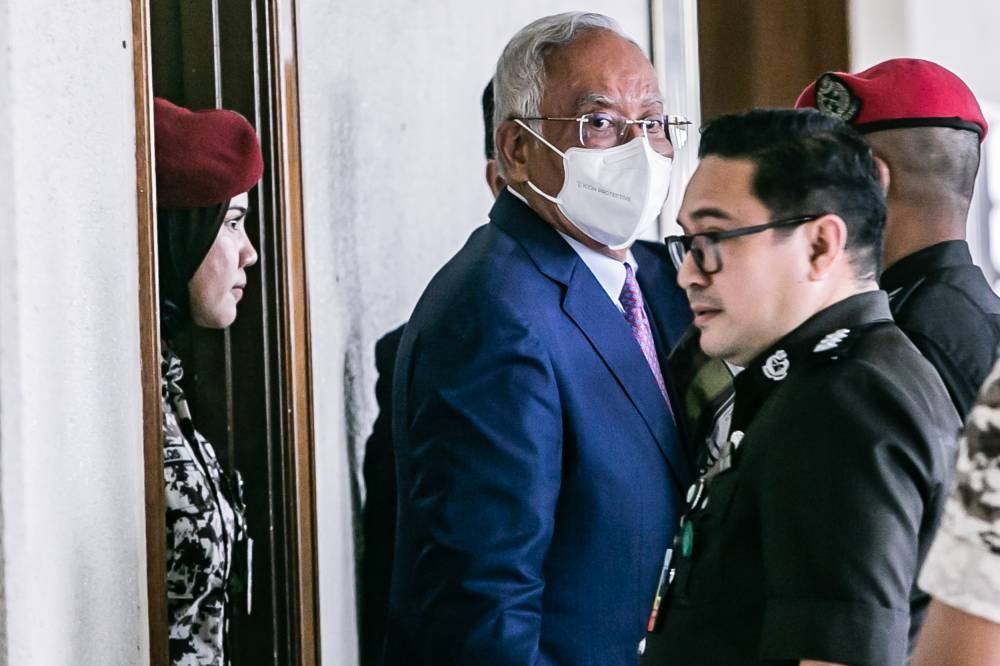
In respect of Najib’s petition, what may follow after the above is one of the following — that is, the UNWGAD may —
- consider that the case is not one of the arbitrary deprivations of liberty, and accordingly, it will render an opinion to this effect;
- consider that further information is required from the Government or the source, and accordingly it may keep the case pending until that information is received;
- consider that it is unable to obtain sufficient information on the case, and accordingly it may file the case provisionally or definitively;
- decide that the arbitrary nature of the deprivation of liberty is established, and accordingly will render an opinion to that effect and make recommendations to the Government.
The opinion is sent to the Government, together with the recommendations. 48 hours after this notification, the opinion is also conveyed to the source of the allegation(s)for information.
The UNWGAD issues approximately 70-90 opinions per year and all of these are adopted during its sessions. In each opinion, which is a public document (once adopted), the group examines whether the situation presented is one of arbitrary detention.
The arbitrary detention must fall under one or more of the five categories:
Category I: When it is clearly impossible to invoke any legal basis justifying the deprivation of liberty (as when a person is kept in detention after the completion of their sentence or despite an amnesty law applicable to them);
Category II: When the deprivation of liberty results from the exercise of the rights or freedoms guaranteed by articles 7, 13, 14, 18, 19, 20 and 21 of the Universal Declaration of Human Rights and, insofar as States parties are concerned, by articles 12, 18, 19, 21, 22, 25, 26 and 27 of the International Covenant on Civil and Political Rights;
Category III: When the total or partial non-observance of the international norms relating to the right to a fair trial, spelled out in the Universal Declaration of Human Rights and in the relevant international instruments accepted by the States concerned, is of such gravity as to give the deprivation of liberty an arbitrary character.
Category IV: When asylum seekers, immigrants or refugees are subjected to prolonged administrative custody without the possibility of administrative or judicial review or remedy; and
Category V: When the deprivation of liberty constitutes a violation of international law for reasons of discrimination based on birth; national, ethnic or social origin; language; religion; economic condition; political or other opinion; gender; sexual orientation; or disability or other status, and which aims towards or can result in ignoring the equality of human rights.
Najib may have alleged at least a Category III arbitrary detention.
If the allegation(s) satisfies any one of the above, the UNWGAD will recommend that the Government take appropriate actions (usually the release of the individual) and may also ask for reparations (e.g. compensation) as well as guarantees of non-repetition.
Each of the UNWGAD’s opinions entails a follow-up section where the Government and the source of allegation(s) are asked to respond within 6 months on the steps taken regarding the implementation of its recommendations. The UNWGAD may also invite other parties, such as civil society organisations, to provide further information on the implementation of the suggested measures.
To be sure, Najib is not the first detained person from Malaysia to have submitted a petition to the UNWGAD.
Anwar Ibrahim did it in 2015, following the Federal Court affirming his conviction and 5-year sentence for sodomy on February 10 of that year after finding the prosecution witness to be credible and that the prosecution evidence corroborated the allegations.
Anwar was taken into custody the same day at the Federal Court.
On March 16, Anwar’s petition for a royal pardon was denied and he officially lost his seat in Parliament. On April 30, he filed an application in the Federal Court requesting that a new panel of judges review his sodomy conviction and sentence on the grounds of injustice.
On May 6, Anwar filed an originating summons in response to statements by the Election Commission Chairman that he had not been eligible to vote in a by-election because he was in prison, contrary to Article 119 of the Malaysian Constitution, which entitles a person to vote regardless of his or her imprisonment.
Anwar submitted that his detention resulted from his exercise of the rights to freedom of opinion and expression and the right of political participation, as guaranteed by articles 19 and 21 of the UDHR.
Anwar further submitted that the Government violated numerous procedural requirements during his sodomy trial, in violation of articles 10 and 11 of the UDHR. Finally, Anwar submitted that his detention was arbitrary and fell under Categories II and III.
The UNWGAD transmitted the allegations to the Government on June 25, requesting the Government to provide detailed information by August 26 about the current situation of Anwar and to clarify the legal provisions justifying his continued detention.
Having not received a response from the Government, it decided to render its opinion on the detention of Anwar. The opinion, adopted on September 1, was as follow:
“The deprivation of liberty of [Anwar] is arbitrary, being in contravention of articles 10, 11, 19 and 21 of the [UDHR], and falls within categories II and III of the categories applicable to the consideration of cases submitted to the [UNWGAD].”
Consequent upon the opinion rendered, the UNWGAD requested the Government to take the steps necessary to remedy the situation of Anwar without delay and to bring it into conformity with the standards and principles in the UDHR. The opinion may be searched here: https://wgad-opinions.ohchr.org/search/results
What will be the consequence of Najib’s petition? It is hoped that the Government will respond when Najib’s allegation(s) is transmitted to it by the UNWGAD.
* This is the personal opinion of the writer or organisation and does not necessarily represent the views of Malay Mail.


