


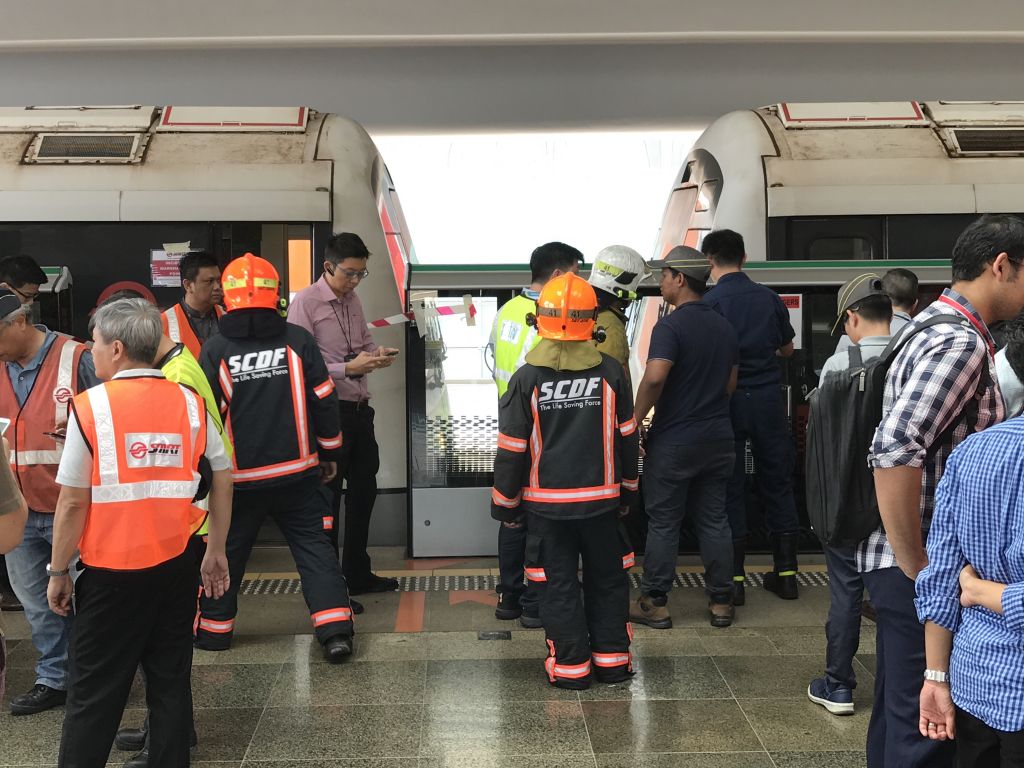


SINGAPORE, Nov 16 — The collision between two trains at Joo KoonT station yesterday morning (Nov 15) that left 29 injured was caused by a software problem, the Land Transport Authority (LTA) said.
The incident took place at about 8.20am. Two minutes earlier, a train heading towards the Tuas Link station stopped at Joo Koon station to allow the passengers to disembark, following an “anomaly in the train signalling system”.
A minute later, a second train stopped behind the faulty train. At this juncture, the two trains were about 10.7m apart, in accordance with safety protocol, said LTA deputy chief executive (infrastructure and development) Chua Chong Kheng at a press conference held at SMRT’s headquarters yesterday evening.
At 8.20am, after all its passengers got off, the first train’s doors closed. But before it could move off, the second train — which was carrying 517 commuters — was activated by the signalling system and moved towards the first train, hitting it at a speed of 16kph.
Based on preliminary finding, the first train had departed Ulu Pandan Depot with a software protection feature, but the feature was “inadvertently removed” when the train passed by a faulty signalling circuit, Chua said.
The train then arrived at Joo Koon station without the feature. The removal of this feature resulted in the train giving off a “train profile on the new signalling system of a three-car train instead of a six-car train”, Chua added.
As a result, the second train detected the first train as a “three-car train and misjudged the distance between the two trains, therefore resulting in the collision,” said Chua. He added that the “signalling safety responsibility is primarily” with Thales, the supplier of the new signalling system.
The second train was on automated mode, although a driver was on board. It had moved forward for about 10 seconds before hitting the train in front. On whether the driver could have reacted in time and applied the brakes, Alvin Kek, SMRT senior vice president for rail operations (North-South East-West Lines), said that investigations were being conducted.
“The (driver) has 1.5 years of driving experience on the main line, so (he) is not considered inexperienced,” he said. The driver was one of two SMRT staff who were among those injured. The other employee is an assistant train manager, who was “getting ready to help commuters and detrain the passengers” at the time of the incident, Kek said.
Following the incident, SMRT shut down services between Boon Lay and Tuas Link stations for a few hours to “facilitate the recovery” of the two trains. Free bus and bridging bus services were provided.
In a statement yesterday night, LTA said that Thales - which is the supplier of the new signalling system - has “confirmed the new and old signalling systems continue to be safe operation”.
It added that the East West Line is currently on the old system from Pasir Ris to Pioneer, and the new signalling system from Joo Koon to Tuas Link. “As a precautionary measure, trains will go through an additional layer of control measure and manual checks before they are deployed,” LTA said.
The injured, which comprised 27 passengers and the two SMRT staff, were taken to the Ng Teng Fong General Hospital and the National University Hospital. In an update from LTA and SMRT at about 11.30pm, three remain warded for observation, while another three are being treated. One person declined to be treated. The rest had been treated and discharged.
Earlier, TODAY learnt that two of the injured at Ng Teng Fong were classified as “major emergencies”, which may include injuries such as fractures, joint dislocation, and severe back pain.
At NUH, TODAY spoke briefly with a woman in a wheelchair who said she was one of those injured by the incident at Joo Koon station. She said her neck was injured and declined to give further details.
Commuter Eddy Ong, who was on the train when the incident occurred, told TODAY that the train was “travelling at (a) very slow speed” after PioneerT station.
“When it started to come close to Joo Koon Circle, we all heard a loud bang and everyone who was standing fell to the ground,” said the 43-year-old manager.
Some passengers hit themselves against the railing in the train cabins while Ong himself was injured.
He sustained minor abrasions on his left knee and arm.
“A while later, as I was in the first cabin, we heard some passengers knocking at the driver’s door to tell (the) driver (that) there was someone injured… (the) driver replied (through the) system and said help is on the way”.
SMRT group chief executive Desmond Kuek was seen at the Joo Koon station yesterday morning after the collision, as well as at Ng Teng Fong General Hospital. But he declined to comment when approached by TODAY.
The first major collision betweenT trains took place on August 5 1993, when a front-to-back collision occurred between two trains at ClementiT station. The accident injured 156 commuters.
Several passengers were flung against panels and steel railings inside the train, while others were piled on top of one another.
An east-bound train from Jurong had reportedly stopped at ClementiT station for two minutes longer than scheduled due to a technical fault. It was then hit by another train.
Operations were affected at threeT stations: Clementi, Buona Vista and Commonwealth and services resumed within a day after intensive checks by theT Corporation engineers. — TODAY


