


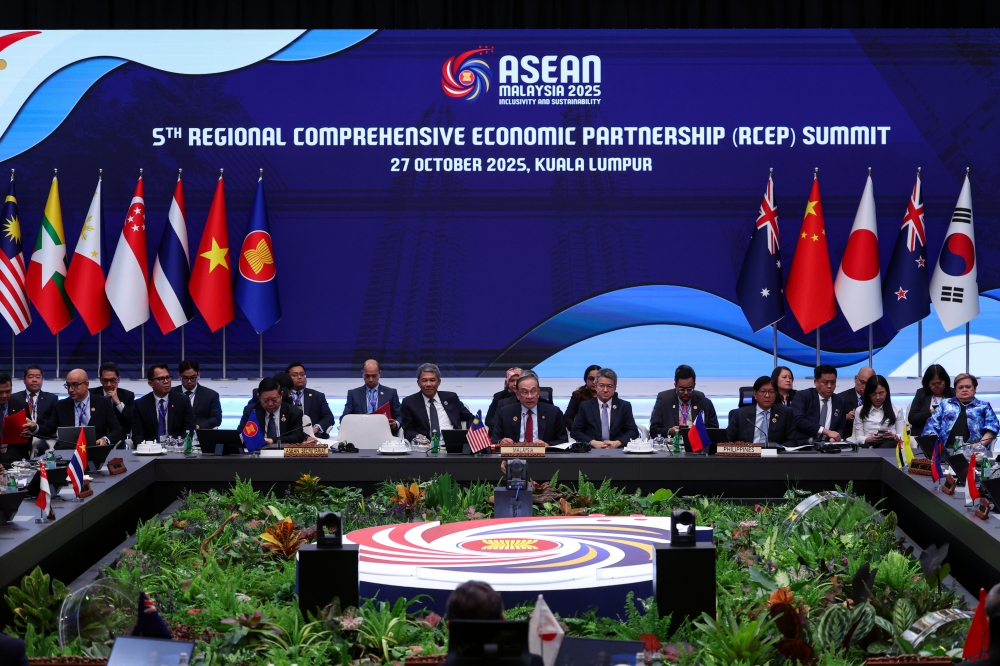
OCTOBER 28 — When the 5th Regional Comprehensive Economic Partnership (RCEP) Summit convened in Kuala Lumpur, it did more than mark another milestone in regional economic cooperation — it reaffirmed Asean’s central role as the strategic insurer of Asia’s economic stability. The world today faces unprecedented market-access turbulence: tariff spikes, supply-chain disruptions, and protectionist headwinds from major powers. Yet amid these storms, RCEP continues to embody the quiet logic of regionalism — a steady hand in a world spinning with volatility.
The Kuala Lumpur Summit, held under Malaysia’s Asean Chairmanship in 2025, came at a critical time. The global economy has become dangerously fragmented. The United States has pursued unilateral trade measures; China remains locked in a cycle of retaliatory tariffs with Washington; and the European Union’s internal divisions have slowed its trade outreach. Meanwhile, the developing world is caught in the crossfire of currency depreciation, energy insecurity, and fluctuating commodity prices.
In this chaotic environment, RCEP functions as a stabiliser — Asean’s insurance policy to safeguard open markets, secure regional supply chains, and sustain economic confidence across Asia and the Pacific.
RCEP: From vision to lifeline
Launched in January 2022 and now entering its consolidation phase, RCEP is no longer a mere trade pact.
It has become a living framework connecting all 11 Asean member states, including Timor-Leste, together with China, Japan, South Korea, Australia, and New Zealand. Collectively, these economies represent almost one-third of global GDP and trade.
The Kuala Lumpur Summit demonstrated that Asean’s leadership in crafting inclusive regionalism remains unmatched. The discussions went beyond tariff schedules and touched on how to institutionalise resilience.
Leaders focused on deepening digital integration, improving cross-border logistics, and facilitating greener trade — all to ensure that the world’s most dynamic economic corridor remains open and competitive.
Asean has always been the convener of consensus. By shepherding RCEP’s implementation and expansion, it has proven again that pivotal powers and small states can design frameworks that major powers must respect. In a world of coercive diplomacy and economic nationalism, RCEP’s inclusive logic — “a rule-based architecture that leaves no one behind” — is precisely what gives it strategic weight.
Insurance in a world of economic turbulence
The metaphor of “strategic insurance” is deliberate. Since the 1997–98 Asian Financial Crisis, Asean has learned that regional cooperation is the best defence against external shocks. The Chiang Mai Initiative, the Asean Plus Three Macroeconomic Research Office (AMRO), and now RCEP are all layers of protection in a risk-filled world.
Today, those risks are multiplying. Trade barriers once dismantled are being rebuilt. The US tariff regime on Asian goods has swung between punitive and preferential, depending on political cycles.
Supply chains disrupted by pandemic lockdowns are now vulnerable to geopolitical disruptions in the Taiwan Strait, the Red Sea, and the South China Sea. Energy markets are tightening as conflicts in Eastern Europe and West Asia persist.
In this environment, RCEP ensures continuity and certainty. It offers predictable trade rules across 15 economies, harmonises customs procedures, and strengthens e-commerce governance.
More importantly, it institutionalises mutual assurance: when one member faces global headwinds, others can absorb and stabilise the shock through market access and investment flows.
Malaysia’s own economic posture reflects this insurance logic. The country’s National Semiconductor Strategy, Renewable Energy Transition Plan, and Green Industrial Policy are embedded within RCEP’s framework of open regionalism.
By positioning Malaysia as a semiconductor and clean-tech hub, Prime Minister Anwar Ibrahim’s government ensures that even amid global trade turbulence, supply chains anchored in Malaysia — and by extension, Asean — remain reliable and rules-based.
The return of the Asean will
RCEP’s steady progress underlines what Prime Minister Anwar has repeatedly called the Asean Will — cooperation rooted in comity, coordination, and consensus. Unlike rigid Western trade blocs, Asean’s model thrives on flexibility.
Its pragmatism allows member states with different political systems and economic models to integrate incrementally, building trust over time rather than imposing uniformity.
This is precisely why the inclusion of Timor-Leste as Asean’s 11th member is so significant. It illustrates Asean’s expanding gravitational pull — a readiness to integrate new partners from its own region into a shared economic orbit. The symbolism of holding the 5th RCEP Summit in Kuala Lumpur is therefore profound: it is both a reaffirmation of Asean centrality and a projection of confidence that Asia can manage globalisation on its own terms.
Beyond tariffs: Building future readiness
The discussions in Kuala Lumpur were not confined to trade in goods.
They tackled deeper questions: how can RCEP help members digitalise supply chains, improve food security, and achieve energy-transition targets? How can small and medium enterprises (SMEs) in Asean use RCEP’s e-commerce provisions to access wider markets?
By focusing on these issues, Asean sent a message to the world — regionalism is not about walls; it is about bridges.
While other parts of the world are witnessing the resurgence of protectionism, Asean is building pathways of connectivity that transcend borders.
RCEP’s rules on data flows, intellectual property, and investment protection are precisely the guardrails that ensure predictability in a volatile economic landscape.
The Summit also reaffirmed a commitment to deepen collaboration between RCEP and complementary frameworks such as the Asean–GCC–China Economic Summit and the Asean–EU Free Trade Negotiations. Together, these overlapping architectures form a safety net — a multi-layered insurance system that keeps Asean at the core of global economic governance.
RCEP as Asean’s economic security framework
What makes RCEP indispensable is that it operates as an economic-security framework as much as a trade deal. It offers a buffer against weaponised interdependence — the growing tendency of powerful economies to use sanctions, tariffs, or export controls as geopolitical tools.
Asean’s design philosophy is different: it promotes diversification, redundancy, and interconnectivity.
The more connected the region becomes internally, the less any single external shock can destabilise it. In this sense, RCEP is Asean’s way of anchoring peace through prosperity — a principle rooted in its founding ethos since 1967.
Conclusion: Asean’s insurance dividend
The 5th RCEP Summit in Kuala Lumpur showcased Asean at its best — pragmatic, adaptive, and quietly decisive.
It proved that even in a world of market-access turbulence, Asean’s brand of diplomacy still delivers predictability. RCEP remains its strategic insurance policy, guaranteeing that no external tempest — be it tariff wars, technology bans, or financial contagion — can derail Asia’s momentum.
As global powers oscillate between rivalry and retreat, Asean stays steady at the helm. With Timor-Leste now formally part of Asean, RCEP stands as the world’s largest free-trade partnership — not as an exclusive club, but as an inclusive commitment to open and equitable development.
In a world of turbulence, RCEP is not merely a trade pact — it is Asean’s promise of resilience, renewal, and responsibility.
* Phar Kim Beng, PhD is the Professor of Asean Studies at International Islamic University of Malaysia and Director of Institute of International and Asean Studies (IINTAS). Luthfy Hamzah is a Research Fellow at IINTAS.
** This is the personal opinion of the writer or publication and does not necessarily represent the views of Malay Mail.


