


OCTOBER 27 — The world came dangerously close to the edge of a global economic crisis this month. Tariffs were rising again, supply chains were splintering, and the fragile recovery from years of inflationary shocks looked ready to unravel. Yet, over the past week, a quiet series of diplomatic moves helped the world breathe easier — and Asean, under Prime Minister Datuk Seri Anwar Ibrahim’s chairmanship, deserves much of the credit.
At the 47th Asean and Related Summit, Malaysia wove together a web of initiatives that diffused tensions between the two largest economies — the United States and China — while stabilising energy, trade, and investment flows vital to the Global South. The summit’s outcomes may not have carried grand headlines, but their cumulative impact helped steady a trembling global order.
A cooling effect on the G2 rivalry
Days before the Apec Summit in South Korea, US Treasury Secretary Scott Bressent and Chinese Vice Premier He Lifeng met in Gyeongju. Their agreement to suspend new tariffs — and China’s pledge to delay restrictions on rare earth elements (REEs) for a full year — signalled the first thaw in months of hostility.
This truce did not emerge from nowhere. It was Malaysia’s diplomatic patience that made it possible. Prime Minister Anwar Ibrahim worked through quiet Asean channels to reassure both capitals that South-east Asia could serve as a safe, neutral platform for compromise.
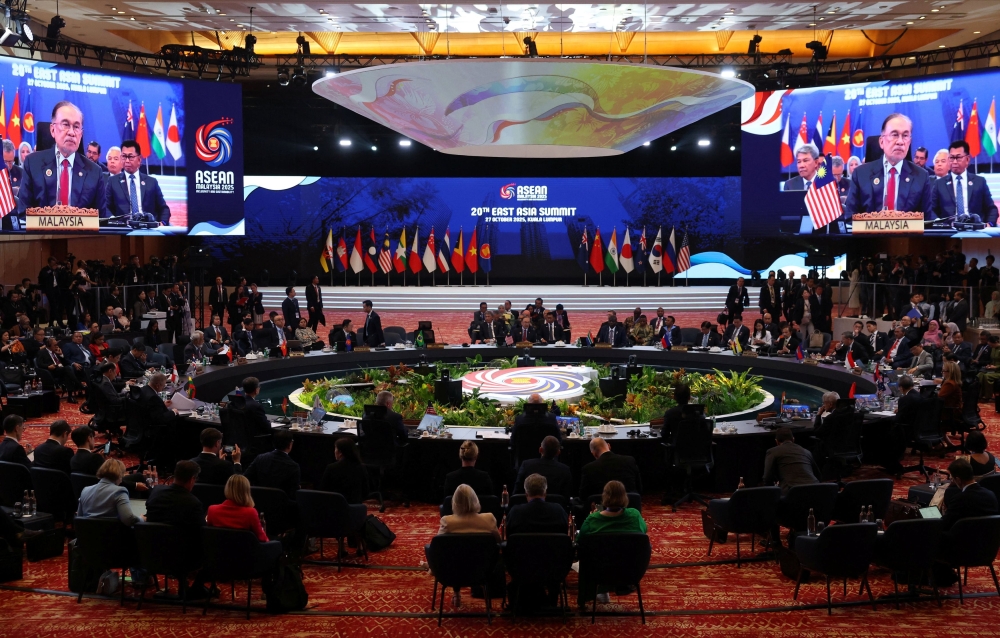
By offering Malaysia as host for pre-Apec dialogues and trade coordination, Asean transformed the region from a potential collateral victim into a genuine stabiliser. The suspension of China’s REE export controls prevented what analysts feared most — an escalation that could have frozen global electronics production and sent energy transition costs soaring.
From semiconductors in Penang to EV batteries in Europe, the ripple effect of Asean’s quiet intervention has averted panic in boardrooms worldwide.
Asean’s ‘prosper-thy-neighbour’ doctrine
Anwar’s approach built upon Asean’s long-standing ethic of prosper-thy-neighbour. Rather than choosing sides, he demonstrated that economic security must be collective.
During the summit, Malaysia spearheaded the lowering of tariffs on Cambodian goods to 19 percent, signalling that open markets, not protectionism, remain Asean’s creed. That seemingly small gesture resonated globally. It encouraged other members to ease intra-Asean trade barriers and reminded Washington and Beijing that cooperative regionalism still works.
Asean’s economic ministers followed through with a roadmap aligning supply-chain diversification with sustainable development. The Asean Power Grid, the Trans-Asean Railway Network, and digital trade facilitation initiatives were highlighted not merely as infrastructure projects but as crisis-prevention instruments — spreading risk across multiple corridors rather than concentrating it in one chokepoint.
From Kuala Lumpur to Brasília: Bridging the Global South
Anwar’s mediation extended far beyond Asia. When President Donald Trump’s tariff escalations threatened Brazilian exports, Malaysia quietly acted as a conduit between Washington and Brasília.
Anwar’s outreach to President Luiz Inácio Lula da Silva helped redirect the quarrel from confrontation to collaboration on renewable-energy supply chains. Brazil, a key member of Brics, found in Asean a credible interlocutor — neither captive to US interests nor antagonistic to China.
This bridge-building reassured G20 members that Asean’s chairmanship could restore a measure of predictability to global trade governance. The result was palpable at the G20 sidelines, where Brazil and the United States agreed to co-chair a task force on biofuel standards — a direct outcome of Malaysia’s quiet shuttle diplomacy.
Preventing contagion across blocs
By stabilising commodity and technology flows, Asean effectively helped prevent contagion across the G2, G20, GCC, and Brics networks.
The Gulf Cooperation Council, for instance, had grown anxious that a full-blown US-China tariff war would depress oil prices just as renewable investments peaked. The earlier Asean-GCC Economic Summit in Kuala Lumpur gave Gulf states a platform to invest in South-east Asia’s green-manufacturing projects, diversifying their portfolios.
When the REE moratorium was announced, investors from Riyadh to Doha redirected capital toward Malaysia and Indonesia’s processing zones instead of pulling back. Meanwhile, the European Union and Mercosur also benefited indirectly. With tariffs frozen and minerals flowing, energy transition plans regained momentum.
Global markets — from lithium to nickel — stabilised, averting the chain reaction that could have plunged emerging economies into recession.
The Asean model: Low tension, high trust
The genius of Asean diplomacy lies in its low-tension, high-trust model. There are no ultimatums, only incremental alignments. This patience is often mistaken for passivity, yet it is precisely what keeps crises from spiralling.
Anwar’s chairmanship embodied that philosophy. He allowed dialogue to ripen rather than forcing breakthroughs. By keeping communication channels open between President Trump’s economic team and China’s reform commission, Asean gave both sides a dignified way to climb down from confrontation.
Even Washington insiders now acknowledge that Kuala Lumpur’s “open door, open mind” policy contributed to the resumption of trade coordination meetings that had been frozen since 2022.
Averting crisis through strategic humility
It is easy to overlook how perilously close the world came to a downturn. Had China enforced its REE embargo, semiconductor shortages would have intensified just as Western inflation returned. Had the US retaliated with higher technology tariffs, Asia’s export-oriented economies could have slid into contraction.
Instead, a measure of stability prevails. Credit flows are loosening, manufacturing forecasts are improving, and investors are re-engaging with emerging markets. The IMF’s October report even credits “regional frameworks led by Asean” for buffering global volatility.
Anwar Ibrahim’s combination of humility and resolve — consulting not only the US and China but also Brazil, India, Japan, and Saudi Arabia — offered the world a template for cooperative resilience.
The road ahead: From avoiding collapse to building confidence
Avoiding crisis is only half the task. The next step is rebuilding confidence in multilateral trade itself. Asean must now translate its diplomatic capital into institutional architecture: an Asean-G20 dialogue mechanism, a permanent Asean-GCC Investment Forum, and stronger links with Brics members on digital and green-tech standards.
Malaysia’s success as Group Chair should inspire the region to institutionalise its crisis-management capacity so that future shocks — financial, technological, or environmental — can be mitigated collectively.
Conclusion
The global economy still faces headwinds, but it is no longer teetering on the cliff’s edge. The calm hand of Asean, guided by Prime Minister Datuk Seri Anwar Ibrahim, has done what few believed possible: coax two superpowers toward cooperation, reassure multiple blocs, and remind the world that dialogue remains the best stabiliser of markets.
In an era of tariff tantrums and political volatility, Malaysia’s leadership within Asean has proven that quiet diplomacy can yield loud results. By preventing confrontation and fostering compromise, Asean has not only averted a global economic crisis — it has redefined what constructive global leadership from the Global South can look like.
* Phar Kim Beng, is professor of Asean Studies and Director, Institute of International and Asean Studies (IINTAS), International Islamic University Malaysia. Luthfy Hamzah is a Research Fellow at IINTAS.
** This is the personal opinion of the writer or publication and does not necessarily represent the views of Malay Mail.


