












FEBRUARY 17 ― Educationists and activists of Chinese lineage bestowed on Lim Lian Geok as the “soul of Chinese Malaysians”. Teacher Lian Geok passed away in 1985 aged 84, and his funeral procession was reported to be five kilometres long. The impact of his contributions is etched in the Lim Lian Geok Memorial located in the Kuala Lumpur Hokkien Cemetery.
He first arrived in Malaya as a teacher in 1927 and till 1935 had taught in Perak, Java, Klang, Kajang and even in his home district Yongchun. And from October that year he started teaching in Confucian Middle School in Kuala Lumpur, an association which lasted till an enforced ending August 1961.
Teacher Lian Geok became attached to Malaya and to induce his then countrymen to stay and build this new found homeland together he must help to ensure that a sturdy education structure is available for their children. It was an entrenched cultural practice to afford children to do better than their parents so that parents can be well tended in old age. Social programmes by the state were much less sophisticated then.
Anyway it was an ingrained Confucian philosophy of self-help regardless of the situations.
Tumultuous journey
To convince colleagues and parents that he is planting his roots where he stood, he sought citizenship in the Federation of Malaya and was granted in September 1951. He vigorously persuaded his fellow settlers to switch loyalty from China to Malaya.
He helped found the Kuala Lumpur Chinese School Teachers’ Association in 1949 because of two incidents ― a Confucian School teacher passed away leaving his family in destitute and another teacher in Perak who chose suicide when in sickness, also leaving behind similar circumstances. Two years later the KLCSTA evolved into the United Chinese School Teachers’ Association or better known by the moniker Jiao Zong. The other equally known organisation is the United Chinese Schools Committees Association or Dong Zong. When it’s a joint endeavour they are credited as Dong Jiao Zong (DJZ).
He ran afoul of the authorities when he opposed the 1960 Rahman Talib Report which proposed the conversion of Chinese secondary schools into English medium. First the authorities cancelled his teaching permit and then revoked his citizenship. He fought to retain his citizenship from September 1961 and by February 1964 his case was dismissed by the Privy Council, London and the revocation was official in October of the same year. One of his counsels was Tan Sri PG Lim.
Teacher Lian Geok had to earn a living by providing private tuition and writing feature articles for newspapers. It wasn’t a comfortable living. That was sixty years ago when the middle-income segment was virtually non-existent rendering tuition a semi luxury expense.
Today we still have 1300 SRJK(C) and non-Chinese enrolment has exceeded 20 per cent. The values of hard work and good moral character are imbued in all instructions. The secondary schools which didn’t agree to be the conforming SMJKs still stand as 61 Chinese independent high schools (non-government funded) but with additional branches. The official situation is ― the freeze on new approvals for these independent schools stays but requests for branches are considered on a case-by-case basis.
The DJZ organised Unified Examination Certificate (UEC) continues to be not accepted for entry into public universities but is widely accepted in privately run universities and almost everywhere else in the world. The UEC is recognised for employment in Sarawak, Penang and Selangor.
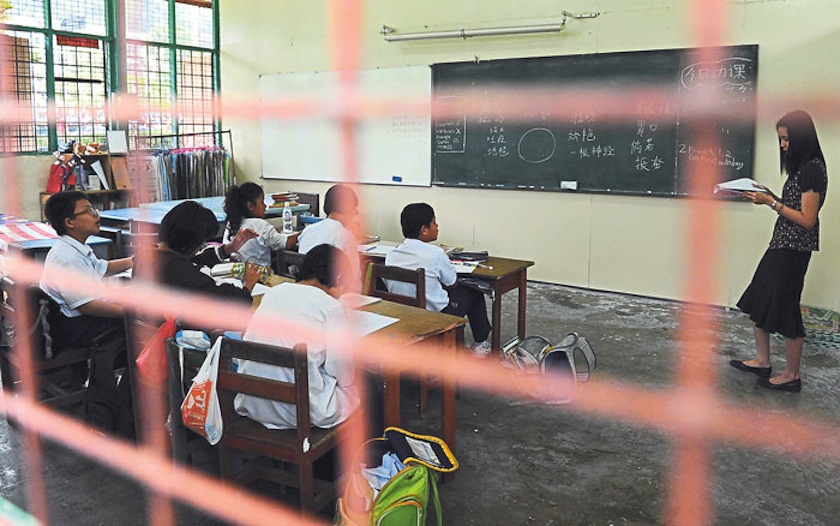
The “mother tongue” language preservation had a new twist with the economic miracle in China. Malaysians were gifted with a leg-up!
Teacher Lian Geok strived with unequalled zeal but unfortunately his adopted land forsook him. It was during an era when dissent wasn’t tolerated as one is “either with us or against us”. In an ideal setting he would have been heralded as an early towering nationalist.
Another tumultuous period
In 1962, Universiti Malaya became our first university on location.
Meanwhile the idea of establishing a Chinese-medium university was mooted. The Chinese educationists were naturally keen to have the tertiary offering available especially with the government planned imminent closure of the Chinese-medium Nanyang University (Nantah) in Singapore.
The overseas Chinese (Huaren) sentiments were dominating with the strong presence of first generation settlers. It was the natural progression for DJZ to take up the mantle to coordinate the establishment of Merdeka University. It wasn’t difficult to garner wide appeal amongst the cross section of Chinese community. In fact the majority in the MCA top leadership too supported the Merdeka Uni cause.
The Cold War was in full bloom. USSR and China were on the other side. At stake was the fear of the spread of communism ideology amongst the free world especially with the newly independent states. It reasons that the colonial government was vehemently against the inclusion of Chinese high schools within the system. It was envisaged that these schools could be manipulated to be a “feeder” for the Malayan Communist Party as the Chinese language was equated as the “Communist lingua franca”. It was already decided that the Chinese primary schools were sufficient to provide “mother tongue” learning. That was the background.
The Merdeka Uni establishment had become a Movement.
It was incumbent upon MCA to act fast and decisively. Is Chinese language higher education the end goal, or is it actually higher education per se? Party president Tun Tan Siew Sin in statesman fashion decided that MCA would pursue the latter with English as the medium. He had a major fight in his hands both externally and internally. Almost the entire Central Working Committee (CWC) members favoured Merdeka Uni. Party comrade/deputy president Tan Sri Khaw Kai Boh was staunchly by Tan’s side. Khaw had served as head of Special Branch in Perak in 1949, then Singapore in 1950, and became its Director of the Special Branch in 1957. Obviously he had the big picture view.
Tan announced the proposal to set up Tunku Abdul Rahman College in the party general assembly in 1968.
Khaw as the chairman of the MCA Education Committee was tasked to make TARC a reality.
Postscript
While the authorities linked any promotion of the Chinese language to potential spread of communism ideology, the community saw the lack of its promotion as a setback for Chinese tradition and culture. No explanations however well-reasoned could quell the misplaced chauvinism.
Under this precarious situation Tan and Khaw knew that it wasn’t nearly adequate that the TARC set-up fulfilled higher education aspirations. It must also be affordable to the masses and create employment opportunities as well as to meet a young developing nation’s varied needs.
The third general election was due May 10, 1969. To be continued.
* Datuk Lee Yew Meng is the former CEO/MD of Genovasi Malaysia (Design Thinking School/Genovasi University College). He has been involved in the communications industry for over 40 years with executive roles in The Star and theSun, and was also the StratCom consultant to Agensi Inovasi Malaysia. He is presently the Corporate Adviser to several companies.