




IVREA, July 14 — Economic decline takes many shapes. In the northern Italian town of Ivrea, it looks like the abandoned, overgrown tennis courts where the employees of electronics giant Olivetti SpA once played.
In the 1980s, Ivrea was a European version of Silicon Valley. Of the 50,000 people employed by Olivetti, half worked in the town, enjoying generous salaries and plush corporate recreation facilities. Today Ivrea’s biggest employers are the state health service and two call centres. Together they employ 3,100 people.
Olivetti still exists, but these days it is a small office machinery company. Its former factories, jewels of 20th-century industrial architecture, have been refashioned as museums. Most of Ivrea’s 30-year-olds have little work and live off their parents’ pensions.
“They were exciting times. But gradually at first and then suddenly, everything fell apart,” says 59-year-old Massimo Benedetto, who has worked at Olivetti for 30 years, most recently in customer support, and is about to retire.
More than 120,000 Italian manufacturers have closed shop and 1.2 million industrial jobs have disappeared since the start of the century, according to business association Confindustria. In the last 20 years even Japan, with its so-called “lost decades” of stagnation, has grown almost twice as fast as Italy.
As Olivetti crumbled it spawned a few small- and medium-sized businesses. But a crushing mix of high taxes and red tape makes it increasingly hard to operate, entrepreneurs in Ivrea say.
Stefano Sgrelli, 58, is a former Olivetti engineer who in 2009 founded Salt & Lemon, a company that uses drones to take aerial footage for cinema, advertising and topography. He complains about bureaucratic procedures that “stupefy” clients outside Italy and the painfully slow train that takes more than an hour to cover the 50 km (30 miles) to Turin.
Submerging economy
Italy’s woes are myriad. Its birth rate is the tenth-lowest of 236 countries and territories ranked by the OECD. Little more than half its working-age population has a job, and public and private investments as a proportion of economic output in 2013 were at the lowest level since World War Two, according to the Bank of Italy. Investment in research and technology, an important factor for growth, is about half the level of France and Germany as a proportion of economic output and a third of the level of Sweden, according to the OECD.
That has hit living standards. In 1994, Italy’s per capita gross domestic product adjusted for the cost of living was about the same as that in Britain and France, according to the International Monetary Fund. Today, it is just 80 per cent of those countries. Italy is the only EU country whose per capita GDP has fallen since 2000.
There is no single reason for Italy’s economic decline, just as there is no one explanation for Olivetti’s downfall.
Camillo Olivetti founded the firm in 1908 to make classy typewriters. It blossomed as a pioneer of electronics under his son Adriano in the 1950s, producing one of the world’s first fully-transistorised computers in 1959. Its first personal computer, unveiled in 1965, was used by NASA to help plan the Apollo 11 moon landing. It also made the world’s first electronic typewriter in 1978.
In the 1960s and 1970s Italy flourished, undergoing a remarkable post-war transformation from a poor, largely rural economy, to a founder member of the Group of Seven industrial nations. It became known for its energy and style thanks to figures like Fiat chief Gianni Agnelli and Enzo Ferrari, founder of the sports and racing car company. Its national carrier Alitalia was among the world’s most admired airlines.
In its heyday, Olivetti’s cutting-edge products enjoyed profit margins of up to 35 times production costs. It ploughed that income into research and innovation at laboratories in Ivrea and in California.
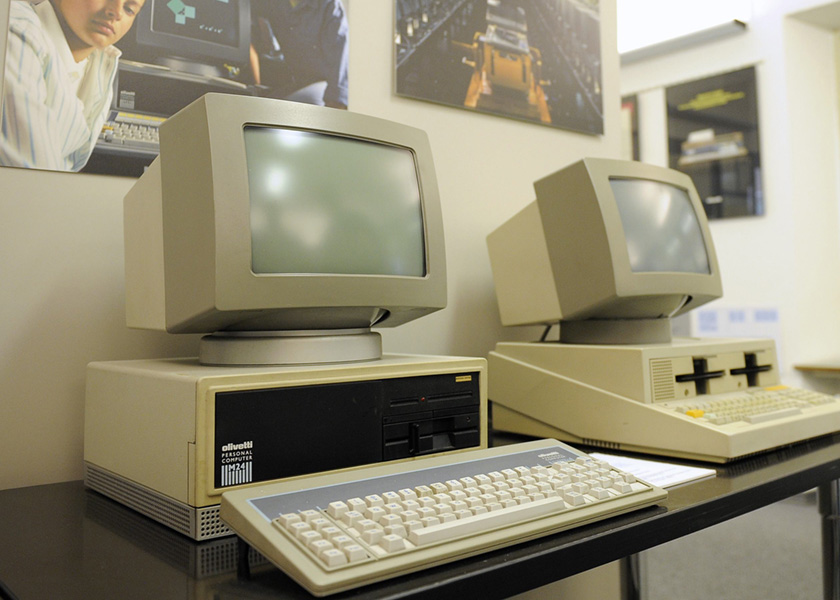
Sales and profits peaked in the mid-1980s, when Olivetti’s M24 computer sold more than 200,000 units in the United States, helping make it the second-largest computer maker in the world behind IBM.
“We worked flat out to meet demand,” said Massimo Benedetto as he walked around a deserted site that once housed the factories and offices of 8,000 workers.
Business magnate Carlo De Benedetti bought Olivetti in 1978, and enjoyed initial success. But in the early 1990s, as competition from the United States and Asia grew, De Benedetti began to focus on the rest of his portfolio: finance, food and publishing. He sold Olivetti’s personal computer division in 1997 and moved the company into telecommunications.
It was the beginning of the end. In 2003, De Benedetti offloaded what remained of Olivetti to Telecom Italia, which tried to re-launch the office machinery business, even brushing off Olivetti’s seventies-looking red “O” logo.
The new company never got off the ground. Olivetti now has fewer than 700 workers globally. It posted 265 million euros in sales last year, selling cash registers, printers and its own iPad, known as an “Olipad.”
Struggle to emerge
Many in Ivrea blame the Italian state for not promoting a tech-savvy culture. The crucial failure, however, was what came after Olivetti’s demise: nothing.
Former Olivetti employees in Ivrea who have reinvented themselves as entrepreneurs have focused primarily on exportable products. Antonio Grassino, a one-time Olivetti engineer who left the company in 1986, now runs a firm that tests electronic circuits. Seica SpA employs 110 people and has an annual turnover of €21 million, 80 per cent of it from exports. Clients include Boeing, Samsung and Thales.
Grassino, like many of Italy’s successful businessmen, says working there makes life harder. Political instability, he says, makes it impossible for companies and individuals to plan ahead. Italy has had 65 governments in the 69 years since World War Two. New governments regularly rip up their predecessor’s efforts and start again.
“You never know if a tax incentive that has been announced is really operative or how long it will last,” he says. “At the same time I don’t want to hire someone now if I think there are going to be tax breaks on new hires in the near future.”
For foreigners, it’s even harder to navigate the changing rules and regulations. Foreign direct investment in Italy has fallen by 58 per cent in the last six years and is less than half that in Germany, France or Britain, according to the OECD.
Stefano Sgrelli, the Salt & Lemon founder, got a job with Olivetti in 1980 after he designed software for a computer game. He spent three years at Olivetti in California, before leaving in 1993 to set up his own computer services company with a former colleague. Since 2009 he and his four partners have dedicated themselves to Salt & Lemon, operating drones for a growing range of clients from cinema to agriculture. Like many in Ivrea he is exasperated by red tape. Before he can bill his customers in Italy, he says, he has to prove he paid his workers’ welfare contributions. Yet it’s hard to get that information from state agencies whose records are not up to date.
“That is why so many Italian businessmen are successful abroad. They can’t believe how easy it is,” chuckles the moustachioed Sgrelli.
His 22-year-old daughter Diana studies engineering at Turin University, ignoring her father’s advice to study abroad. He hopes she will leave after graduation.
If she does, she will be joining an exodus. Italian emigration, which virtually dried up in the 1970s as living standards improved, has jumped again in the last 10 years. Since 2011 an estimated 250,000 Italians have moved to London alone, making it the sixth most populous Italian city after Genoa. Most of those who leave have high-school diplomas or university degrees. — Reuters


