


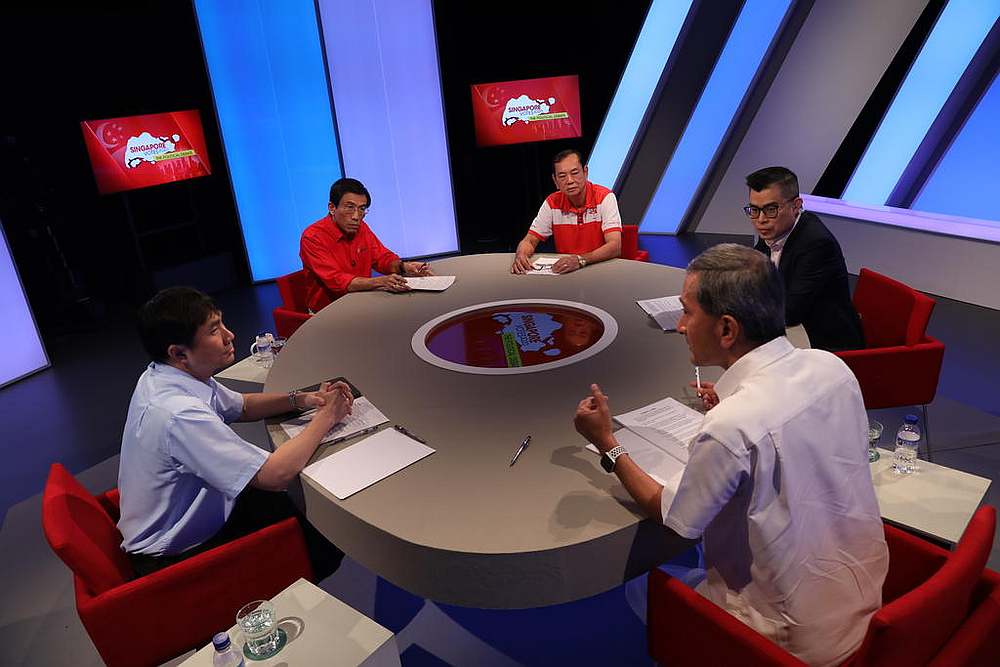


SINGAPORE, July 2 — They were not exactly tearing at each other’s throats but seated a safe distance apart in the confines of a studio. Still, representatives from four political parties had a spirited live debate on television that produced some heated moments — especially over unsubstantiated claims by the Singapore Democratic Party (SDP) that the People’s Action Party (PAP) Government plans to increase the population size to 10 million.
The one-hour broadcast yesterday evening featured Vivian Balakrishnan from the incumbent PAP, Jamus Lim from the Workers' Party (WP), Chee Soon Juan from SDP and Francis Yuen from the Progress Singapore Party, who are all contesting at this year’s General Election on July 10.
Balakrishnan questioned the proposals being put forth by the three opposition parties and he particularly went after Lim from WP and Chee from SDP.
To Lim, he asked whether WP considered the trade-offs that come with the plans laid out in its manifesto.
He also asked Chee about the total cost of his various campaign proposals.
Turning the tables on him, Lim asked whether PAP has evaluated the efficacy of its policies, particularly over the S$93 billion (RM285.43 billion) the government had pledged through the four Budgets this year.
Chee in turn asked Balakrishnan, who is a member of PAP’s central executive committee, about what Chee claimed was the government’s plans to increase Singapore’s population to 10 million.
This drew a sharp rebuke from Balakrishnan, who said that Chee was peddling a falsehood and that the government had no such plans.
The first segment of the debate had each party member share his party’s proposals on how they will create jobs, improve social mobility and help small- and medium-sized enterprises overcome challenges brought about by the Covid-19 pandemic.
The second segment was when things got tense as Balakrishnan debated with each of the other three men. For each time, two of them were allowed to ask one question of each other and respond.
After that, they had to give their concluding remarks.
Referring to Chee as a person with whom he has had “many disagreements” in the past, Balakrishnan asked him what is the total bill of the schemes that SDP is proposing in its manifesto.
“In particular, not only the total bill, but how are you going to allocate it to the taxpayers, and specifically how much and to whom?” he asked.
SDP’s “4Y1N” election campaign, which stands for “Four Yeses, One No”, proposes saying “yes” to retrenchment benefits, an income for retirees, putting people first and suspending the Goods and Services Tax (GST), while saying “no” to a population of 10 million.
Chee said that two of the proposals would amount to an annual budget of S$5 billion. That is, providing workers who are retrenched as a result of Covid-19 with a monthly payout for 18 months, as well as giving out S$500 to the bottom 80 per cent of those aged 65 years old and above every month.
This is just a tiny amount of what the PAP Government signed off on the four national budgets this year, and that SDP is not a “tax and spend” party that Dr Balakrishnan accused it of being during the last election in 2015, he added.
“I want to remind people that the budget that you blew in the Youth Olympic Games going back (to) 2010 and then the Auditor-General… cited this (as an example of) overspending and not practising financial prudence. This is where I think the tax-and-spend policy applies to the PAP more than anyone else,” Chee retorted.
He also probed Balakrishnan on whether the government has plans to increase Singapore’s population to 10 million, claiming that this was something mentioned by PAP’s first assistant secretary-general Heng Swee Keat.
When Balakrishan pointed out that what Chee said was false, both men started talking over each other, with the SDP chief insisting that it was something Heng said.
Calling his defence a “cheap shot,” Balakrishnan said: “For the record, we will never have 10 million, we won’t even have 6.9 million. The government doesn’t have a target for the population.
“What we want is a Singapore core that is demographically stable, able to reproduce ourselves, able to create opportunities and jobs for ourselves and able to stay as a cohesive whole.
“You are raising a false strawman. That is a false statement.”
After the debate, Chee posted on his Facebook page a March 29, 2019 article from The Straits Times, which reported Heng’s remarks made at a forum.
It read: “Singapore's population density is not excessive, he said, noting that other cities are a lot more crowded in terms of liveable space.
He cited former chief planner Liu Thai Ker, who said in 2014 that Singapore should plan for 10 million people for it to remain sustainable in the long term.”
The National Population and Talent Division released a statement yesterday saying that it is not true that the government is planning to increase the population to 10 million after statements claiming so have been circulating.
WP is 'PAP-lite'
During his debate with Lim of WP, Balakrishnan said that the opposition party’s manifesto is so similar to PAP's that it is no surprise why people are calling WP “PAP-lite or PAP-like.”
Still, he said that WP’s policies are a “half-step left” of PAP's and asked how the party will manage the trade-off that comes with these minor differences.
Lim replied that WP has done the math behind its manifesto and that it is budget-neutral.
“Where we fundamentally differ is where we think those trade-offs should occur. PAP would tend to side on the side of capital.
“We think that for every dollar of national income, Singaporean workers already receive an insufficient amount — 42 cents. Compare that to 55 cents in Japan and much higher in other high-income countries,” he said.
Responding to Balakrishnan’s veiled criticism that WP is just like PAP, Lim said that WP’s stand has always been that it does not object to policy for the sake of objection.
“Ultimately what we want is the right policy. I think the fact that we are having a debate and agitating towards an answer is a step positive in that direction.”
Lim’s comeback was on whether PAP has evaluated the efficacy of its policies, especially the large stimulus package costing more than S$90 billion. He also cited the example of how productivity has not risen much despite all of PAP’s policies.
Balakrishnan then said that Singapore is funding the Covid-19 crisis budgetary packages from its reserves and not burdening it on the country’s next few generations.
Referring to the specific example of productivity raised by his WP opponent, Balakrishnan said that the high-capital and high-tech investments that the PAP Government has made do not generate the same labour share, compared to the last Industrial Revolution.
Jobs and PMET segment
The focus of the exchange between Yuen of PSP and Balakrishnan was about jobs for professionals, managers, executives and technicians (PMETS).
Balakrishnan said that a higher percentage of Singaporeans are PMETs and that most job losses due to Covid-19 mainly affected foreigners.
However, Yuen responded by saying that there are still 100,000 local PMETs out of jobs, in contrast with 400,000 foreign expatriates.
Yuen also questioned the time frame that the Government has set in delivering the promise of creating 100,000 new jobs, as mentioned in Mr Heng’s fourth national budget in May, as well as the nature of these jobs.
Balakrishnan said that the plan was to have these jobs created within the next one year.
'Denying PAP a blank cheque'
In his concluding remarks, Lim of WP poked holes into the PAP’s reasoning that the calling of this GE is to give them a mandate to bring Singapore out of this crisis caused by Covid-19.
After saying that PAP is likely to win the mandate in this GE, Lim added: “What we’re trying to deny the PAP isn’t a mandate. What we are trying to deny them is a blank cheque. And that, is what I think this election truly is about.
“So that we can actually have this kind of a debate, not just in a constrained form over a table, but actually in the forum which was designed for this, which is parliament.”
Yuen said that economic growth cannot come at all cost, and that policies have to be compassionate and provide a better social safety net.
As for Chee and Balakrishnan, in the last few moments of the debate, they continued their disagreement with both sides refusing to back down.
Balakrishnan cautioned that Chee should be careful that his proposals of imposing wealth taxes and estate duties do not ignite a class warfare.
“Don’t indulge in this. Don’t take it out against people who, through no fault of their own, have been somewhat more successful,” he said. — TODAY


