


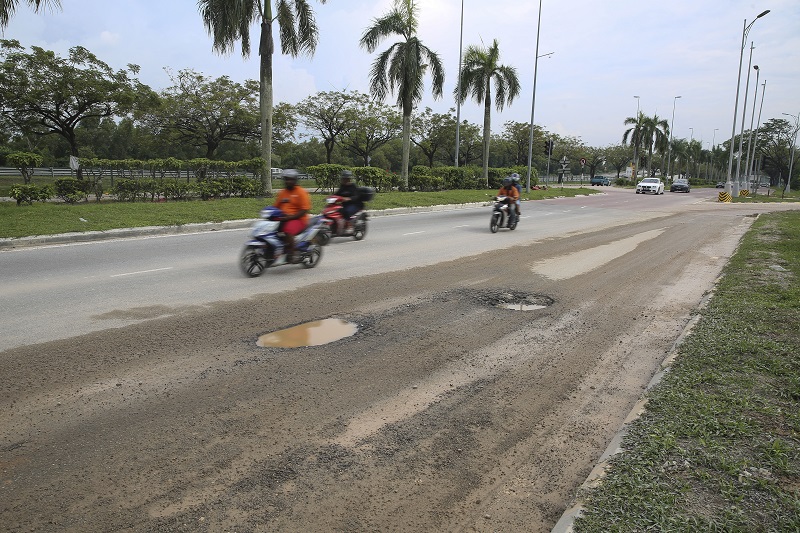
PETALING JAYA, Feb 19 — Malaysia may be aiming to become a developed nation soon, but Malaysian motorists face a distinctly third-world problem daily: pockmarked roads that sometimes leave them dented wheels and even larger dents to the pockets.
At a time when the public is already grappling with rising costs, one run-in with the country’s many infamous potholes could leave you staring at a repair bill that is several hundred ringgit large if you are lucky, or more if you are not.
While road users know enough to avoid these potholes, this is not always possible; sometimes there is no space to manoeuvre or they may be unsighted by another vehicle.
One such victim is Syed Irman Syed Ali, 36, who told Malay Mail he knew from experience to dodge potholes as best he can, but still could not avoid them all.
“It is just irritating. The latest was when I fell victim to bad roads along the Pasir Gudang Highway near Taman Daya, where I had to replace my damaged front left tyre.
“Several days prior to that, I had also replaced the front right tyre due to a puncture after I drove through a bad stretch of road at high-speed at Section 14 in Petaling Jaya,” he lamented.
The incidents cost him RM500, and even then, Syed Irman counted himself lucky as the only items damaged were his tyres.
Contractor A. Halim told Malay Mail how an encounter with a bad stretch of road forced him to replace the tyres on his two-year-old Honda Jazz.
Halim said he was fortunate to be able to afford the replacements, but not all road users may be as blessed.
“To be honest, I was on a tight budget and just fed-up as my tyres were beyond repair; they had cuts on the sidewalls due to hitting sharp-edged potholes,” he complained.
Motorcyclists are also not spared. SM Chai depends on her Honda EX5 to travel around Ipoh and told Malay Mail that potholed roads were adding to her maintenance bills.
While she would normally send her machine in for maintenance every six to eight months, this has been cut severely due to the condition of roads dug up for a sewer system upgrade in the city.
“Ever since construction for the treatment plant started last year, I have to send my motorcycle for servicing every two months,” she added.
She explained the heavily shortened service intervals were especially necessary for motorcycles that only have two wheels and were more susceptible to tyre damage.
Nicks and cuts to the tyres could leave her stranded by the roadside if not discovered early and repaired.
“Due to construction works, the roads are sandy. If my tyres are not in good condition, I may just crash,” she added.
Chai has found a way around her problem — on some days, she just takes a detour to avoid the most badly damaged roads.
However, that comes with its own added cost, even if it is safer for both Chai and her motorcycle.
“This has inadvertently increased my cost as I had to pay more for petrol,” she said.


