


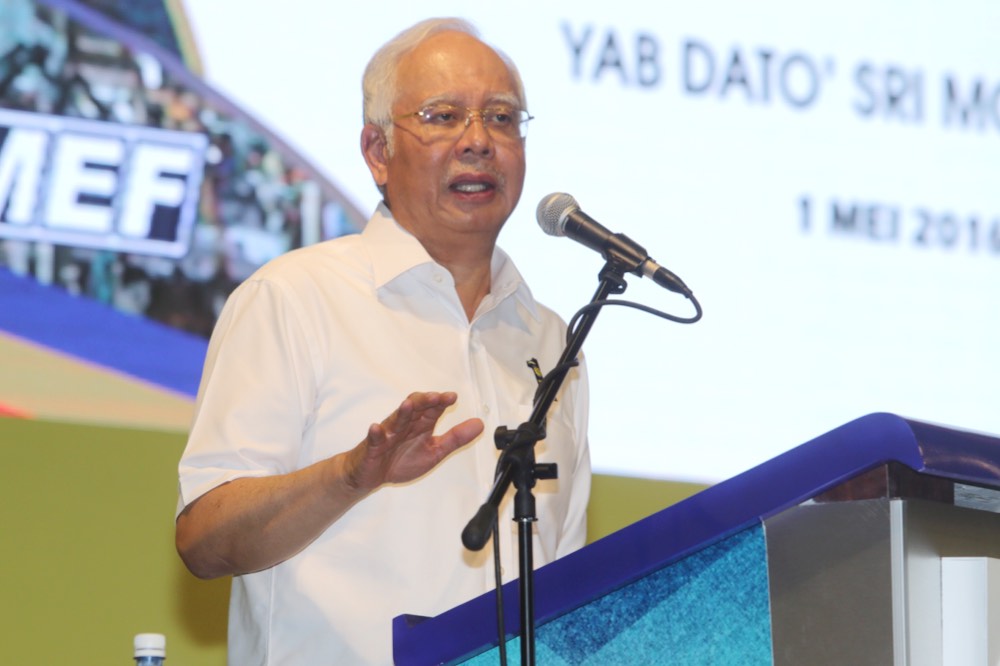
KUALA LUMPUR, May 1 — The government is considering introducing an insurance scheme to help workers who have lost their jobs, Prime Minister Datuk Seri Najib Razak said today.
He added that the proposed Employment Insurance System (SIP) is aimed to extend the social safety net for workers and will provide them with job counselling, among other measures.
“SIP is intended to help workers who had their jobs terminated by helping with their expenses during the period where they are searching for jobs after termination, as well as reducing the hardship and poverty due to a loss of income,” he said in his speech at the national Labour Day celebrations.
This insurance scheme will increase workers’ skill levels through training and retraining, Najib said, adding that this will also benefit employers as they will be able to hire those with suitable skill sets.
“SIP gives room for employers to adjust their organisations to any changes in technology and business structure, as well as reduce pressure arising from bankruptcy or reduction in operations,” he said.
“We are finalising the details but it will be a sharing of responsibilities between employers and workers. And we will make the announcement after we complete the process of engagement with all quarters,” he told reporters later.
Earlier, Najib launched a new mobile application called the i-Perkeso, which he said was developed without any cost to the public and would enable the Social Security Organisation (Perkeso) to better deliver its services.
Najib also announced that the Occupational Safety and Health Master Plan for the 2016 to 2020 period will be launched today.
He said the previous master plan successfully reduced work accidents from 49,598 cases in 2006 to 42,148 cases in 2014, adding that fatal accidents fell from 7.24 per cent to 4.21 per cent during the same period.
In his same speech, Najib urged Malaysians facing rising living costs to look beyond ensuring traders do not increase prices unscrupulously and also improve their skill set, noting that those with low education and skill levels earn low wages and have no access to high-income jobs.
“We must increase the capability of the public in order to generate high income and this high income can only come through high levels of skills and education and increasing productivity,” he said.
Malaysia is seeking to increase its annual average productivity growth from 2.3 per cent to 3.7 per cent, in order to boost the productivity levels from RM77,100 in 2015 to RM92,300 by 2020, he said.
Najib also cited the experiences of Finland’s Nokia, which he said previously dominated the mobile phone market but lost out to competitors Apple and Samsung as it was not innovative and was slow to respond to changes.
“If we are not innovative, we will lose in the competition. So I want to encourage the culture of innovation,” he said when noting that Malaysia could learn from that story.
He said Malaysia is ranked 32nd out of 141 countries on the Global Innovation Index 2015.


