


















SINGAPORE, Oct 14 — As someone who creates sculptures from his own dead skin and nails, Ezzam Rahman must be used to the sometimes-squeamish, other times-awestruck reactions he gets from people by now.
In fact, he rather enjoys it.
Speaking to TODAY at his studio, Ezzam recalled the response to his very first sculpture, which was created while he was pursuing his Bachelor of Fine Arts at the Nanyang Academy of Fine Arts in 2009. It was crafted entirely from dead skin and nails, and sculpted in the shape of a fish, or more accurately, a fish skeleton.
According to the 35-year-old, who recently received the Young Artist Award, his professors Dr Chandrasekaran and Dr Susie Lingham initially assumed he was displaying real bones that were left over from fish he had consumed the day before, perhaps while eating nasi lemak, he quipped.
“I told them, no, those are made out of my own dead skin. Immediately, Chandra pushed it away and freaked out, Susie also freaked out and I was like ‘Yeah! Yes!’ I was having a lot of fun,” Ezzam recalled with amusement.
The “fish bones” sculpture was to be the start of a series of sculptures mimicking animal fossils, including a baby snake, baby bird, dragonfly and even house lizard for the exhibition Unearthed at the Singapore Art Museum in 2014.
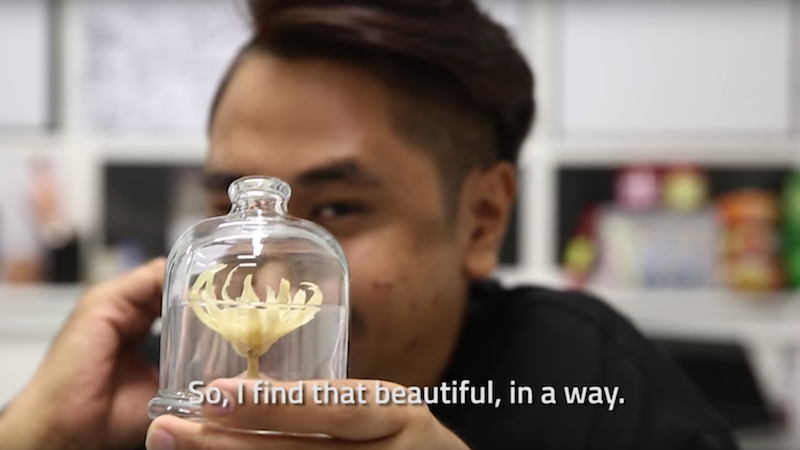
Ezzam then created a series of flowers for the President’s Young Talents exhibition last year, where he won both the main prize (in a tie with fellow young artist Ong Kian Peng) and the People’s Choice Award.
Reflecting on what his family thinks of his practice, his face lit up talking about his mother, whom he described as his number one supporter, his inspiration and his critic.
“When I showed her my coloured flowers, she told me ‘you know what, the coloured pieces are almost exactly like the Hari Raya flowers we have in the living room’. So it’s like I have a critic at home. She has no art background, but she is always honest and open about it,” he shared.
Although he receives a fair amount of compliments when it comes to his work, he also gets his share of detractors.
Some tell him that they feel these remnants should not be highlighted, and ask why he has to portray something as ordinary as body waste.
But Ezzam is unfazed by those comments. “I say: Why not? Because (art) is about the everydayness, it is about the common things.”
He added that he was inspired by internationally renowned performance artist Marina Abramovic’s show. Titled Art Must Be Beautiful Artist Must Be Beautiful, the performance comprises her combing her hair while saying ‘Art must be beautiful’ repeatedly.
Ezzam explains that he sees actions of everyday grooming such as “putting wax on my hair, applying moisturiser on my face, trimming my goatee, shaving my cheeks, (and) digging my ears and nose as very performative”.
In fact, his series of dead skin sculptures began with a performance art piece as part of Ket Noi: Vietnam-Singapore Performance Art Event in 2008. Ezzam was one of five artists selected from each country to participate in the three-day art festival curated by Vietnamese artist Tran Luong and Singapore artists Lee Wen and Jason Lim, which took place at the Singapore Art Museum and Singapore Management University.
“I decided to do this performance where I built a cardboard house... and I sat inside and I clipped my finger nails, my toe nails, and my skin around it. First, I cut the skin of my heel and the sole of my foot, so I had chunks of skin, then I start grating it and turning it into powder and I collected this power dry form of my skin, placed them in a porcelain bowl, added a bit of water and drank it,” described Ezzam.
Currently pursuing his Masters of Arts in Fine Arts with Goldsmiths, University of London at Lasalle College of The Arts, Ezzam said he does face difficulties, even though he is working with his own skin.
“These materials can retaliate, and sometimes they will choose not to work with you. Sometimes when I go overseas and come back, the skin feels different because it is adapting to the temperature and then it breaks down even easier.”
Another challenge is the fact that he can “never predict how much skin I cultivate”.
Pointing out that although humans typically generate nails and skin measuring an inch in 32 days, he said he has found a “technique” that helps him grow his material faster. “If I expose myself to the elements as much as possible by wearing flip flops — the closer I am to the ground, touching the concrete floor and natural heat (the better) — it grows fast. Within three weeks, I can start having a new batch of skin.”
“Living in a tropical city definitely helps my practice,” he added, chuckling.
To Ezzam, curating his dead skin requires a poetic intimacy of sorts — in fact, he has “conversations” with them.
“I allow the materials to talk to me, to tell me that it’s going to work or not, by whether the glue sticks to the skin or not. (For instance), some thinner slices will immediately gel up, some will refuse to curl. I allow the material to respond.”
And if they do not behave the way he wants them to, he either cuts the larger pieces of “successful” skin into smaller pieces, or replaces them with “fresher” skin from more-recent grooming sessions.
Ultimately, the artist said he was drawn to the fact that life is transient, and was hoping to leave a form of legacy behind. “I remember watching a documentary in 2003 on Channel NewsAsia about how they discovered Napolean Bonaparte’s hair and were auctioning it off. It became so valuable. I questioned myself on what mark I am leaving as an artist and as a person.”
He cited a Malay proverb that is close to his heart: When a tiger dies it leaves behind its stripes, when an elephant dies it leaves behind its tusks, but when a person passes away, you will only remember his or her name.
“Of course, facing departures of someone very close to me, like my dad passing away, had an effect. As days pass, I am starting to forget who he is, so it raises a question of what kind of impact you want to leave behind,” he said.
“Here I am making art works of my own body, you can feel me (in the works), I am there. I am so present and yet I am absent.” — TODAY


