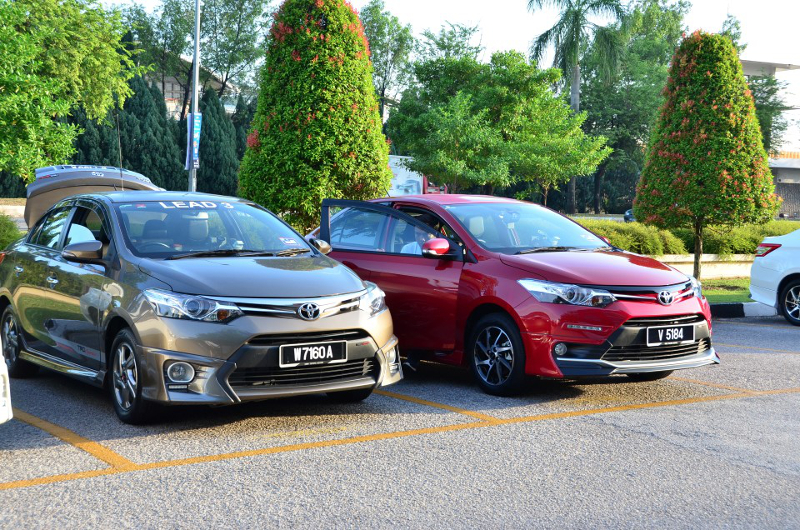











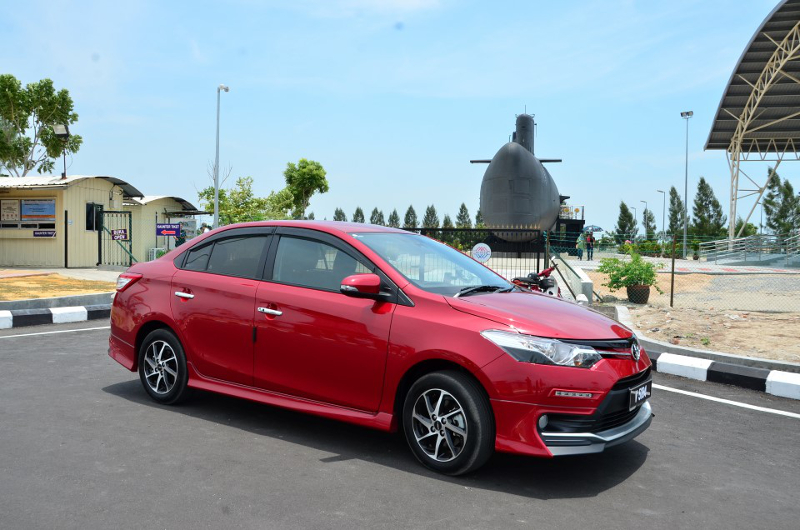


KUALA LUMPUR, Dec 12 — The Toyota Vios, now in its third generation since 2013, has just got another upgrade, probably the last one before a full model change which I suspect would be due in 2018. What’s new is an upgraded 1.5-litre engine (2NR-FE), which is rated a mite lower in horsepower and torque than the 1NZ-FE engine of the same capacity it replaces. This is a rationalisation move to standardise engines with the newly-launched Toyota Sienta, which carries the same engine. It is no coincidence also that the new 2016 Vios also gets a CVT, just as in the Sienta. UMW Toyota, however, maintains that the new engine performs better than the one it replaces, due to fine tuning of the torque curve — anyway, with the CVT, the drivetrain behaviour is changed totally — for the better.
The combination of engine tuning and the introduction of the CVT has garnered the Toyota Vios EEV status — which means a reduction in some of the duties payable, enabling UMW Toyota to maintain competitive pricing despite the addition of many new features.
CVT’s are not on my favourites list, but without a doubt it does contribute greatly to a car’s fuel economy. Being constantly variable and therefore an almost infinite range of gear ratios (within a given range), plus a relatively high top gear ratio, CVT’s can provide smooth acceleration and help the vehicle maintain a high speed at a relatively low engine speed, especially when the car is on light throttle at high speed. The particular CVT on the Vios has a torque converter to reduce shift shock. For the more adventurous, there is a 7-speed Sport Sequential Shiftmatic mode for UP/DOWN shifting using the gear shift lever.
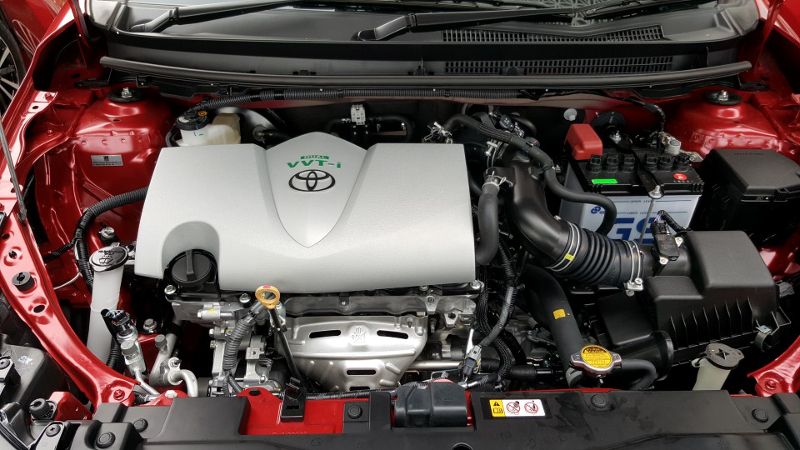
Meanwhile, on the engine side, the new engine features dual VVTi, which means variable valve timing is available both on the inlet and exhaust camshafts — this provides greater flexibility in engine tuning, thus improving fuel efficiency and power delivery. The engine now uses Iridium spark plugs and a re-designed combustion chamber improves the combustion process. Other improvements include oil jets for piston lubrication to reduce friction. Toyota’s own factory testing shows an improvement of 18 per cent better fuel economy over the previous Vios.
On the new Vios, there is an ‘ECO’ Indicator — a little green light that appears on the instrument panel whenever the engine is running optimally.
VSC (Vehicle Stability Control) is now standard across all variants, together with ABS, EBD, and BA. For the higher spec versions, (Vios TRD Sportivo, 1.5 GX, and 1.5G), rear disc brakes are fitted as standard. Other safety items include dual SRS airbags for driver and front passenger, seat belts with pre-tensioners, a collapsible steering column with breakaway feature, and a knee brace for the driver. For the rear, there are three 3-point belts, and ISOFIX points. The top 4 variants are also fitted with a reverse camera.
From the exterior, there are small visual differences, but possibly not enough to distinguish the new form the not-so new — the main items are new 15-inch alloys, an aero-kit fitted to the Vios 1.5 GX, which is available as an option for the 1.5E and the 1.5J; Daytime Running Lights (DRL) are now incorporated into the front bumper.
Keyless entry and keyless start are now standard features across all variants. The top four variants, (1.5 TRD Sportivo, 1.5 GX, 1.5G and 1.5E) get a 2-DIN head unit with a 6.8 inch touch-screen and DVD player, with AUX, USB ports and Voice recognition, plus leather upholstery.
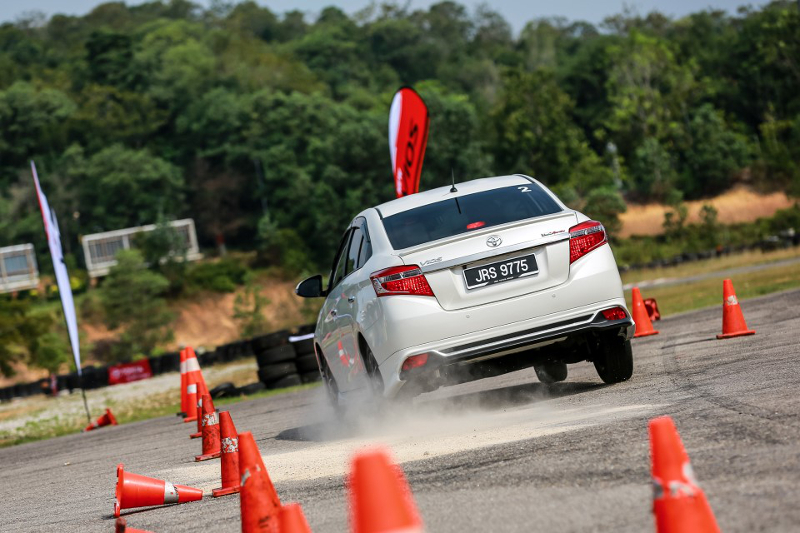
On the road, the Vios behaved very much as expected. Power delivery is good, and the CVT delivered as promised. Acceleration with the CVT is seamless, and as long as you are reasonably gentle with the acceleration (as 85 to 90 per cent of normal drivers are) you will get along just fine. Driven normally, you will enjoy the benefit of smooth motoring, and you will love it when you experience the improved fuel economy. However, if you are in a hurry, and push pedal to the metal, the CVT will spend more time in the lower gears and your engine will be pushing its limits as the CVT senses your need for power and keeps it in a lower gear to give you maximum acceleration. Having said that, in a conventional 4-speed automatic, if you did the same thing, the engine would also be spending a lot of time in 3rd gear instead of in 4th gear, and you would hear the engine screaming in much the same tone too. Thus, given the choice of a 4-speed automatic or a CVT, the CVT wins, simply because it can provide a smoother drive and give more fuel economy.
Engine power is adequate for the 1.1 tonne kerb weight (weight varies slightly across variants), and the new Vios, just like all the Vios before it, has no problem moving this mass. It is not the most powerful car in its class, nor is it the slowest — there is just enough, with nothing lacking, and the Toyota Vios is reputed to be one of the most reliable cars around, like a faithful servant, never demanding much attention, but ever ready to serve.
The Toyota designers have pretty much sorted out the suspension throughout the years — the Vios was always a good handler — it is well sprung, on the firm side of comfortable, which is what a car of this size and weight should be sprung — so that it can still carry another 30 to 35 per cent in weight and still behave with dignity on the road.
At the end of the test drive, here is our verdict — the new Toyota Vios, despite being an upgrade, has turned out to be a better car than the one it replaces — it doesn’t look very different, but it will perform its designated tasks better with its new engine and transmission. With VSC and other safety features across all variants, the Vios is now safer than ever.
Prices, (on-the-road, Peninsular Malaysia, with GST and insurance) are as follows:-
1.5 TRD Sportivo with CVT RM 96,400.00
1.5 GX with CVT RM 92,800.00
1.5 G with CVT RM 89,800.00
1.5 E with CVT RM 83,900.00
1.5 J with CVT RM 79,800.00
1.5 J with 5-speed manual RM 76,500.00