


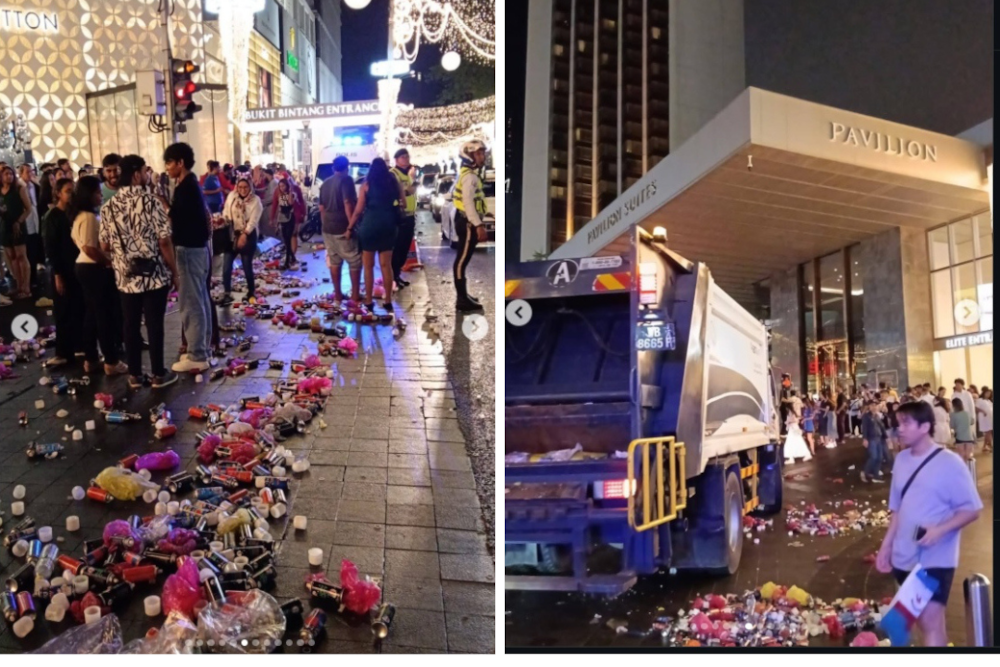
DECEMBER 31 —Recently, Housing and Local Government Minister Nga Kor Ming expressed dismay on his social media about littering on the streets of Bukit Bintang. He also shared images of the city centre after the Christmas revelry, where rubbish lined walkways and corners in what should be one of Kuala Lumpur’s most presentable streets.
As someone who’s been actively doing community work in Bukit Bintang, I am not unfamiliar with the eyesore. This is why I fully support the Minister’s reminder that, come 2026, the government will be enforcing littering laws more firmly.
Cleanliness is not just a cosmetic issue. It is part of the city’s user experience, just like safety, lighting, walkability and public order. When people step into a city centre, they form an impression within minutes. Overflowing bins, pavements strewn with food wrappers, and food waste lining the roadside, even for short periods such as after a New Year’s countdown, leave the area feeling unpleasant.
Littering also has a real cost – one that residents and businesses pay twice. First, through assessment rates and taxes that fund daily clean-ups. Second, through lost spending when people shun the place, tourists take fewer photos and shoppers cut their visits short. A messy street is bad for business, especially as we welcome Visit Malaysia Year 2026.
There is also a bigger picture. Less litter on the streets usually means we recycle more. It supports sustainability goals and reduces waste finding its way into drains and rivers. Cities that are serious about the environment start with basic discipline. You cannot talk about climate goals while ignoring rubbish at your doorstep.
Strict enforcement of littering laws can certainly help. Many Malaysians often look up to Singapore for its cleanliness and civic behaviour. That is partly achieved through strict enforcement, which is something we should emulate.
But enforcement alone will not solve everything. This is also about mindset. We cannot demand First World facilities while keeping a Third World attitude. It is time we stop treating public space as someone else’s problem. That mindset must change. Public space belongs to everyone, and we all have a duty to protect it.
Local authorities like the City Hall (DBKL) have a role to play too. People are more likely to litter when bins are hard to find or already full. Hotspots need more bins at strategic locations, on top of strict enforcement, including using technologies like artificial intelligence.
Clean-up strategies can also be smarter. Anyone who lives or works in Bukit Bintang knows the pattern. After New Year countdowns, weekends or big events, rubbish piles up fast. Cleaning resources should match these peaks. Sufficient crew should be deployed immediately after crowds disperse.
Foreign visitors must also be part of the equation. Multilingual and tourist-friendly signage, especially on penalties for littering, helps. Visitors usually follow rules when they understand them. Nga was right to remind visitors that they, like Malaysians, are subject to fines of up to RM2,000 and 12 hours of community work if caught littering from 2026.
From personal experience, litter management in Bukit Bintang is a daily battle. I am sure this is not confined to Bukit Bintang alone. I have seen cleaners hard at work, only for the same spots to be littered again shortly after. It is frustrating but also shows how unfair it is if we don’t do something about it.
That is why firm enforcement matters. It sends a strong message that bad behaviour has consequences.
As the “heart” of the nation’s capital, Bukit Bintang can lead the way. In many respects, the area is Malaysia’s “face” to the world, one where many visitors often visit. If discipline, enforcement and shared responsibility can take root in one of the country’s busiest districts, there is no reason why it cannot happen anywhere else.
Clean streets are not about image alone. They reflect who we are as a society. Keeping our streets clean is how we show that our values are not just talked about, but lived.
* Ben Fong Kok Seng is the chairman of the Bukit Bintang Parliamentary Zone Residents’ Representative Council
** This is the personal opinion of the writer or publication and does not necessarily represent the views of Malay Mail.


