


NOVEMBER 26 — I flew to Perth for the first Ashes Test – a small act of devotion, really. Five days ring-fenced, notebook ready, the slow theatre I love: morning cloud, a hard Kookaburra, and batters who remember the courage of not playing at one outside off.
It ended in two.
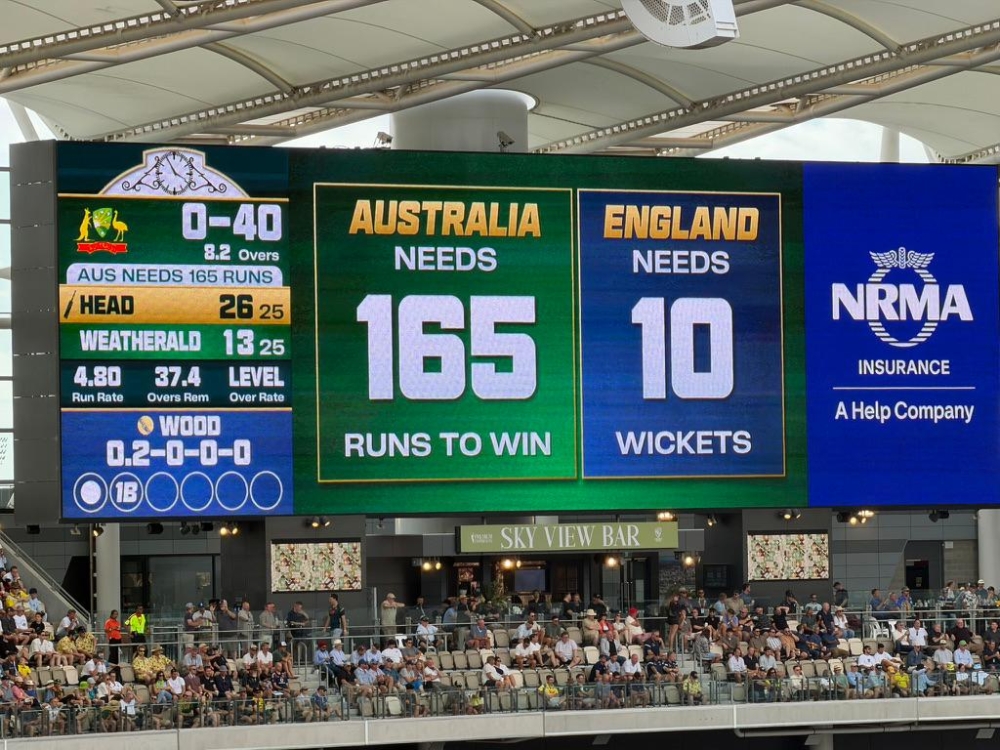
Two days. The Ashes – a Netflix mini-series. Somewhere between gate change and baggage claim, Travis Head unfurled a 69-ball hundred (equal-fastest by a Test opener, second-fastest Ashes ton after Gilchrist’s 57 at the old WACA) and England collapsed in stereo. It was, the statisticians informed us, the fastest Ashes Test result since 1888. I had five days of notes pre-labelled; Perth gave me two. That frustration, more than anything, made me write this.
The hinge: from 1–65 (lead 105) to rubble
Here’s the shape of it. Just after lunch on Day Two England were 1–65, 105 ahead on a pitch doing plenty – “in control” by any normal metric. Twenty minutes later they were a cautionary tale. The first innings had already included 5–12 in 18 balls; the second detonated from 1–65 to 6–88 in 8.2 overs. Michael Vaughan, who does understatement about as often as England leave outside off, called it “bloody disappointing” and warned the defeat would “damage” the team.
“You can’t be competitive without brains… you can’t just play one way,” he said on Kayo, sounding less pundit than headmaster.
Piers Morgan, who had tweeted “we’re going to win” earlier, issued the national mood two hours later: “This is painful.” He added that Head’s century, given the match situation, was one of the great Ashes innings. From premature swagger to headache in the time it takes to pour a pint.
Twenty minutes of madness (and three near-identical crimes)
Mark Waugh called it “twenty minutes of madness.” Scott Boland – day one’s human afterthought – tuned his metronome, and England obliged. Ben Duckett nicked, Ollie Pope drove on the up, and Joe Root – the No.1 Test batter – copied the same airy stroke five deliveries later. “Three particularly poor shots,” Waugh said; “loose driving on the up… not in Perth.” Brett Lee: “That’s Test cricket – it turns in twenty minutes.”
Simon Smale (ABC) stripped the euphemism: brainless batting. “Bazball with brains,” Vaughan has always pleaded; “the brains haven’t arrived.” England in 2023 had Edgbaston and Lord’s within reach, then handed both away with the same swaggering imprecision. Two years on, same movie, harsher lighting.
Travball, and how to earn your violence
Head’s hundred wasn’t anarchy; it was calculated acceleration. He began with 3 off his first 14 balls, absorbed the bounce, then filleted lines: four boundaries in one over off Stokes, a straight lift of Jofra Archer that felt personal, and the kind of tempo change that makes analytics look romantic. If Bazball is philosophy, Travball is a mugging – sudden, clinical, oddly joyful.
Meanwhile England’s pace battery, lauded on Day One for averaging 141 km/h (CricViz’s fastest England collective since 2006), turned to sawdust on Day Two. Archer barely grazed 140; Wood lost rhythm; Atkinson and Carse became Head’s canvas. If Day One was “fight fire with fire,” Day Two was finding the hose full of air.
The tactical subplot: bumpers, fatigue, and the tail that wagged
Not all the chaos wore England’s shirt. Australia, having sliced through England on a fuller length, flirted with the bumper plan at the tail. Kerry O’Keeffe was scathing: “Pitch it up, two slips, nick-off – why are we feeding this with short stuff?” It let Carse and Atkinson stitch a 50-run stand, four sixes, and pushed England’s lead beyond 200 when 170 felt terminal. In the end Doggett bounced out Carse and Archer and finished with 3–51, so the tactic cashed out, if untidily.
Elsewhere the ledger evened: Boland 4–33, the quiet reassertion of length; Starc 10 for the match, Root for peanuts again; and a bruised England staring at the scoreboard like it had sworn at them in public.
A small museum of perspective
Wit travels fastest by tweet, and Yas Rana delivered the museum label:
“Alastair Cook faced more balls in his Brisbane double-ton in 2010 than England faced in the whole Test here.”
That’s not nostalgia; it’s arithmetic. There was a time when patience bought you time: Cook in Brisbane, Dravid at Headingley, Atherton at Johannesburg. You could build the future of a match one leave at a time.
The old code (and why I miss it)
I’m not here to preach. I’m the bloke in Row Q with a coffee, watching and wincing. But I grew up on the old code: Gavaskar under Caribbean light, helmetless and unblinking; Viv Richards, who could leave and chose when not to; Botham at Headingley, mischief over muscle memory; Lara at Antigua, who knew that genius shows up only after judgement. The art wasn’t flamboyance; it was discernment.
Leaving outside off was never passive – it was the most assertive thing a batter could do. It said: I know my off stump; you’ll need something better than hope. In Perth, England forgot that sentence. Drives on the up at Optus are postcards home for slips.
Brains, bodies, and the bill that comes due
Vaughan’s roll-call was clinical: Edgbaston ’23, Lord’s ’23 – opportunities tossed aside; now Perth ’25. “They’re judged on these seven weeks,” he said, “and this is a big blow.” His grim echo on X: “Exactly the same mistakes.” Waugh wanted Archer to “rip in” with new-ball heat; Lee wondered why Stokes didn’t bring himself on sooner. And in a rare, human moment, Stokes admitted he was “a little bit shell-shocked.”
England’s approach does something cruel to its own bowlers: score fast, fold faster, and your five quicks have no rest. You don’t just lose wickets; you empty lungs. Travball didn’t just beat Bazball; it exposed its hidden tax.
What survived the wreckage
Amid the carnage: Boland’s adjustment (from a metre too full to handkerchief length), a one-handed Starc snare, and Head remembering that even mayhem starts with a period of listening. Australia were, as Fox put it, without Cummins and Hazlewood, Lyon bruised, Khawaja hamstrung by spasms – and still won inside two days. If you’re English, that stings more than the result. If you love Test cricket, it stings full stop.
The humble witness
So what do I actually know? Only this: from my seat in Perth, the match felt like a parable of the present – TikTok Test rhythms, twenty-minute plot twists, and a format forgetting its best habit: the quiet, grown-up decision to let one go. I’m not wagging a finger; I’m mourning a cadence.
Because the leave is not inaction. It’s intelligence made visible. It buys your bowlers breath, your innings shape, your day a future. It turns a collapse into a session. It turns a session into a match.
Travball 1, Bazball 0.
Brains optional; consequences not.
If there’s a moral – and maybe there shouldn’t be – it’s small enough to fit on a dressing-room whiteboard:
On a lively Perth afternoon, the smartest shot is often the one you don’t play.
And if Test cricket wants its five days back, it might start by remembering how to say no.
* This is the personal opinion of the writer or publication and does not necessarily represent the views of Malay Mail.


