











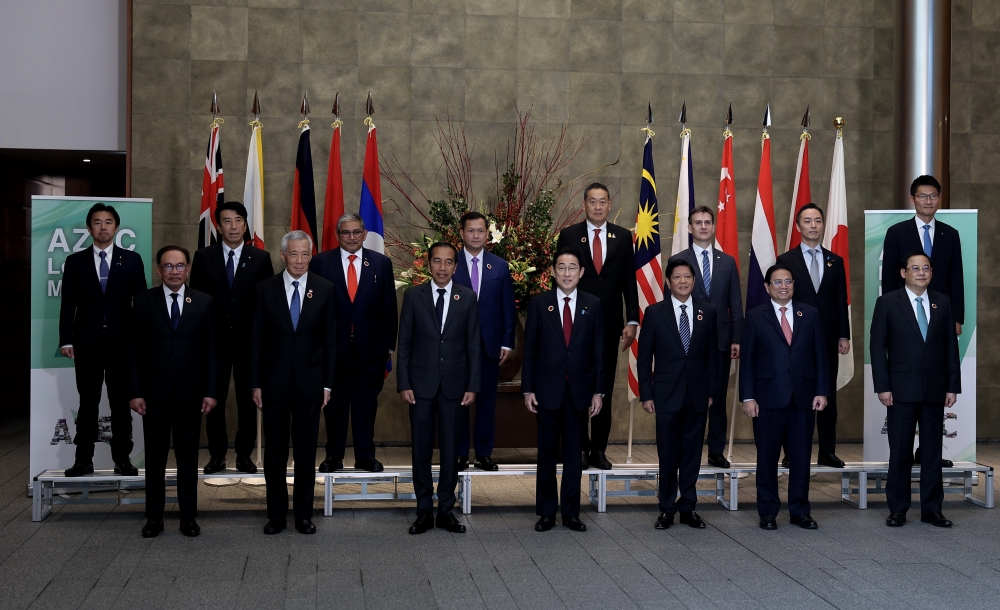
SEPT 27 — When Japan and its partners launch the third series of the Asia Zero Emissions Community (AZEC) on September 28, 2025, it will mark more than the continuation of a climate initiative.
It will signal Japan’s determination to sustain its return to the centre of regional development debates — this time by aligning its financial muscle, technological expertise, and political credibility with Asean’s most pressing challenge: the energy transition.
From concept to continuity
AZEC began as a bold Japanese proposal to gather like-minded countries into a coalition for decarbonisation. Its first series laid the foundation by outlining broad goals for renewable energy cooperation, hydrogen and ammonia projects, and smart grids.
The second series moved beyond rhetoric, mobilising JBIC and NEXI to provide guarantees, loans, and equity support for green projects across Asia. It made clear that AZEC was not just about dialogue, but about actual capital deployment.
Now, the third series demonstrates continuity. For Asean, this matters. Too often, regional initiatives start with enthusiasm, only to lose momentum. By sustaining AZEC into its third iteration, Japan is showing that it intends to remain committed over the long term, offering Asean both reassurance and partnership.
Why Asean is central
Asean is the hinge on which AZEC turns. The region’s energy demand is projected to nearly double by 2040, yet fossil fuels remain the backbone of supply. Coal dominates in Indonesia, Vietnam, and the Philippines. Subsidies for oil and gas remain entrenched in Malaysia, Thailand, and Myanmar.
This trajectory risks locking Asean into decades of high emissions just as the climate crisis intensifies. Floods, droughts, and typhoons are already displacing millions and destroying livelihoods. The costs will only grow heavier.
AZEC’s third series offers Asean an alternative trajectory. It provides finance to de-risk clean energy projects, technology partnerships to accelerate adoption, and participation in carbon markets that will soon shape the rules of global trade.
If Asean engages with AZEC proactively, the region can shift from being a laggard in climate action to a leader in sustainable growth.
Finance as the lever
At the heart of AZEC is Japan’s ability to mobilise public financial institutions. JBIC and NEXI are not new players. They have decades of experience financing large infrastructure, particularly in Asia.
What has changed in this third series is the scale and specificity of their commitments. Rather than general development assistance, they are now explicitly targeting renewable energy, hydrogen production, storage solutions, and decarbonisation infrastructure.
For Asean governments, where private banks remain cautious about financing long-gestation clean energy projects, JBIC and NEXI provide a crucial lever. With their involvement, risk is shared, making projects more bankable and attractive to private capital.
Technology choices and competition
Japan’s comparative advantage remains in hydrogen and ammonia utilisation, advanced battery systems, and smart grids. By linking Asean projects to these technologies, AZEC brings tangible expertise to the table.
But Asean is not beholden to Japan alone. China dominates global solar and wind production. South Korea is advancing rapidly in energy storage and digital solutions. Europe continues to lead in offshore wind and grid integration.
The diversity of suppliers is an asset. Asean should see AZEC as a platform for inspiration and collaboration, while maintaining technology neutrality.
By doing so, the region can select solutions that are cost-effective, sustainable, and suited to national conditions.
Standards and competitiveness
The third series of AZEC also carries implications for global competitiveness.
As trade shifts toward carbon-sensitive regimes, Asean exporters will face increasing scrutiny. The European Union’s Carbon Border Adjustment Mechanism is only the beginning. The United States and China are moving toward their own forms of green conditionality.
Engaging with AZEC now allows Asean countries to shape the standards of emerging carbon markets. Rather than being forced to comply later, Asean can contribute to designing the rules. This is not only about climate responsibility but also about securing future market access for the region’s industries.
Guarding Asean coherence
One potential risk is that AZEC could develop separately from Asean’s own frameworks, diluting coherence. The region already has the Asean Plan of Action for Energy Cooperation, the Asean Power Grid, and the Trans-ASEAN Gas Pipeline.
To avoid fragmentation, Asean must ensure AZEC’s projects are embedded within these blueprints. Alignment is essential. Without it, Asean could find itself pulled in multiple directions, undermining its centrality.
Malaysia’s moment
Malaysia’s Asean Chairmanship in 2025 provides the perfect stage. As host of the East Asia Summit in October, Kuala Lumpur can place AZEC’s third series on the regional agenda.
Prime Minister Anwar Ibrahim has consistently emphasised sustainability and innovation as Asean’s guiding theme for the year.
By integrating AZEC into Asean’s frameworks, Malaysia can demonstrate leadership, reinforce Asean centrality, and showcase Southeast Asia’s seriousness in the global climate conversation.
This is also consistent with Malaysia’s National Energy Transition Roadmap, which seeks to position the country as a renewable energy hub. Linking that domestic agenda with AZEC can create powerful synergies.
A sustained comeback
Japan was once Asean’s undisputed development partner, funding highways, ports, and industrial estates. In recent years, however, its influence waned as China expanded its Belt and Road, South Korea became a more agile investor, and the United States reasserted its political weight.
AZEC, now in its third series, represents Japan’s sustained comeback. Not by competing on scale or coercion, but by offering what Asean truly needs: credible finance, reliable technology, and continuity of commitment.
A shared future
The launch of AZEC’s third series on September 28 should not be seen as just another event in the crowded calendar of regional diplomacy. It is a moment for Asean to decide how to engage with a serious partner offering long-term collaboration on the defining issue of our time.
Climate change is not waiting. Trade rules are shifting. Technology races are accelerating. Asean must not remain a passive bystander.
If Asean embraces AZEC with clear strategies — equitable financing, technology neutrality, and alignment with its own frameworks — it can accelerate its transition to a cleaner, more resilient future.
Japan’s comeback through AZEC provides the spark. It is now up to Asean to ensure that spark ignites a transformation worthy of the challenges ahead.
* Phar Kim Beng, PhD, is professor of Asean Studies at the International Islamic University of Malaysia and director of the Institute of International and Asean Studies (IINTAS).
** This is the personal opinion of the writer or publication and does not necessarily represent the views of Malay Mail.