


FEBRUARY 23 — Section 16 of the Malaysian Anti-Corruption Commission Act 2009 (the Act) provides for the offence of accepting gratification. It reads as follows:
Any person who by himself, or by or in conjunction with any other person —
(a) corruptly solicits or receives or agrees to receive for himself or for any other person; or
(b) corruptly gives, promises or offers to any person whether for the benefit of that person or of another person,
any gratification as an inducement to or a reward for, or otherwise on account of —
(A) any person doing or forbearing to do anything in respect of any matter or transaction, actual or proposed or likely to take place;
(B) any officer of a public body doing or forbearing to do anything in respect of any matter or transaction, actual or proposed or likely to take place, in which the public body is concerned, commits an offence.
In the case of Public Prosecutor v Rosmah bt Mansor [2022] 11 MLJ 801, the accused was charged with three charges under section 16(a)(A) of the Act, where she was accused of corruptly soliciting and also receiving gratification as an inducement and reward for helping a company called Jepak Holdings Sdn Bhd (Jepak) in getting a project from the Ministry of Education (Ministry).
The essence of the first charge (soliciting gratification) was that the accused had through her special officer (Rizal) solicited RM187.5 million from one Saidi for herself as an inducement to help Jepak be awarded the project by the ministry through direct negotiations.
The prosecution would need to prove the following elements in order to prove the first charge:
(a) that the accused had through Rizal corruptly solicited from Saidi gratification for RM187.5 million being 15 per cent of the project’s value; and
(b) that she had solicited the gratification as an inducement to assist Jepak in getting the project from the education ministry through direct negotiations.
To solicit is to request or to ask for something. Raja Azlan Shah’s FJ (as His Highness then was) elucidated the word in Public Prosecutor v Datuk Haji Harun bin Haji Idris (No 2) [1977] 1 MLJ 15 at p 20 (HC) as follows:
“The word ‘solicit’ is a common English word, and it means, in its simplified form, ‘to ask’. In various English dictionaries this simple meaning is given, but other similar words are also used to explain other meanings it possesses, such as ‘to call for’, ‘to make request’, ‘to petition’, ‘to entreat’, ‘to persuade’, ‘to prefer a request’ (see Sweeney v Astle [1923] NZLR 1198 at p 1202).
“Thus, when a businessman advertises his goods, we say he is soliciting customers. He wants to sell his goods, and he solicits people to buy them. Again, such a businessman goes to a person whom he selects to try to induce him to buy, we say he is soliciting orders.
“To solicit then, means to ask for or invite offers. Thus, to solicit an order for goods means merely to ask for or invite offers for the purchase of those goods.
“A statement therefore, the real and operative purpose of which is to induce somebody to make such offers, amounts to asking for or inviting such offers. But to constitute soliciting, the request or invitation must reach the person solicited.”
The act of solicitation need not be done by an accused directly as it can be done through an intermediary. This was emphasised by Raja Azlan Shah FJ (as His Highness then was) as follows:
“Soliciting does not cease to be soliciting if it is received by the person solicited not from the person who solicits, but by other means of transmission or communication, such as a letter, circular, newspaper advertisement, telephone or message.
“To [illustrate] further, if [a] politician enlists the services of his subordinate or some third person or persons to do the act of soliciting for political donation that is nonetheless soliciting for the same by him. It is by the instrumentality of his subordinate or the third person that the act was done by him.”
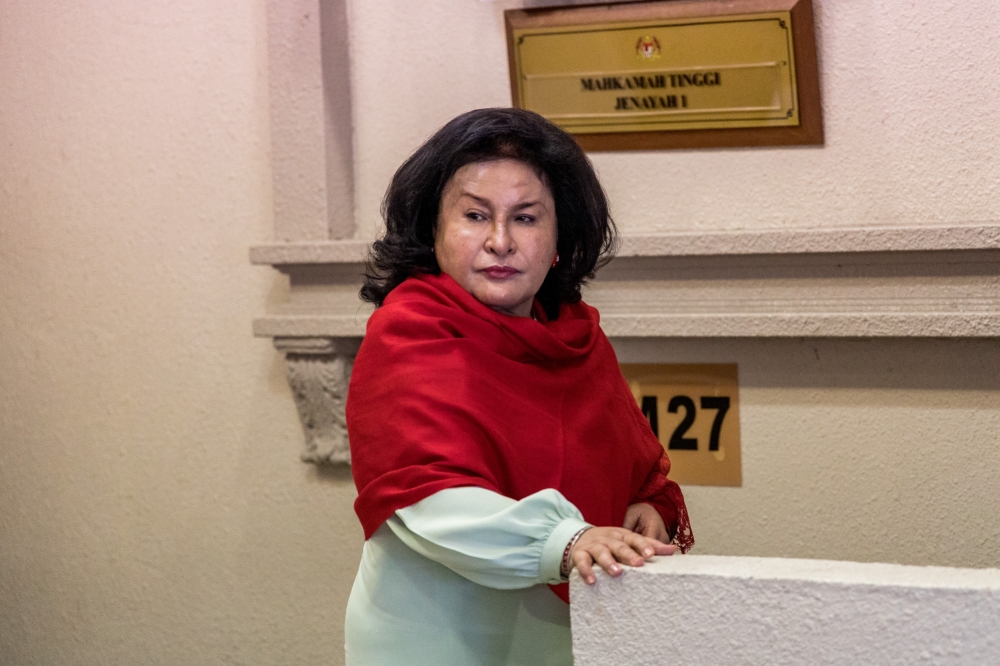
The prosecution in Rosmah’s case contended that the accused’s solicitation from Saidi was done through Rizal and done sometime between January and April 2016. The learned trial judge considered this as a question of fact, which, if proven, would satisfy the first element of the first charge.
The critical issue hence was whether the accused had, through Rizal, solicited 15 per cent of the contract value amounting to RM187.5 million from Saidi. The determination of this issue rested largely on Rizal’s testimony, which, if believed, would prove that the accused’s solicitation was done through him.
The accused contended that the sum was a political donation and that the accused never solicited anything from Saidi.
Rizal was subjected to a barrage of probing and, at most times, intimidating questions by the defence counsel in cross-examination for several days. He was confident and adamant in stating that the accused had instructed him to solicit the 15 per cent from Saidi and another person (Rayyan). Saidi and Rayyan had also testified that Rizal had solicited the 15 per cent from them on the accused’s behalf.
Their testimonies supported Rizal’s testimony.
Accordingly, the learned trial judge, High Court judge Justice Mohamed Zaini Mazlan found that the prosecution had successfully established the first element of the first charge.
Justice Zaini consequently ruled that once the element had been established, the presumption under section 50(1) of the Act arose against the accused. The relevant part of the section reads as follows:
"Where in any proceedings against any person for an offence under section 16, it is proved that any gratification has been solicited by the accused, the gratification shall be presumed to have been corruptly solicited as an inducement or a reward for or on account of the matters set out in the particulars of the offence, unless the contrary is proved."
The presumption above is nothing new, as its predecessors were section 14 of the Prevention of Corruption Act 1961 and section 42 of the Anti-Corruption Act 1997. The presumption is a presumption of law, and is obligatory for the court to raise it once it is proven that the gratification was solicited by the accused.
The second element of the first charge was therefore fulfilled, in that the accused was presumed to have solicited the gratification as an inducement to assist Jepak in getting the project through direct negotiations with the ministry, unless the contrary was proved.
The burden on the accused to rebut the presumption was on a balance of probabilities, which the learned trial judge ruled as follows:
“I have conducted a maximum evaluation of all the evidence by the accused and prosecution at the end of the trial, and find that the accused has failed to rebut the presumption under section 50(1) of the Act on a balance of probabilities that the solicitation for RM187.5m under the first charge was corruptly solicited as an inducement.”
The learned judge also found that the accused had failed to rebut the presumption with regard to the second and third charges.
Before sentencing the accused, Justice Zaini reflected on how corruption “has reached almost every level of society. It must be curtailed before it becomes pandemic. If corruption is left unbridled, our society will come to accept it as a way of life or business.”
The accused was accordingly sentenced to 10 years of imprisonment for each charge with the sentences to run concurrently and to run from the date of judgment.
The accused was also fined a total of RM970 million for all three charges, and in default imprisonment for 10 years to run concurrently for each fine in accordance with section 283(1) of the Criminal Procedure Code.
The accused has appealed to the Court of Appeal against her conviction and sentence, which is set for hearing in the middle of the year.
Until then, society must be reminded that if corruption is left unbridled, it will come to accept it as a way of life or business.
*This is the personal opinion of the writer or publication and does not necessarily represent the views of Malay Mail.


