


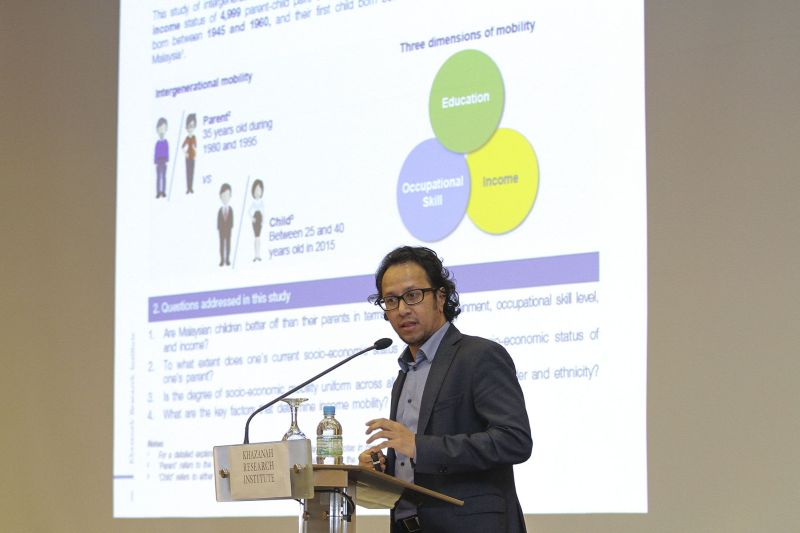
KUALA LUMPUR, Oct 28 ― Women have a lesser chance of increasing their pay over time, Khazanah Research Institute (KRI) found in its latest study on socio-economic mobility in Malaysia.
According to the study, which compared adult Malaysians' socio-economic stature to that of their parents when the latter were younger, women find it harder to move up the income structure than men.
“Women are less upwardly mobile than men. Policies focusing on removing gender barriers and encouraging higher female participation in the labour market should be continued,” said the report titled “Climbing the Ladder: Socio-Economic in Malaysia”.
Among those born to the bottom 40 per cent income category parents, their female children are 3.6 times less likely to be move upward than males, it said.
Even women born into the top 20 per cent income category families face a similar pattern, with females being three times more likely to be “downwardly mobile” than their male siblings.
This means it is at least three times harder for women to climb up the economical ladder, but at the same time they can drop down the ladder three times as easy.
Women comprise around 49 per cent out of Malaysia’s 28.3 million population, based on the latest census data from 2010.
The study had earlier found that Malaysians are receiving better education and earning more at a faster rate compared to their parents, a new study on socio-economic mobility.
In the first large-scale inter-generational mobility study in Malaysia, KRI found that Malaysians has a high rate of mobility in education, occupation and economy compared to the previous generation.
Malaysia's Intergenerational Earnings Elasticity (IGE) also recorded good numbers and is “low by international standards.”
The measure is used to determine the extent of influence parents' income has on children's income.
Malaysia's IGE score is 19 per cent, which lower than Great Britain, Germany, Italy, United States, France and Spain.


