


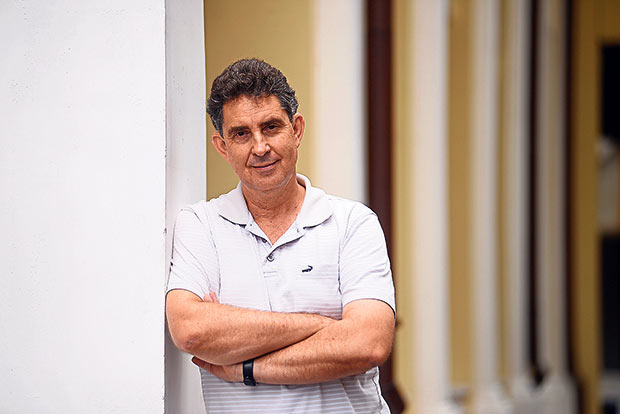
GEORGE TOWN, Sept 13 — He spent hundreds of hours poring over historical records and archives and piecing together bits and pieces of history to form a clear picture of Penang’s past.
Two years ago, he published volume one of a series of four historical books on Penang, titled Penang: The Fourth Presidency of India 1803-1830, after 10 years of meticulous research. Volume two is due to be published soon.
Marcus Langdon may be a British-born Australian but he now calls Penang home after moving here about five years ago under the Malaysia My Second Home programme.
The 61-year-old started researching his ancestors almost two decades ago when he found links between his ancestors and this tiny island in Southeast Asia.
He remembered Penang from his trip here back in 1977 so he started digging through more historical archives and records on the history of Penang and the East India Company.
Today, Langdon is known for his extensive knowledge of Penang’s early history under the East India Company and he also recently put together an exhibition on the history of the Penang ferry and the port at the ferry terminal in conjunction with George Town Festival.
He also founded Entrepot Publishing, a publishing and distribution company, together with fellow Australian and author Keith Hockton.
Hockton himself also wrote a book on Penang and this year, published another book Festivals of Malaysia which is distributed by Entrepot.
The duo are now working on more book projects on the history and heritage of Penang as they find this little island up north a fascinating place full of stories to record and tell.
Here, Langdon shares his views of Penang and why he is so fascinated by the island.
In his own words:
The East India Company set off the whole development in the region and my interest dates back to its early days. I have an ancestor who was here in Penang in the 1820s and held some interesting positions as parish clerk in St George’s Church, he was also headmaster of the Penang Free School and then he became a merchant and made a lot of money trading here and took it to Australia and then became a pioneer of Melbourne.
There’s some nice links there and this started my interest in the East India Company here in Penang. I spent about 15 years researching that in Melbourne and then moved over here to kick things about. Penang: The Fourth presidency of India 1805-1830, Volume 1: Ships, Men and Mansions came out in 2013 and since then, we’ve been involved in several other books. The Festivals of Malaysia book by Keith, to me, it is something that’s rightfully for Malaysians but it’s also for visitors.
My research of 15 years is of going through thousands and thousands of microfilms just trying to find one line that talks about the fort or the Penang Free School, picking those things out and slowly building this big jigsaw puzzle. My book is actually a four-volume set, and it’s designed so that other researchers or students of history and those interested in history don’t have to go back to those archives and sift through all that.
My second book that’s coming out has a huge chapter on the fort (Fort Cornwallis), with a lot of focus on the fort. That would be a great resource for people. And it’s really a labour of love. We are not making any money.
The port and ferries exhibition at the ferry terminal, the one we put up for the George Town Festival, that also raises possibilities of interesting subjects for us. The port people now want it on permanent display but I’m not sure if it will be there forever.
We are always working on a project. We’ve got a couple of book projects on history and heritage of Penang that we are working on right now. I’m working on a book that should be out early next year.
lIt’s interesting in Penang. These are all learning curves for everyone, because of the world heritage listing, there’s this exploding interest in history, partly because people are becoming interested and partly because they have to. With the revitalisation of George Town now, the difficulties for heritage bodies is to control it, to keep a control on the rampant development, incorrect development of shophouses and places like that. So, they are running around madly trying to teach the correct method of restoration. I think it’s very good to educate people about all these so that it’s done sensitively.
Also, unusually, we were both here in the 70s, I first came here in January 1977. We are both under MM2H. We actually don’t get paid to do this. We met through Joe Sidek of George Town Festival. I came back quite a lot because I have an uncle who lived here for 60 years and that’s the attraction and if you lose that, you lose the soul of the town. Then there’s a real problem.
It’s interesting that Penang is changing so fast. There’s good and bad, like everything. There’s an energy at the moment. Like, there’s street art going on now, I mean, some people are worried about what that means for heritage. I think it’s all good, because it basically means it brings attention.
I think the changes will go through several evolutions, we’ve got so many people setting up boutique hotels, there’ll be some natural attrition, some of them will drop out, things will change. The real challenge is not allowing George Town to lose its soul. That’s the real danger.


