


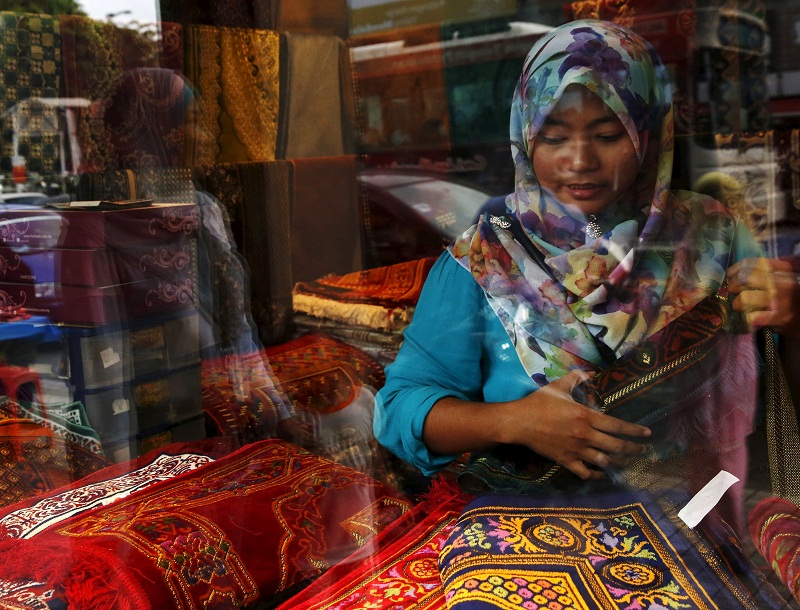


KUALA LUMPUR, July 15 ― The dour economy has taken the fun out of the coming Hari Raya celebrations, as Malaysians decide against the norm of changing their cars and furniture amid strict loan policies, a weak ringgit and a new consumption tax.
High-value businesses like cars, furniture and electronic goods usually thrive during the Aidilfitri festivities, as the majority Malays typically reserve Hari Raya ― the country's biggest religious and cultural yearly celebration ― to splash cash but this year, auto dealers and traders say they have posted a steep drop in sales, likely due to crumbling consumer confidence.
“The showrooms are now empty. Usually during Ramadan, it's filled up. Not this year,” Mursyidul Azam Mahruz, a sales advisor with Korean car brand KIA Motors, told Malay Mail Online.
“Malays usually like to show that they have new cars during Raya, but this trend has actually slowed for the past five years. But this year is really bad. It’s worse than last year. There is about a 50 per cent drop,” the 36 year-old, with more than a decade experience in car sales, added.
Inflation caused by the Goods and Services Tax (GST), which was introduced on April 1, has become the chief agent behind spending nervousness.
While car prices have actually dropped with GST’s six per cent rate replacing the 10 per cent Sales and Services Tax, the marked increase in other goods has weighed down on consumer spending power.
“At first they thought they'd hold buying cars until the GST is in. That would make car cheaper. But prices of other goods have also gone up so people are just afraid to spend,” Perodua salesman Mohd Fadzil Mohd Talib said.
Perodua sales at his showroom in Putrajaya has dropped by 30 to 45 per cent compared to the same time last year, Fadzil revealed.
Shahrul Nizam Daud, a sales advisor for national car maker Proton said his showroom have posted close to 50 per cent drop in sales and said that the strict loan policies imposed by Bank Negara, coupled with the GST, have also affected sales badly.
“For example our Axia car is the cheapest automatic car out there. But people cannot buy it because they now have to pay RM3,300 downpayment. Those who usually buy these cars earn RM4,000 below. So for them, RM3,300 is a lot of money,” Shahrul said.
The compulsory 10 per cent down payment requirement for cars follows Bank Negara's attempt to rein in the country's staggering household debt by imposing stricter loan policies for cars and houses purchases.
Latest data showed Malaysia's household debt stood close to RM150 billion, or 146 per cent to GDP.
Similar anecdotes were told at medium sized furniture and electrical appliances stores in the Klang Valley surveyed by Malay Mail Online ― with the absence of the Hari Raya celebratory mood as customers fear spending amid a gloomy economic outlook.
“It's quite bad. Raya is usually when Malays like to replace their old furniture with new ones as they have people visiting, but not this year. I recall one of them telling me that times are hard, and it is better for them to save than risk spending,” said a senior salesman of Plaza Perabot, a furniture store in Wangsa Maju here.
Ikea, the Swedish multinational giant that specialises in budget ready-to-assemble furniture, however, said it has seen a steady stream of customers visiting its sole store in Mutiara Damansara despite the poor economic climate, but admitted that it had to adapt to the situation by absorbing the GST and keeping the price low despite the weakening ringgit.
“We have maintained our prices in the 2015 IKEA Catalogue as before GST implementation on 1 April 2015. At the same time, we are also providing customers with the same low-price offerings, including the Even Lower Price range, where products become more affordable the more we sell them,” Ikea Damansara's store manager Gerard Jensen told Malay Mail Online in an email response.
But unlike Ikea, smaller furniture stores like Plaza Perabot are not as capital intensive, which makes it hard to absorb GST or inflation of raw materials caused by the weak ringgit and keep prices low.
“We cannot sell it low like Ikea. We have to increase the price or at least maintain a small profit margin. So customers, already going to Ikea for cheap stuff, now abandon companies like us completely,” said one of the company's sales officer.
Like Ikea, electrical appliances company like Sen Heng and Harvey Norman are also working hard to push sales through Hari Raya promotions by slashing prices on certain products and absorbing the higher costs triggered by the weak currency.
The strategy has worked but sales have not been booming like previous years.
“For businesses like us, television and hi-fi sets are usually favourites for customers celebrating Hari Raya. We still have customers buying but sales is not as good as past Hari Raya lah,” Peter Chin, a store manager of one of Sen Heng's branches in Ampang, told Malay Mail Online.
Similar to cars, Chin said some of the electrical appliances are now actually slightly cheaper now but as customers will still have to pay more for other services and products with GST, they tend to be nervous about spending on big items.


