




WANG KALIAN (Perlis), May 27 — The horrific image of what is probably the largest migrant prison camp authorities have discovered thus far in Wang Kelian in Perlis will be difficult to erase from my memory.
As I stood inside the camp, I could not imagine the torture, deprivation and harsh living conditions that men, women and children from Bangladesh and Myanmar would have endured.
The media was allowed into the camps to get an insight of what took place at the killing fields.
For Malay Mail though this was not the first time as our reporter S. Arulldas had on May 13 visited a similar camp and mass grave.
The hike to Bukit Wang Burma began at 11.30am.
From the mountainous site, one can cross over to the Thai border, a mere 150 metres away.
The hike was not easy, an uphill grind all the way.
At certain parts, I had to use my bare hands to hold on to something so that I could pull myself up.
Army personnel who escorted us at one stage said we were 500 metres above sea level and told us to get on the ground if we heard gunshots.
They said human traffickers could still be hiding in the jungle.
A few reporters decided to turn back as they were unable to climb the treacherous terrain after barely 1km uphill.
The officer who walked them out and came back to join us said: “If you can’t hike up this hill, imagine what pregnant migrants and children who barely had enough food and water went through.”
Along the way, cans of cheap sardines manufactured in Thailand were littered everywhere along with rice packets printed with Thai script.
A reporter from Thailand said it was super pack rice that comes with an extra 5kg. She explained that this was a cheap brand back in her country.
As I walked I trod on a cute orange slipper, the kind a three or four-year-old girl might wear. This was clear evidence that there was at least one child in this camp. God only knows what happened to her.
Inside the Wang Kelian death camp
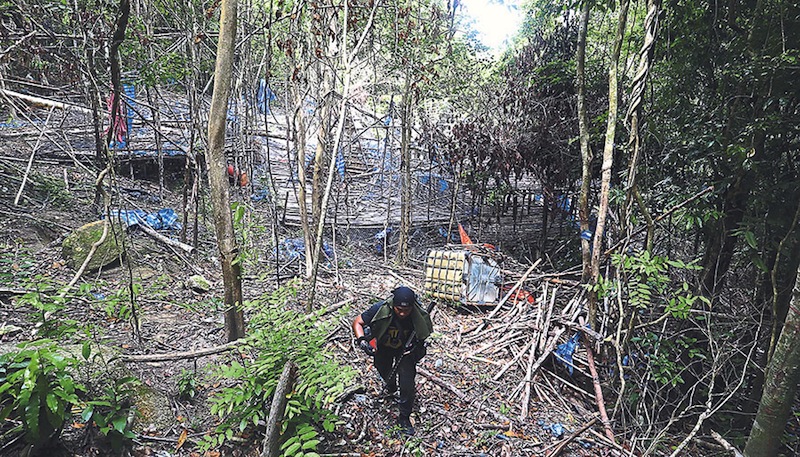
After nearly 2½ hours, the massive, partially collapsed migrant prison camp lay before me. The camp was the size of two futsal courts.
Judging by how the prison camp was built, with barbed wire surrounding the perimeter, the migrants were kept in close confinement and obviously against their will.
The first thing that caught my attention as I walked into the camp was a two-metre by 1.5-metre wooden cage with barbed wire all around it.
We surmised that immigrants who tried to escape or went against the human traffickers were caged inside as punishment.
A collapsed sentry post where the human traffickers were supposedly stationed to ensure no migrants tried to escape was right at the top of the camp.
As I walked into the living area that could easily house 300 or 400 migrants, I realised even that looked like a cage.
The only difference was this was bigger and in place of a bed, there was a thin canvas sheet the migrants also used as blanket.
Army personnel said the temperature at night could go down to 23°C.
The camp was also surrounded by iron fencing and barbed wire. Spare rolls of barbed wire were found nearby.
Another prominent structure was a water tank, along with a toilet made of canvas.
Faeces and other waste was disposed of in two 2-metre deep holes which were filled with plastic cups and plates.
I was unable to get a phone signal and police believe the traffickers used walkie-talkies to communicate
A police officer said of the 300 migrants at this camp, most were probably smuggled in while others would have been locked up until security at the borders was lax.
However, they would have probably starved to death in the interim.
He said it was common that the migrants were smuggled across the border in small groups once they arrived at the camp.
Horrific mass graves
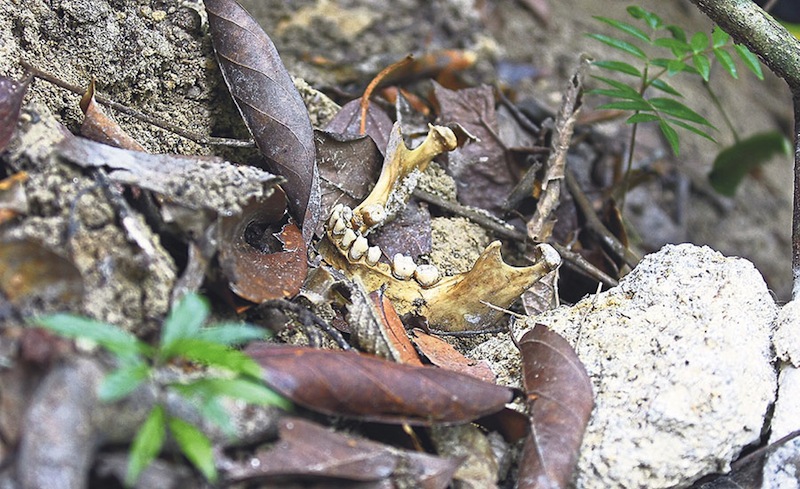
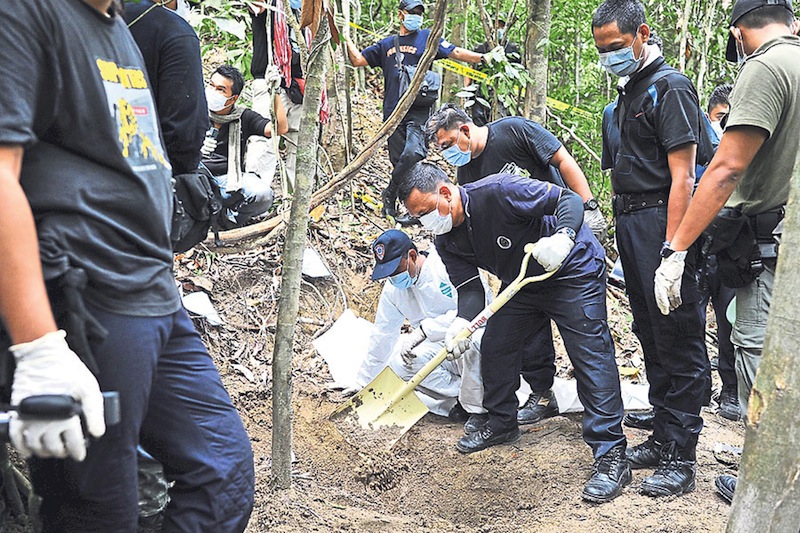
We were then taken to a mass grave site 100 metres away where a police forensic team had dug out the skeletal remains of a human trafficking victim.
Forensic personnel used a shovel to uncover the soil and used their bare hands to bring out the remains.
They spent nearly three hours to dig out one set of remains. The hilly terrain prevented the use of excavators or other powered tools.
“We also need to respect the dead. We can’t just dig and pull out the remains,” said one forensic officer.
When I arrived, I saw the forensic team bring out one set of remains wrapped in kain kapan.
They found the remains after digging five feet and said they would have to dig deeper as there could be more remains.
As I was watching, an officer told me to move away as he believed a few other reporters and I were standing on a grave they planned to dig next.
The forensic team had no choice but to also hike up the hill with their forensic kit and other equipment as the only way in was by foot.
Authorities plan to set up camps nearby so that they don’t have to trek up and down the hill.
They believe there are 37 other mass graves surrounding the camp.
The remains will be send to the nearest hospitals where post-mortems will be conducted.
The forensic officer said there were no markings to indicate it was a grave.
They had to look for signs such as uneven soil and then dig to find out.
In 2013, when I covered the conflict in Lahad Datu, Sabah, I was taken to the site where a mass grave of Sulu militants was found.
I had no sympathy for them then as they were armed men who came to claim something that was not theirs.
They came with the intention to cause mayhem and were ready to kill.
But when I saw the mass grave site of the migrants, I was filled with sorrow.
These men, women and children travelled far for a brighter future, putting their trust in people who were little more than ruthless pirates.
But alas, their dreams were dashed by the greed and avarice of a few heartless individuals, with no pot of gold at the end of their rainbow, only an unmarked grave.


