


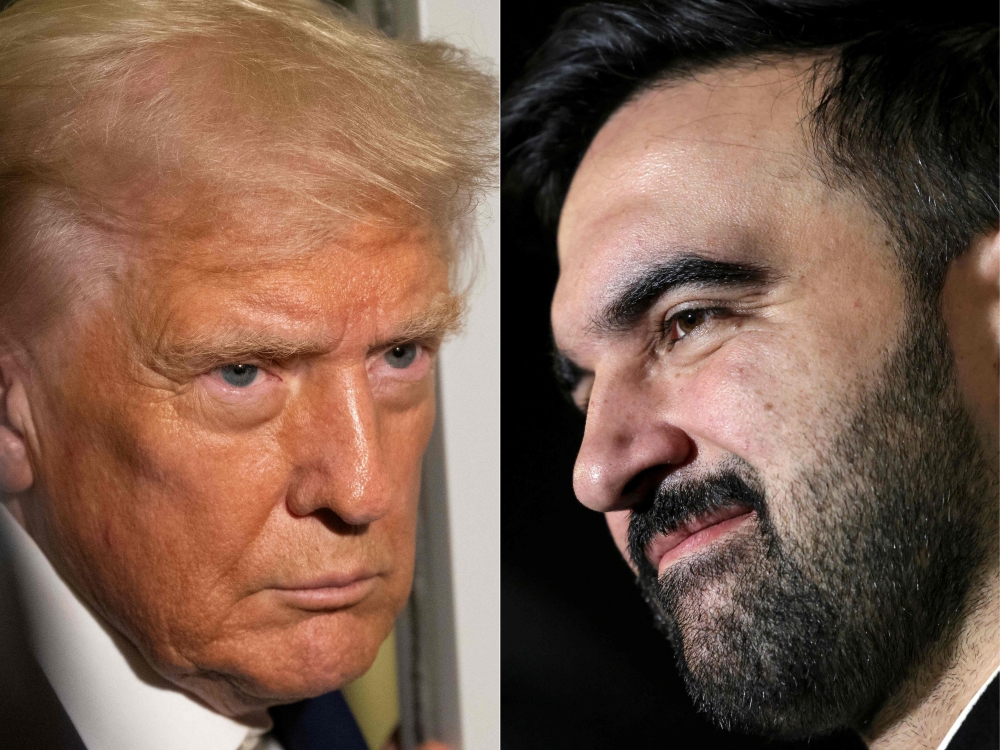
NOVEMBER 9 — In the unfolding political theatre of the United States, the confrontation between Zohran Kwame Mamdani and Donald Junior Trump marks one of the clearest illustrations of a domestic ideological struggle – one that has little to do with foreign interference or global geopolitics. It is, by every measure, a contest for America’s moral and economic soul, not a matter for the world beyond.
The new face of American progressivism
Zohran Mamdani represents a new generation of American progressives who refuse to accept that capitalism and inequality are inseparable. As a Democratic Socialist and State Assemblyman from Queens, his call for fare-free public transport, rent freezes, universal childcare, and city-owned grocery stores has electrified New York’s working-class neighbourhoods. His mayoral victory in the Democratic primary – defeating political veterans like Andrew Cuomo – signifies an urban revolt against corporate complacency and political elitism.
To many ordinary New Yorkers, Mamdani is the rebirth of a city once proud of its civic conscience, a city that fought for labour rights and immigrant dignity. But to Donald Trump, he embodies everything that went wrong with what he calls “the socialist decay of New York.”
Trump’s federal leverage and threats
Trump’s reaction has been characteristically theatrical and combative. Calling Mamdani a “communist lunatic,” Trump has vowed to withhold federal funds from New York City should Mamdani become mayor. Such threats – reminiscent of his earlier clashes with Democratic governors and mayors during the pandemic – reveal a familiar tactic: the use of federal power to discipline local dissent.
This is not foreign policy; it is a domestic showdown over federalism itself. Trump’s version of executive authority seeks to make cities obedient to Washington’s political alignment, while Mamdani’s campaign reasserts the principle of local autonomy and social justice. Their battle is an internal American reckoning with how democracy is meant to function when ideological polarisation corrodes governance.
The limits of external concern
To observers abroad – from Kuala Lumpur to Brussels, from Tokyo to Jakarta – this confrontation may seem like yet another test of American democracy. But the truth is simpler: this is a family quarrel within the American household. It concerns neither Asean nor Europe, nor any other global partner.
When Trump weaponises funding to punish New York City, he is not rewriting international norms; he is merely deepening the fault lines within the US federal system. Similarly, Mamdani’s proposals for progressive taxation and public ownership have no bearing on global markets unless they are distorted by partisan media. The struggle is local in origin, national in consequence, but domestic in nature.
The world has long learned that America’s internal conflicts – from the civil rights movement to Black Lives Matter, from the Tea Party to the January 6 riots – eventually shape its foreign posture, but they begin as domestic reckonings of justice, power, and identity. Mamdani versus Trump is another chapter in that continuing narrative.
Two visions of America
At its heart, this is a battle between two incompatible visions of America. Trump sees a nation to be commanded – a fortress of dominance that rewards loyalty and punishes defiance. Mamdani envisions a republic of compassion – one that measures greatness by how it treats its most vulnerable citizens.
Yet neither side can claim moral monopoly. Trump channels the discontent of millions who feel excluded from urban elitism. Mamdani channels the anguish of those crushed by inequality and rising costs of living. Both are symptoms of a fractured American polity still struggling to reconcile liberty with equality.
The confrontation is thus less about policy and more about the meaning of governance: whether America will be ruled by coercion or by consent, by populist nationalism or by participatory justice.
A lesson for the world – but not a battle for it
For foreign audiences, the temptation is strong to interpret this clash as an omen of America’s global decline or a warning about the fragility of liberal democracy. That would be a mistake. The Mamdani–Trump struggle does not export itself; it is a strictly domestic debate about taxation, social policy, and moral vision.
The United States is a vast and resilient federation. Its contradictions, though loud and often ugly, remain internal conversations about how to distribute power and wealth. They do not require international mediation, nor do they justify foreign commentary masquerading as solidarity.
Just as other nations resent outside intrusion in their domestic affairs, so too should the rest of the world recognise that Mamdani versus Trump is an American issue for Americans to resolve – through their ballots, courts, and civic discourse.
The closing reflection
In truth, America has always been at war with itself – between the Puritan ideal of moral virtue and the frontier instinct of self-interest. Trump and Mamdani personify these two impulses in the 21st century. Theirs is not a clash between East and West, nor between democracy and authoritarianism, but between two versions of American destiny.
And for that reason alone, the world should watch, but not interfere; learn, but not lecture.
Because the Titanic struggle between Mamdani and Trump is not the world’s burden to bear – it is America’s own test of conscience.
* Phar Kim Beng is Professor of Asean Studies and Director, Institute of International and Asean Studies (IINTAS) International Islamic University Malaysia
** This is the personal opinion of the writer or publication and does not necessarily represent the views of Malay Mail.


