


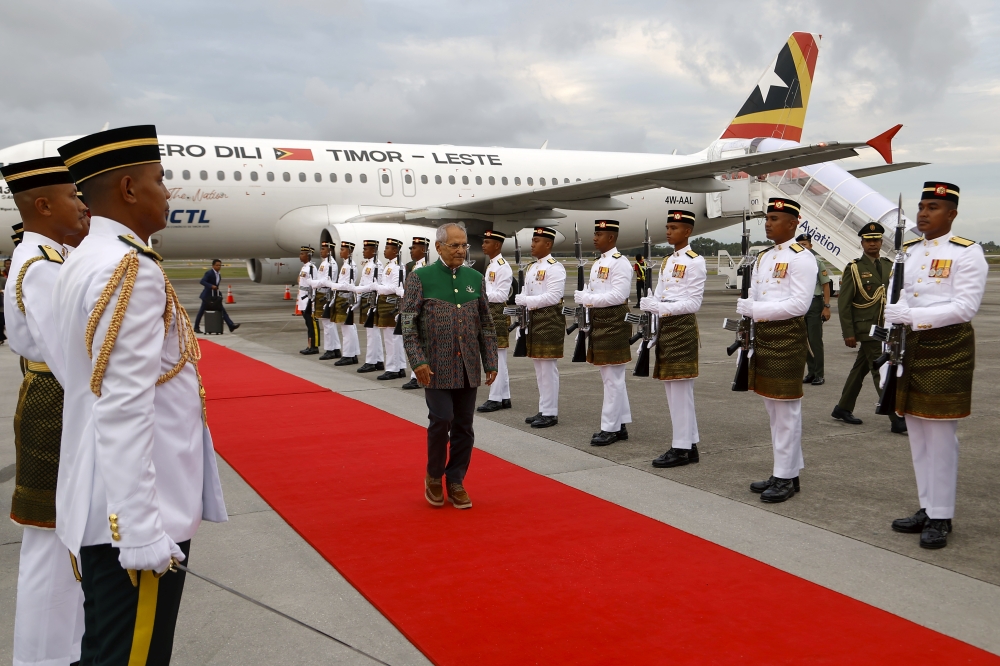
OCTOBER 26 — When Timor-Leste finally takes its long-awaited seat as Asean’s 11th member today, the moment is rich with symbolism.
Two decades after independence, one of the region’s smallest and youngest democracies is being welcomed into its largest political family.
The theme chosen by Dili, “Together We Rise”, captures both the pride of arrival and the optimism of belonging. But in the echo of that phrase lies a quieter question that Asean must confront: in this region, who truly gets to rise?
For Timor-Leste, the slogan is not a branding exercise but a lived experience. Its story is not one of easy ascent, but of survival, rebuilding, and belief in solidarity forged through suffering.
Few nations understand “together” the way Timor does; through years of collective resistance, reconciliation, and rebuilding a democracy from the ashes of conflict. When its people say “we rise,” it is an act of remembering as much as of reaching forward.
Asean’s version of “rising,” however, has long carried a different weight. Within its vocabulary, to rise often means to integrate, to grow, to maintain stability; an agenda shaped by markets, major powers, and middle-class security.
The bloc prides itself on consensus, but behind that harmony lie quiet hierarchies: between founders and latecomers, large and small economies, strong and fragile democracies.
As Timor joins, the question is whether “together” refers to equal participation or polite inclusion under unequal terms.
Timor-Leste steps into Asean not only as one of its poorest members, but arguably its most
idealistic.
It enters a region wrestling with democratic retreat, from the junta in Myanmar to shrinking civic spaces elsewhere.
Yet Timor-Leste, despite poverty and fragility, has managed to hold free elections, sustain open media, and maintain a culture of public debate.
Its legitimacy comes not from wealth or might, but from moral clarity. In a sense, Timor brings to Asean what the bloc most lacks: conviction born of struggle.
That conviction, however, may sit uneasily within Asean’s political culture.
The bloc’s tradition of non-interference and slow diplomacy rewards caution, not candour.
To rise within such a system often requires learning to stay silent on uncomfortable issues, precisely what Timor-Leste’s democratic ethos resists.
It has spoken boldly on Palestine, supported Myanmar’s democratic movement, and maintained friendships that reflect principle rather than expedience.
These instincts, while admirable, may test Asean’s tolerance for difference.
The promise of “Together We Rise” thus meets its first paradox. Rising together should mean shared dignity and voice, but within Asean, rising often means adapting to a hierarchy that rewards compliance.
Will Timor-Leste be embraced as an equal partner, or socialised into conformity? Will it retain the audacity that made it stand out, or learn the art of saying less to belong more?
Timor-Leste’s entry is not simply about membership; it is a mirror. It reflects what Asean has become and what it fears becoming.
The bloc’s rise over the decades has been uneven. Some members surged into industrial powerhouses, others remained mired in inequality.
Its geopolitical relevance has grown, yet its moral authority has waned. By welcoming Timor-Leste, Asean gains youth, energy, and a sense of unfinished history, but also inherits a conscience it may not be ready to hear.
To rise “together” in any meaningful sense, Asean must rethink what counts as rising.
Development without dignity, unity without equality, and diplomacy without accountability cannot sustain a shared future.
The region’s strength lies not only in size or GDP but in its capacity to listen to smaller voices, to newer members, to citizens whose struggles rarely make it into communiqués.
As the flags are raised and anthems played in Dili, it is worth remembering that this moment belongs not just to governments but to people.
The Timorese who marched, voted, and rebuilt their nation did so without waiting for permission from powerful neighbours.
Their notion of “together” is deeply human-rooted in memory, care, and endurance. It is that spirit, not ceremony, that Asean most needs to rediscover.
So yes, this is a day of celebration. But it is also a quiet reckoning. Because “Together We Rise” only means something if the rising is shared, not just by states, but by the societies they claim to represent.
For Asean to truly rise with Timor-Leste, it must look beyond expansion and towards empathy; beyond integration and towards equality.
Only then will “together” be more than a slogan, and rising means something more than standing tall.
* Khoo Ying Hooi, PhD is associate professor at Universiti Malaya. She also serves in the International Advisory Council of Centro Nacional Chega! (CNC) in Timor-Leste.
** This is the personal opinion of the writer or publication and does not necessarily represent the views of Malay Mail.


