














Oct 25 — Donald Trump’s rare visit to Malaysia has reignited a familiar refrain in diplomatic circles — that Malaysia must continue its delicate “balancing act” between the United States and China. Yet that reading no longer captures the spirit of Malaysian foreign policy under Prime Minister Datuk Seri Anwar Ibrahim.
Malaysia today is not balancing between two poles. It is pursuing what may best be described as omni-directional dynamism — a forward-looking, multidimensional engagement that expands diplomatic and economic options while preserving national autonomy.
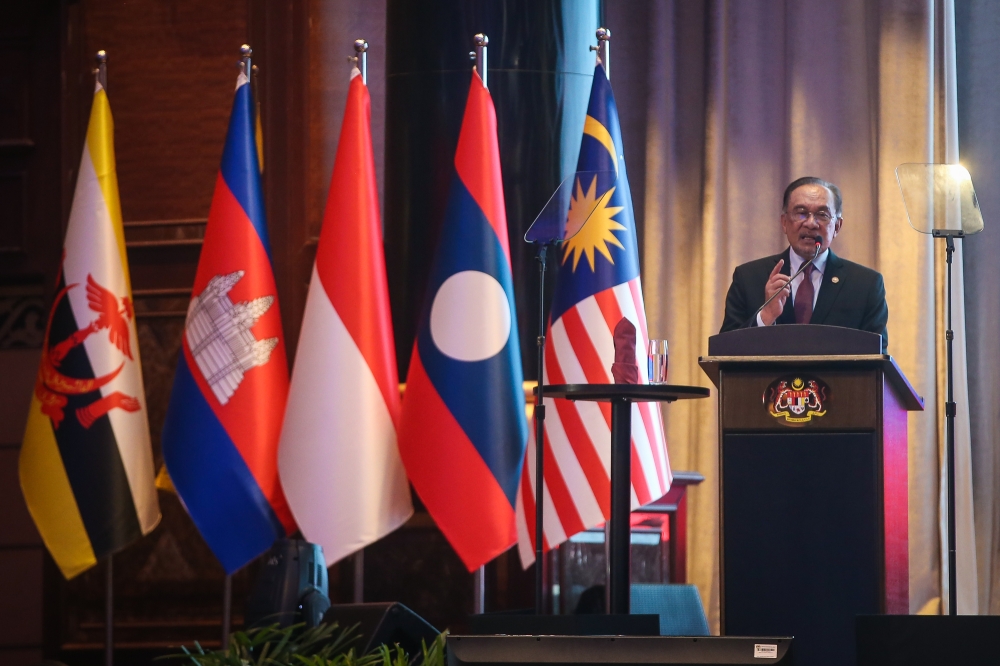
Trump’s stop in Kuala Lumpur, his first since leaving office, underscores how Malaysia has become a necessary meeting point for multiple powers. As chair of Asean, Anwar has convened leaders from the Indo-Pacific, the Gulf, and Latin America. Japan’s Prime Minister Sanae Takaichi, Brazil’s President Luiz Inácio Lula da Silva, and South Africa’s President Cyril Ramaphosa are among those attending the regional summit, reflecting Malaysia’s widening reach.
The absence of China’s Xi Jinping and India’s Narendra Modi only amplifies the symbolic significance of Trump’s visit at a moment of deep strain in US–China relations.
For Malaysia, the stakes are immense. Washington remains a key investor in advanced manufacturing and energy transition industries, while Beijing is the country’s largest trading partner. Both markets are vital, yet both are now locked in escalating tariff wars, technology restrictions, and strategic rivalry. The question for Malaysia is not how to keep equal distance from both, but how to chart an independent course that advances its own interests.
Anwar’s diplomacy reflects Malaysia’s unique worldview — pragmatic, inclusive, and rooted in peace. It is less about “balancing” and more about “broadening.” Malaysia seeks to work with all nations that respect sovereignty, fairness, and mutual gain.
That principle explains Anwar’s willingness to host Trump despite ongoing disagreements over Washington’s policies in Gaza. Diplomacy, as Anwar often reminds observers, is “the practical art of navigating imperfection.”
Four pillars of omni-directional dynamism
Malaysia’s omni-directional dynamism rests on four reinforcing pillars.
First, economic diversification. As global supply chains shift, Malaysia is deepening engagement not only with the US and China but also with Japan, South Korea, Australia, the Gulf Cooperation Council, and the European Union.
The coming Malaysia–Saudi–UAE investment framework in halal industries and digital finance exemplifies how Southeast Asia and the Middle East can complement each other.
Second, technological adaptability. Malaysia’s National Semiconductor Strategy positions it to benefit from, rather than suffer under, superpower competition.
By hosting American firms for high-end packaging while partnering with Chinese companies for upstream materials, Malaysia embeds itself in both ecosystems — not as a pawn, but as a platform.
Third, civilisational dialogue as diplomacy. Anwar’s engagement with Islamic, Confucian, and Western traditions situates Malaysia as a bridge of ideas as much as of trade. This moral legitimacy strengthens Kuala Lumpur’s voice in calling for conflict de-escalation in Myanmar, the South China Sea, and beyond.
Fourth, Asean centrality through leadership, not lip service. Malaysia has revitalised the bloc’s convening power by holding over 300 meetings this year and prioritising collective resilience in food, energy, and digital security. The message is clear — Asean’s strength lies in inclusivity, not exclusivity.
Turning entanglement into opportunity
This omni-directional outlook marks a shift from reactive to proactive diplomacy.
Earlier generations of Malaysian leaders sought to avoid entanglement; Anwar’s Malaysia turns entanglement into opportunity — engaging every partner without subservience to any.
It is a philosophy shaped by history and necessity — small and medium-sized states survive best when they are indispensable to all, not dependent on one.
Critics who call for boycotts or isolationism overlook Malaysia’s reality as a trading nation.
A prolonged US–China cold war would disrupt supply chains, raise inflation, and endanger jobs across Asean. The responsible course is dialogue, even with those whose policies Malaysia disagrees with.
Trump’s presence in Kuala Lumpur is therefore more than a diplomatic spectacle. It affirms Malaysia’s capacity to engage across divides without surrendering its principles.
Should the Asean summit produce progress on regional security or trade facilitation, it would confirm that quiet statecraft can achieve what confrontation cannot.
The Anwar doctrine takes shape
The true test for Malaysia’s foreign policy lies ahead. As global competition intensifies over technology, energy, and values, omni-directional dynamism must remain the nation’s compass. It demands dexterity — the ability to face West, East, North, and South at once — without losing moral coherence.
Malaysia’s foreign policy is no longer about balancing external powers. It is about bridging the principle of pragmatism with autonomy and engagement.
In a world increasingly polarised by rivalry, Malaysia’s answer is direction — all of them.
That is how omni-directional dynamism will define the Anwar Doctrine in and beyond Asean Group Chair and Related Summits — firm in independence, flexible in partnership, and faithful to the belief that peace, not polarity, remains the highest measure of national strength.