


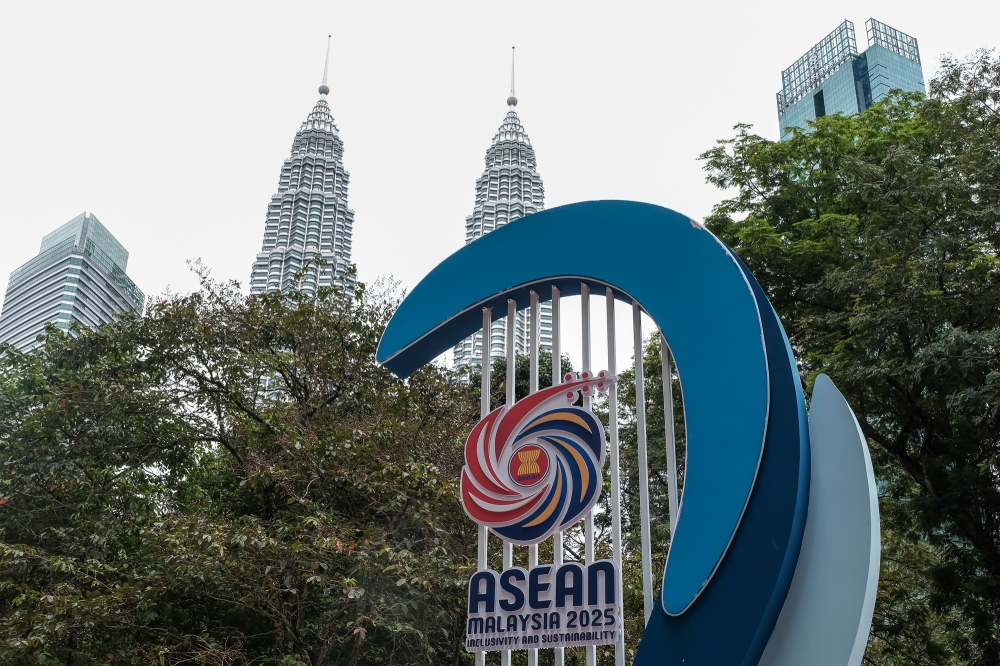
OCTOBER 23 — The 47th Asean Summit takes place at a moment of unprecedented responsibility for Malaysia, which has held the Group Chairmanship of Asean and Related Summits since early 2025.
The tempo of regional engagement accelerated after the Asean Ministerial Meetings at the Langkawi Retreat on January 19, 2025, setting the tone for a year marked by ambition, urgency, and a reassertion of Asean’s central role in the global order.
This renewed momentum is not accidental. In a world splintered by geopolitical rivalries, tariff wars, and technological fragmentation, world leaders are descending upon Asean because the region now represents one of the last functioning arenas of inclusive multilateralism. Asean remains a forum where the United States, China, Japan, India, Russia, and the Gulf Cooperation Council (GCC) can all sit at the same table — even when they refuse to do so elsewhere.
For global powers, Asean is a stabilising bridge between East and West, North and South. Its ability to convene, mediate, and moderate amid great-power rivalry has turned it into a diplomatic sanctuary in an increasingly polarised world.
For corporations, Asean is an economic magnet — a 700-million-strong market that remains youthful, open, and digitally connected, with the fifth-largest combined GDP in the world.
As Malaysia leads the chairmanship, it has positioned Asean as both a regional anchor and global interlocutor.
The region’s challenge, however, lies in managing its transformation from a convening platform into a true community capable of collective action.
Economic integration remains Asean’s foremost priority. While its growth rates outpace the global average, the region faces heavy turbulence from US tariff policies, China’s slowdown, and the reordering of global supply chains. The test now is whether Asean can deepen intra-regional trade to build resilience against external shocks.
Geopolitical competition further complicates that goal. The US-China rivalry has spilled into the East and South China Sea, the semiconductor industry, and the battle for 5G and artificial intelligence dominance. Asean must balance its role as a neutral broker while safeguarding national interests — a delicate act that requires patience and strategic dexterity.
Internal cohesion remains a soft underbelly. Asean’s ten members are at vastly different stages of development and political evolution. While Singapore and Malaysia are pushing digital transformation and renewable energy, others such as Laos and Myanmar face structural and humanitarian challenges that threaten to drag the bloc’s credibility down.
Connectivity and digital transformation are Asean’s long-term pillars of strength. The Asean Power Grid, the Trans-Asean Railway Network, and the Asean Digital Economy Framework Agreement are designed to bind the region’s economies into one seamless ecosystem.
Yet, these ambitions also bring new vulnerabilities.
Subsea cables — which carry 99 per cent of global internet traffic — cut across the seismic zones of the Pacific Ring of Fire and are vulnerable to both accidental damage and hybrid interference. Protecting such critical infrastructure will require shared vigilance, coordination, and defence-level cooperation.
Beyond these traditional and hybrid challenges, non-traditional security threats — from climate change to pandemics, food insecurity, and human trafficking — are forcing Asean to expand its understanding of security.
The 47th Summit marks a critical juncture: Asean must evolve from declaratory diplomacy to practical implementation, focusing on real deliverables that affect lives.
Malaysia’s chairmanship provides the opportunity to lead that transition. It has placed emphasis on “operational regionalism” — the idea that Asean’s unity must be visible not only in communiqués but in projects that enhance food security, clean energy, and disaster preparedness.
To achieve this, Asean must strengthen the National Asean Desks in each member state rather than depending solely on the Secretariat.
These domestic coordination units — often housed within foreign ministries or planning departments — are the engines of policy translation. Empowering them with the authority, budget, and inter-agency cooperation mechanisms to implement regional commitments will close the long-standing gap between Asean’s declarations and domestic realities.
Across the continent, the European Union’s Council of Ministers Meeting is confronting a parallel set of challenges. Europe’s ministers are wrestling with an equally congested agenda: the war in Ukraine, debates over enlargement, economic stagnation, migration pressures, and the spiralling cost of energy.
Ukraine and enlargement dominate the agenda.
The ongoing conflict has strained unity within the bloc, testing solidarity and budgetary capacity. Meanwhile, the discussion over whether to welcome new members from Eastern Europe raises existential questions about identity and sustainability.
Energy transition and affordability are also critical concerns. Europe’s commitment to net-zero carbon emissions collides with voter anxiety over high utility costs and inflation. Balancing climate ambition with political and social stability is proving more complicated than drafting green targets.
Digital and trade sovereignty have emerged as defining issues for Europe’s next decade. Dependence on external suppliers for semiconductors, rare earths, and energy infrastructure has spurred calls for “open strategic autonomy.” The same debates echo in Asean, where digital sovereignty and cyber resilience are also rising on national agendas.
Yet despite these similarities, the EU’s problem mirrors Asean’s: execution. Decision-making is slow, complex, and often hostage to domestic politics. The difference lies in emphasis — Europe debates how to deepen integration, while Asean debates how to maintain cohesion.
Both blocs are therefore wrestling with the same implementation deficit — the gap between aspiration and action. The frameworks exist; what’s missing are empowered institutions and consistent follow-through.
For the EU, the focus must be on linking fiscal tools and policy instruments to strategic priorities. For Asean, the key lies in empowering the national Asean desks to coordinate across ministries and ensure that every summit commitment results in tangible progress at home.
Regionalism in both Europe and South-east Asia must now be measured not by the volume of declarations but by the depth of delivery — on trade facilitation, digital governance, environmental cooperation, and peacebuilding.
The global moment calls for convergence, not competition. Asean and the EU share fundamental values: dialogue, inclusivity, and the belief that peace and prosperity flow from rules-based cooperation.
These shared principles must now be channelled into a Common Asean–EU Free Trade Agreement that harnesses South-east Asia’s dynamism and Europe’s technological sophistication.
Such an agreement would not only boost trade and investment but also set new standards for digital governance, clean energy, and sustainable development. It would demonstrate that inter-regional cooperation remains a viable antidote to protectionism and geopolitical rivalry.
In an era when nationalism and economic fragmentation are reshaping the world order, an Asean–EU Free Trade Agreement would reaffirm that integration — not isolation — is still humanity’s best path to shared prosperity and stability.
* Phar Kim Beng is professor of Asean Studies and Director, Institute of International and Asean Studies (IINTAS), International Islamic University Malaysia. Luthfy Hamzah is a Research Fellow at IINTAS. Rahmah Azizan is a Senior Research Associate (SPIPA).
** This is the personal opinion of the writer or publication and does not necessarily represent the views of Malay Mail.


