










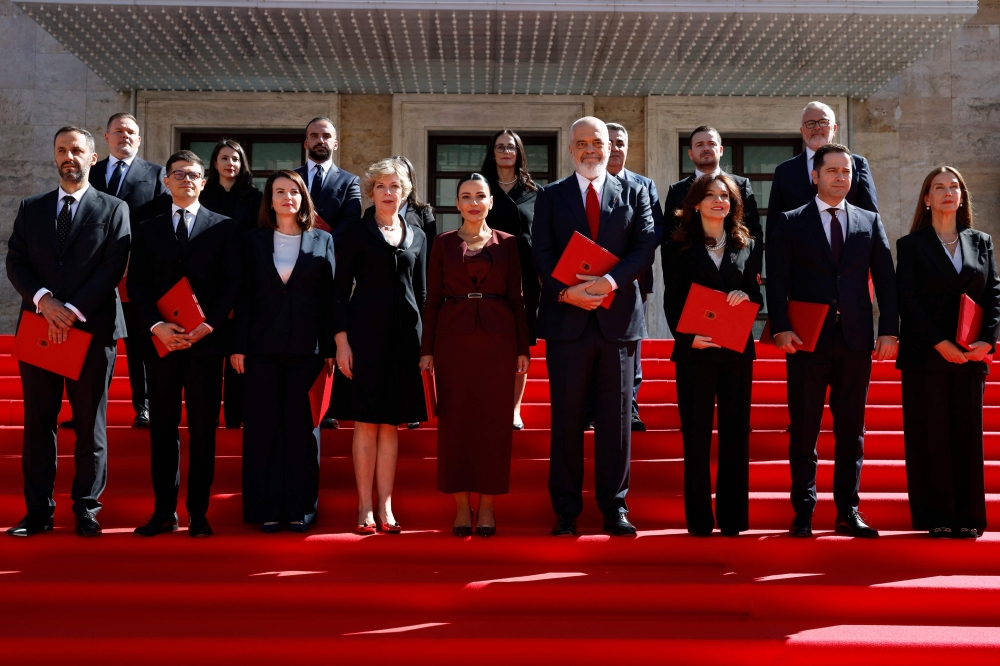
SEPTEMBER 22 — When Albania’s Prime Minister Edi Rama unveiled Diella — a virtual, AI-powered minister of public procurement — he surprised not only his country but the wider world. Diella, which means “sunshine” in Albanian, is entrusted with ensuring that public tenders are transparent, incorruptible, and fully auditable.
Unlike other governments that merely appoint ministers “for AI,” Albania has gone further by creating a minister made of AI.
At the Socialist Party assembly in Tirana, Rama declared that procurement decisions would be removed from the hands of human ministries and handed over to this virtual minister.
Symbolically represented by an avatar in traditional Albanian attire, Diella embodies an ambitious effort to disrupt corruption through technology.
For Asean, the implications are significant. Public procurement remains one of the most corruption-prone sectors across South-east Asia. Whether in the awarding of infrastructure contracts, defense acquisitions, or social projects, tender processes often suffer from a lack of transparency.
Reports from Transparency International and other watchdogs highlight procurement as a persistent weakness undermining trust between citizens and governments. Investors, too, grow wary of opaque systems, preferring environments where rules are clear and contracts are awarded fairly. For a region eager to attract supply chains relocating from China, procurement reform is not just desirable; it is urgent.
Albania’s experiment points to a possible solution. Rama’s assertion that tenders will be “100 percent incorruptible” may sound utopian, yet the underlying logic is clear: when decisions are digitised, tracked, and open to audit, opportunities for corruption diminish. Diella offers three clear advantages. First, legibility: every step in the procurement process is logged, leaving no space for informal deals.
Second, efficiency: AI systems can cut through bureaucratic delays, standardising compliance and speeding up processes. Third, trust: a non-human arbiter reassures citizens and investors that political interference is being curbed.
Importantly, Diella is not conjured from thin air. She is the next step in Albania’s broader digital governance journey, building upon the e-Albania platform that already provides citizens with nearly all government services online.
This demonstrates that digital foundations are crucial before AI oversight can succeed. For Asean, the lesson is that AI procurement systems must grow out of strong e-government platforms rather than stand alone as symbolic experiments.
Could Asean follow Albania’s lead? The answer is yes, though with caveats.
Asean is not a single polity but a collection of diverse states. Singapore’s GeBIZ procurement system is already highly digitised, while other members, such as Myanmar, still rely heavily on opaque paper-based processes. An Asean-wide AI minister is therefore unlikely.
But at the national level, several states are well-positioned to pilot AI-driven procurement oversight. Malaysia, for example, has ambitions to become a regional digital hub.
An AI procurement minister would not only demonstrate commitment to clean governance but also attract confidence from global investors eyeing Malaysia’s semiconductor and high-tech sectors.
Indonesia, meanwhile, preparing to channel billions into its new capital Nusantara, could use AI oversight to ensure credibility and safeguard against scandals that might derail the project.
Beyond national pilots, Asean could also experiment with AI in cross-border procurement.
Regional initiatives such as railway linkages, undersea cables, or joint vaccine purchases are often slowed by disputes and suspicions of favoritism.
A shared AI procurement mechanism, agreed upon by all ten members, could standardize procedures and create a common audit trail.
This would not only improve efficiency but also build trust among states accustomed to competing rather than cooperating.
However, Asean must not fall into the trap of thinking that AI alone can solve entrenched governance problems. Risks abound. Algorithmic bias could creep in if historical procurement data is skewed, leading AI to reproduce past inequities. Cybersecurity vulnerabilities could expose systems managing billions of dollars in tenders to hacking. Political resistance is inevitable, as elites accustomed to controlling procurement may resist ceding patronage power to digital platforms. And accountability concerns persist, because AI cannot be held responsible in the way elected leaders can.
This means Asean must adopt a hybrid approach. AI should be viewed as a tool to assist, not replace, human judgment. It can highlight anomalies, flag risks, and enforce transparency, but final accountability must remain with human decision-makers. In this sense, the most feasible path forward is a partnership: AI as watchdog, humans as guardians of public trust.
Timing is critical. The geopolitical environment presents Asean with a rare window.
With global investors diversifying away from China, South-east Asia stands to benefit — but only if its governance frameworks inspire confidence. Procurement scandals continue to undermine this confidence, inflating costs and scaring off long-term capital.
Albania, though a small Balkan state, has shown how governance innovation can propel a nation into the global conversation. Asean, with far greater resources and ambitions, cannot afford to appear complacent.
Equally, the political symbolism of AI matters. Asean is home to one of the world’s youngest populations, and its youth are increasingly disillusioned by corruption and inefficiency.
An AI procurement system — or the symbolic appointment of a virtual minister — would resonate strongly with younger citizens, sending the message that governments are prepared to embrace technology in the service of clean governance. It would also project Asean as a forward-looking region to external partners, aligning digital modernisation with governance reform.
So, does Asean need an AI minister on public procurement? Perhaps not in the literal sense of a figure not unlike Diella presiding over the region as a whole.
But Asean nations do need AI-driven systems that render procurement incorruptible, efficient, and credible.
Albania has shown that what once seemed like science fiction can become political reality. For Asean, embracing such innovation could transform procurement from a liability into a strength.
The future of governance in South-east Asia may not be only human. It may also be digital, with virtual ministers shining a light where shadows once thrived.
* Phar Kim Beng, PhD, is professor of Asean Studies at the International Islamic University of Malaysia and director of the Institute of International and Asean Studies (IINTAS).
** Luthfy Hamzah is a research fellow at Institute of International and Asean Studies (IINTAS)
*** This is the personal opinion of the writer or publication and does not necessarily represent the views of Malay Mail.