












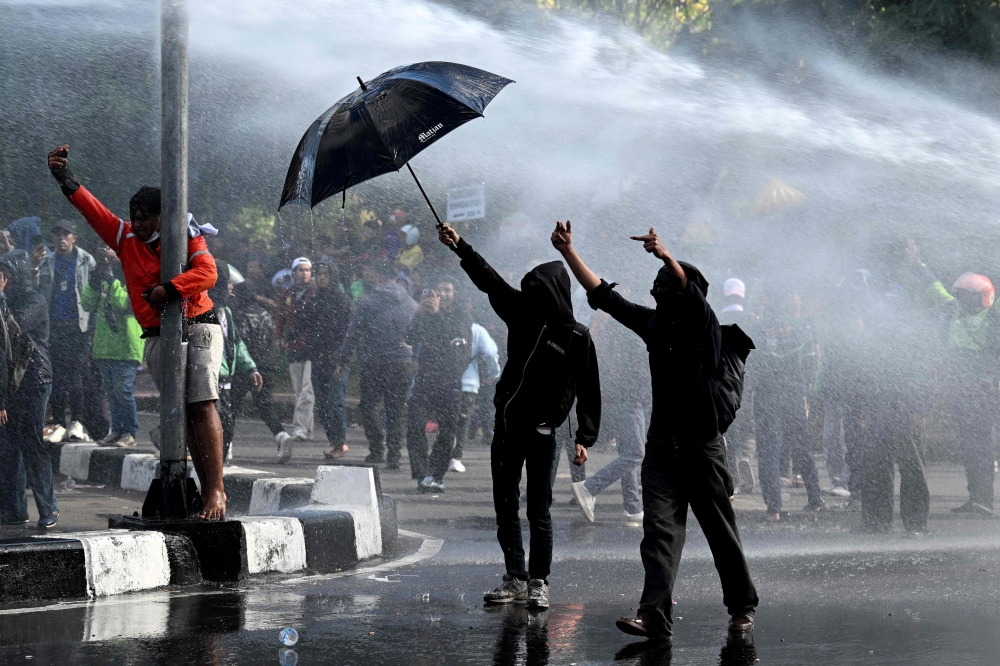
AUGUST 31 — For three consecutive days, Indonesia has been shaken by violent protests that place its police force—the Polri—directly at the brunt of popular anger.
What began as demonstrations against wage stagnation, rising costs, and political disillusionment has evolved into full-blown attacks on the symbols of state order.
The demands have turned explicitly political: protesters want an immediate halt to the Indonesian National Police’s US$8.8 billion budget, claiming it epitomizes a corrupt and unaccountable system.
This crisis cuts to the heart of Indonesia’s democratic promise. For more than a decade, especially under former President Joko Widodo, the police gained enormous prominence, not only in law enforcement but also in political mediation, business affairs, and even governance.
The Polri became a parallel pillar to the civilian bureaucracy, rivaling the military’s long-established role. Yet today, ordinary Indonesians seem to have lost faith in them entirely.
If the police are delegitimized, then Indonesia’s post-Suharto democratic model—often touted as Asean’s best hope for a populous Muslim democracy—has stalled. Worse, it risks collapse.
Regional reverberations
Indonesia’s troubles cannot be contained domestically. Its 280 million people make up more than 40 percent of Asean’s population. Its claim to leadership within the region has long rested on its transition from authoritarianism to democracy after 1998.
But if that model falters, Asean loses its most potent normative export: the idea that Southeast Asia can democratize without civil wars or military coups.
This matters especially for Myanmar, Thailand, and Cambodia—the three Asean members where military prerogatives have repeatedly trumped civilian authority. Each faces its own dilemmas, but all have looked to Indonesia as proof that a large, diverse society can be run by civilians, not generals.
Myanmar: The stalled transition
Myanmar today is a battlefield of legitimacy. The Tatmadaw, which staged the coup in February 2021, insists on its right to rule. It argues, in effect, that the military must always precede society, echoing a Thai-style model where the armed forces remain the final arbiter of politics. Civilian resistance remains strong, but the army refuses compromise.
Indonesian democracy, had it stayed resilient, could have offered an alternative. Jakarta has often chaired Asean mediation on Myanmar, urging dialogue and humanitarian access. But if Indonesia itself is wracked by popular rage against a militarized police apparatus, it forfeits credibility. Why should Myanmar’s generals listen to an Indonesia that cannot manage its own security institutions?
Thailand: Military supremacy in disguise
Thailand is a cautionary tale. Though it holds elections, its military repeatedly intervenes when it feels threatened. Former Prime Minister Thaksin Shinawatra once sought to build a power base rooted in his police background, but he was eventually ousted by the army, which still dictates constitutional arrangements.
The parallel to Indonesia is striking. Just as Thailand’s police could not dislodge entrenched military supremacy, Indonesia’s police may now find themselves equally discredited—though from below, through street revolts, not a coup. In both cases, the military lurks in the background as the “default” guardian of order. That prospect is alarming: if Indonesians lose faith in their police, the army may seek to reassert itself, undermining two decades of reform.
Cambodia: The authoritarian grip
Cambodia demonstrates yet another variation. Prime Minister Hun Manet inherits his father’s authoritarian system, where the military and police are fused instruments of party control. Civil society is weak, elections are managed, and institutions serve the ruling elite.
Indonesia, by contrast, was supposed to be a counter-example: a society where the people, not a family dynasty or a military hierarchy, determined the nation’s path. If Indonesia fails, Cambodia can claim vindication—proving that Southeast Asia is doomed to cycles of coercion and patronage rather than genuine democratization.
Malaysia as the exception
Among Asean’s ten members, Malaysia stands out as a functional democracy where neither the military nor the police have interfered directly in politics since independence in 1957.
The Royal Malaysian Police, numbering 170,000, have remained largely professional. The Malaysian Armed Forces, at around 115,000 strong, have never attempted a coup.
Prime Minister Anwar Ibrahim therefore governs within a system where electoral outcomes matter and where civilian supremacy over the security forces is institutionalized. For Anwar, Indonesia’s crisis offers both relief and regret: relief that Malaysia has avoided such turmoil, regret that his closest Asean partner cannot uphold democratic stability.
The dream of a civilian Asean
Asean has always spoken of building a “community.” Yet what kind of community can it be if military juntas, coup-threatened governments, and politicized police dominate? The Indonesian crisis reveals that Southeast Asia’s so-called democratic wave has shallow roots.
The Asean Charter commits members to “strengthen democracy, enhance good governance and the rule of law, and promote and protect human rights and fundamental freedoms.”
But the region’s lived reality contradicts these words. Myanmar is ruled by generals, Thailand by constitutions written under army tutelage, Cambodia by a party-military nexus, and now Indonesia by a police-state apparatus under siege.
Asean thus risks becoming a club of governments that are civilian in name but coercive in function. The dream of a genuine civilian Asean Community remains elusive.
Strategic implications
The consequences extend beyond democratic ideals. Investors watch governance closely. If Indonesia—the supposed anchor of Asean—descends into chaos, global capital will hesitate. Security cooperation within Asean, already strained by mistrust, will fracture further.
And the notion of “Asean Centrality” in wider Asian diplomacy will ring hollow.
The protests also signal to Washington, Beijing, Tokyo, and Brussels that Southeast Asia’s most important country may no longer be stable. External powers will hedge their bets, reinforcing military allies elsewhere rather than trusting Asean’s consensus diplomacy.
Worse still, authoritarian models may gain traction. China can argue that order, not democracy, is what counts. Myanmar’s generals will feel emboldened. Thailand’s army will tighten its grip. Cambodia’s ruling party will shrug off criticism.
The path forward
What can be done? Indonesia’s leaders must first recognize that policing without legitimacy is untenable.
A bloated budget for security forces, amid mass unemployment and youth disillusionment, is a recipe for revolt. Civilian supremacy requires accountability, transparency, and a return to the democratic spirit of 1998.
Asean, too, must act. It cannot lecture Myanmar on restoring democracy if it ignores Indonesia’s unrest. Nor can it claim to champion “people-oriented” regionalism if the largest people’s movement in its midst is met with silence. A Troika of ASEAN states—Malaysia, the Philippines, and perhaps Vietnam—could urge Jakarta to reform the police and restore trust.
Conclusion
Indonesia today stands at a crossroads. If its police retreat, democracy may survive. If its military steps in, two decades of progress could evaporate. For Asean, the lesson is sobering: without genuine civilian rule, the community it seeks to build remains a dream deferred.
Malaysia’s quiet example shows it is possible. But unless Indonesia, Myanmar, Thailand, and Cambodia change course, Asean will remain haunted by the specter of security forces overshadowing the will of the people.
* Phar Kim Beng, PhD is the Professor of Asean Studies at International Islamic University of Malaysia and Director of Institute of Internationalisation and Asean Studies (IINTAS).
** This is the personal opinion of the writer or publication and does not necessarily represent the views of Malay Mail.