


Oct 17 — In the fight against arbitrary provisions in the Trans-Pacific Partnership Agreement (TPPA), Malaysian civil society is increasingly nervous. At this point, it certainly seems that from the hurried statements coming out of Washington D.C. and the (sometimes) matching commentary from Prime Minister Datuk Seri Najib Razak, that negotiators are trying their very best to get the negotiations to an end point by the end of the year.
 At BANTAH, we are terrified of TRIPS-plus provisions which include repatenting when there’s a new use or form of a medicine, patent extensions, and data exclusivity that could prevent medicines from being registered and therefore used by Malaysian patients. What we know is that the discussions on pharmaceuticals at the intersessional negotiation meetings currently ongoing (there was an IP intersessional in Mexico in September and it is rumoured another 5 day intersessional in Japan) are moving very slowly. This may be due to the fact that the negotiators are waiting for the United States to table text on pharmaceuticals, but because the texts and negotiations are secret, we have no way of verifying this.
What we can verify, however, is that the TRIPS-plus provisions in the TPPA will raise costs of medicines. In an article titled ‘Paying Til It Hurts’ in the New York Times on Oct 13, 2013, we learnt of the high prices of medicines in the United States, and how these prices are causing ‘widespread anguish’. The author also said: ‘The repatenting of older drugs like some birth control pills, insulin and colchicine, the primary treatment for gout, has rendered medicines that once cost pennies many times more expensive.’
Malaysia already pays some of the most expensive medicines prices in the region. A 2013 study by Andrew Hill et al. presented at the International AIDS Society Conference for HIV Pathogenesis, Prevention and Treatment, for example, shows that Malaysia pays 10 times more for HIV drug lopinavir-ritonavir compared to countries in the same per capita national income category. The following table shows current prices for some medicine in Malaysia:
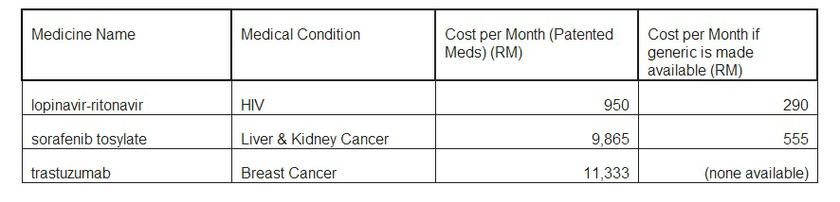 TRIPS+ provisions will keep these prices up for longer and delay entry of the more affordable generics.
We also know from a 2012 article by Abbott in the Journal of Generic Medicines that Jordan, as a result of similar provisions in the Jordan-US FTA, is paying at extra US$18 million (RM56.9 million) per year due to the delay in more affordable generic versions of branded medicines.
So why are we so keen in emulating the American system? Have we just not looked at the economic and human impact? Have we reached that point where we are so keen on appeasing the US government and Big Pharmaceutical companies so that Malaysian cancer, HIV, asthma patients take second place?
What is this really about?
(Don’t answer that. We’d go on forever talking about corporate greed and geopolitics and naval bases etcetera, which we could do another day)
To give our negotiators some credit, they have informed us that they are working very hard to preserve the rights of Malaysians to access affordable generics. But because the negotiations are secret, and the questionnaires provided by agencies doing cost-benefit analyses are drafted in an unfocused, simplistic style, it shouldn’t be so surprising that we remain cautious and sceptical.
We reiterate that political leaders MUST NOT rush the Trans-Pacific to appease American leaders; and that open, intelligent, scientific, and transparent consultation can only benefit them.
*Fifa Rahman is Policy Manager at Malaysian AIDS Council. She has a Master of Health Law and works on improving policy surrounding HIV and people living with HIV. The Malaysian AIDS Council is part of the BANTAH TPPA Coalition.
** This is the personal opinion of the writer or publication and does not necessarily represent the views of The Malay Mail Online.


