














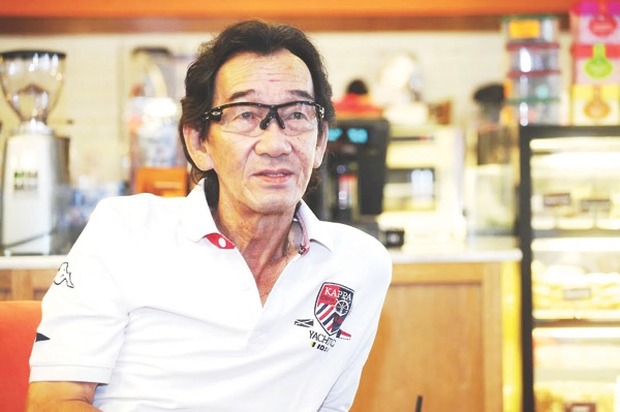


PETALING JAYA, Feb 22 — The late Chow Chee Keong was so good he was courted by a team from the country where football was akin to religion.
His name was already legendary circa 1970s when Hong Kong treated him like royalty.
He earned more than European imports and was once brought to a match by helicopter.
But Chee Keong, from a different time and age, could have been up there in the bright lights cavorting with the Brazilian superstars.
As legend has it, the Malaysian goalie defied the great Pele during a match with stunning saves that launched him into hyperspace of an unimaginable career in Latin America, land of the football gods.
Chee Keong, who died aged 69 at University Malaya Medical Centre yesterday morning — after a heart bypass and bout of bladder cancer — was offered to play for Cruzeiro FC.
The Brazilian club was mesmerised while on a tour of Hong Kong. Chee Keong rejected the offer.
They came again some years later but with the caveat of taking up Brazilian citizenship.
Former AFC secretary-general Datuk Peter Velappan called Chee Keong a simple and humble personality despite epic achievements.
“He’s a true inspiration, we can all be proud of Chee Keong,” added Velappan.
Rightly so, the '70s was not called the golden era of Malaysian football for nothing, with Chee Keong’s contemporaries like Soh Chin Aun and Santokh Singh playing in the citadel of national and regional fame.
Hong Kong fans were in mourning too — South China Morning Post embraced him as one of the isle’s favourite sons.
Chee Keong was just 15 when he became a national player.
And soon after, he lived an illustrious career in Hong Kong where the nickname of “Asian Steel Gate” stuck on.
Another was “Crazy Sword” coined during a time of Shaw Brothers’ Chinese sword-duelling movies.
Some of Chee Keong’s records will stay untouched forever.
In 1963, he represented Malaysia Under-20 as a 13-year-old. Two years later, he became the youngest ever Malaysian international.
He is also the first Malaysian to play in England (Bedford FC in 1967) and turn professional when he joined Jardine in Hong Kong for a record HK$2,500 (RM1,250) salary in 1970.
His move to Tung Sing four years later earned him his biggest pay cheque — HK$7,000 (RM3,500).
From 1966 to 1970, he was voted best Asian goalkeeper five straight times.
Fellow legend and former national teammate Bakri Ibni said among big names like R. Arumugam, Wong Kam Fook, Lim Fung Kee and Rashid Hassan, Chee Keong was the greatest.
“He had great determination and fighting spirit I didn’t find in others,” said Bakri.
“He always carried the hand-gripper, even to sleep. He has his own initiative after training, a rare quality nowadays.”
Kelantan goalkeeper Khairul Fahmi Che Mat called Chee Keong one of his idols.
“I adored him as he was successful at a young age. My regret is I never met him. He’s an inspiration to all goalkeepers,” he said.
National Under-23 coach Datuk Ong Kim Swee simply said: “Young players should follow his footsteps.”
Chee Keong leaves behind wife Christina Kwok and son Adrian Chow.