

SINGAPORE, Dec 17 — Taxi driver Anthony Oh has seen a 55 per cent drop in his income, from about S$2,700 in an average month last year to about S$1,200 in recent months.
The 61-year-old takes the late shift, plying the roads from 4pm to 1am. Where there used to be plenty of customers flagging cabs after a night out, he says that since the Covid-19 pandemic, there is hardly a soul in the downtown area looking for a cab after 10pm.
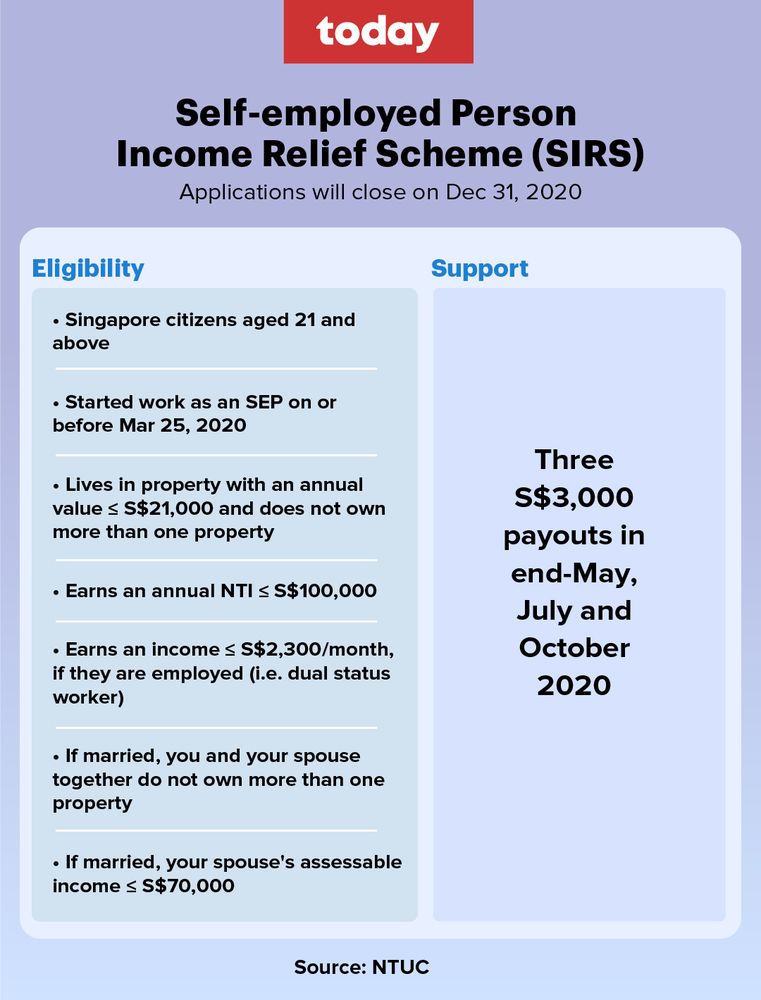
Over the course of the last nine months, he has been buoyed by the Self-Employed Persons Income Relief Scheme (Sirs), which has been providing S$1,000 a month to eligible self-employed persons whose livelihoods have been affected by the Covid-19 situation.
But this scheme will cease on Dec 31. Instead, Oh will have to depend on the Covid-19 Driver Relief Fund that was announced by the Land Transport Authority (LTA) yesterday, which will provide relief to taxi and private hire car drivers.
Taxi drivers like Oh will receive S$600 in monthly payouts from January to March, and S$450 from April to June, to help defray the cost of vehicle rentals.
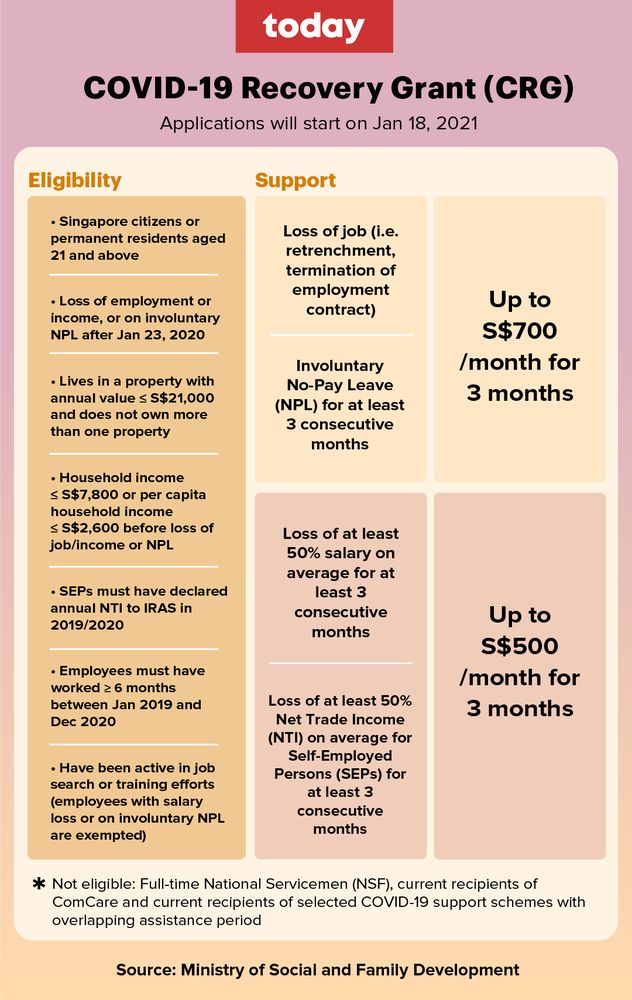
In a separate statement yesterday, the Ministry of Social and Family Development (MSF) said it would launch a Covid-19 Recovery Grant on Jan 18 next year, to help lower- to middle-income workers as well as self-employed individuals who have been financially hit by the coronavirus outbreak.
Those eligible for the grant can receive up to S$700 a month or S$500 a month, depending on their circumstances.
However, should Oh take up the Covid-19 Driver Relief Fund, he will not be eligible for the recovery grant, according to LTA. This means that as a whole, once his Sirs payouts end, he will be receiving less relief.
To make up for this, he will also be signing up with a private-hire platform that his taxi company has partnered so that he can get more jobs.
“But if I can get both (grants), it would really help.”
TODAY spoke to 10 other taxi and private-hire drivers, freelancers and self-employed persons to find out how these new grants will help them.
While some said that they are grateful for any help that they can get from the authorities, others like Oh bemoaned the end of Sirs.
Not enough for some, welcome relief for others
Private-hire driver Henry Ang raised similar concerns to Oh. The 56-year-old has suffered a 60 per cent fall in income compared to last year, and said that vehicle rental costs drastically eat into his income.
He added that the S$600 grant he will receive will not nearly cover the S$2,000 a month that he pays for rental, but “it’s better than nothing”, he said.
Neetasha Zam Zam, a freelance theatre practitioner, said that the new Covid-19 Recovery Grant could not have come at a better time.
The 25-year-old failed to qualify for Sirs and in recent months has been earning a fluctuating income in the hundreds of dollars, depending on the number of performance gigs she has been able to get. This is about a 70 per cent drop in her income compared to before the pandemic, when she would earn upwards of S$3,000 a month.
“It can help me by paying my bills and also for other things (like) household groceries,” said Neetasha, who helps support her unemployed parents.
Some freelancers see business improve
TODAY also spoke to some freelancers who have been seeing their incomes pick up as Singapore prepares for Phase Three of its economic reopening on Dec 28. They said, however, that they still face an uncertain future, and hope that they can receive some help and qualify for the grants.
For badminton coach Wong Shoon Keat, 63, work has picked up, with schools allowing training sessions to resume.
“I had no income at all during the Covid-19 period,” he said.
“I could not coach at all.”
Although he can coach again, the frequency of training sessions has decreased. For example, some schools have reduced training sessions from three to one.
Wong now draws "slightly more than half" of his pre-Covid-19 income.
While he said that he would be "okay" if he does not qualify for the Covid-19 Recovery Grant, he is still worried about his financial situation and will look for more work opportunities, such as private coaching sessions.
A contractor in the renovation industry who wanted to be known only as Mdm Tan is also concerned about her financial situation.
“Much fewer projects,” said the 53-year-old, when asked about her workload. “Just minor, small jobs.”
She does not believe that she is eligible for the Covid-19 Recovery Grant as her household monthly income per capita before the pandemic exceeds the cap of S$2,600.
However, she is not earning enough to cover her company expenses. To cut costs, she intends to either shift her office to a smaller, cheaper location or operate with no office at all.
On the other hand, freelance interior designer and basketball coach Liew Wei Cheng is “not really worried” even though he will get his final Sirs payout this month.
Previously, he would conduct basketball training sessions over Zoom, but school teams have resumed in-person practice.
Since he earns S$3,000 a month as a coach, he does not think he will qualify for the Covid-19 Recovery Grant.
Ang, the private-hire driver, said that he does not expect the authorities to continue providing him with grants as it is not sustainable.
Instead, he believes that the Government should allow more activities such as larger scale weddings and church services, as well as permitting nightlife venues to progressively open up, as these translate to more rides for drivers.
Taxi drivers want to receive relief directly
Some taxi drivers whom TODAY spoke to also questioned how the Covid-19 Driver Relief Fund was being disbursed. They believe the relief fund is being disbursed to the taxi operators, and they are not sure about how much will be passed on to them.
ComfortDelGro taxi driver Kirsty Foo, 60, said that the rental rates at the taxi firm can change from month to month, and she does not know how the funding affects the rates.
Agreeing, 38-year-old Prime Taxi driver Andy Guan said: “If you want to help the taxi drivers, they should pay (the grant) directly to us, because we are the ones who are going to pay the rental companies.”
TODAY has sought comment on the issue from the LTA, but understands that the authority disburses the grant to taxi operators, who will then pass on the relief to drivers in the form of rental rebates.
TODAY understands private-hire drivers will receive the grants directly.
In response to queries from TODAY, ComfortDelGro Corporation group chief corporate communications officer Tammy Tan said that taxi hirers at the firm are currently getting a rental waiver of 20 per cent or at least S$20 a day.
“With the newly announced Covid-19 Driver Relief Fund, the company will increase the rental waiver by another S$10 a day, thereby fully passing on the savings to our hirers,” she added.
TODAY has also sought comment from taxi operators Trans-Cab and Prime Taxi. — TODAY