


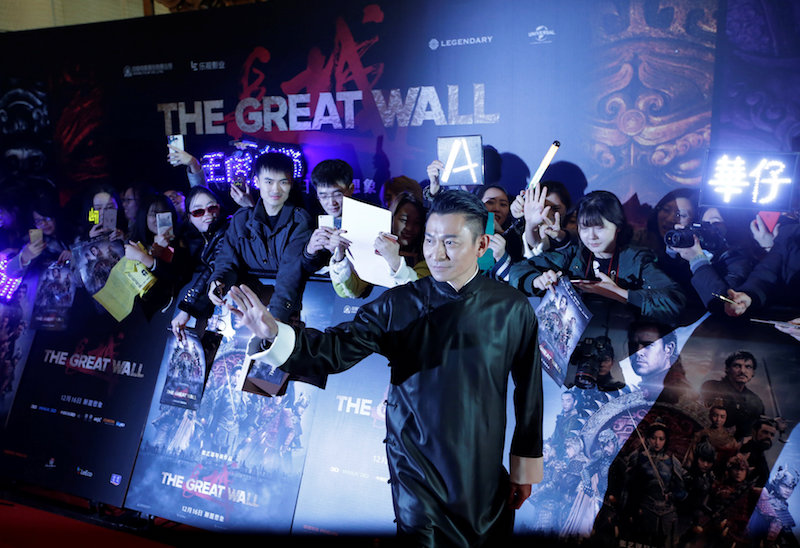
BEIJING, Dec 28 — What if the Great Wall was built not to keep out northern invaders but to defend against mythical monsters?
What began as a passing thought in the mind of Thomas Tull, chief executive of Legendary Entertainment, has now reached the big screen here. Legendary’s The Great Wall, directed by Zhang Yimou and starring Matt Damon, was released in China last Friday. With a budget of more than US$150 million, the fantastical film about fighting monsters on the Great Wall is the largest-ever China-Hollywood coproduction and is being seen as a test of whether event films made in China can become hits in the West. (It is scheduled to hit cinemas in North America on February 17.)
Set in ancient China, the film centres on William Garin (Damon), a foreign mercenary who is taken captive by a secret army of elite fighters on the Great Wall called the Nameless Order. Garin and his sidekick (played by Pedro Pascal) soon learn that the wall was built to protect against mythical flesh-eating monsters called the taotie, who rise up every 60 years to devour humanity.
Reviews of the movie in China have so far been mixed. On Douban, a popular book and movie review website, the movie has an average rating of 5.4 stars out of 10 based on more than 82,000 ratings. Many of the reviewers — both professional and amateur — have expressed disappointment with Zhang, lamenting his turn from art house hits like Raise the Red Lantern to blatantly commercial, popcorn movies.
One amateur critic, Xiedu Film, set off a dust-up when he wrote on the Sina Weibo microblog, “Zhang Yimou has died!” Le Vision Pictures, one of the production companies backing the movie, on Friday demanded that the critic apologise and delete the comment, which the company called a serious violation of Zhang’s right to reputation. “It’s akin to libel and cursing,” the company wrote on Sina Weibo. Xiedu Film explained in a follow-up message: “I just feel that Zhang’s art career is almost coming to an end.”
Still, other reviewers applauded the film for its dazzling effects and expressed excitement about the film’s potential to export Chinese culture to the rest of the world.
We rounded up reactions from Chinese filmgoers and critics writing for Chinese and Western outlets. Here are excerpts (including in some cases translated passages) from reviews from the upbeat to the negative.
Positive, to a point
“I’ve seen a lot of reviews that say The Great Wall has a thin plot. This is indeed a shortcoming. But if the movie turns out to be an international box office success, then [the plot] will also be seen as having contributed to that. For foreigners unfamiliar with Chinese stories, a complicated story would have made them confused and disoriented.” — Raymond Zhou, movie critic, in Tencent’s Dajia Column
“Despite his best efforts [to suppress his signature style], there are still traces of Zhang Yimou in the movie. The scenes with the synchronised drummers recall the opening ceremonies of the Olympics, and the dense forest of arrows and the spear movements of the bungee-jumping female fighters are like those seen in Peking Opera.
There’s no way to erase this. And, even though he did not use very much red, there were still hints everywhere of his passion for vivid colours.” — Yang Shiyang, movie critic, in Tencent’s Dajia Column
Thumbs down
“Most big Hollywood films are very simple, direct and universal in the system of values they embody. Freedom, honour, fairness, justice, love and the spirit of dying for a just cause — these are the most common values that they convey. But in The Great Wall, why are these soldiers fighting, dying and sacrificing their bodies? What spirit did they represent that they could persuade Garin, the ‘foreign bandit’ to stay behind? None of this is fully explained in the movie.” — Yin Hong, film professor at Tsinghua University, on the Sina Weibo microblog
The similarity of the premise to past films “wouldn’t be such a problem if Zhang or his scribes had devoted even a smidgen of time to giving the respective commanders identities or back stories. Instead, though they are played by recognised actors with proven ability and charisma, these characters are just glorified cameos, stomping around in heavy armour looking angry or worried or both.” — Maggie Lee, Variety
“Beyond the casting and the ceaseless onslaught of diverse special effects, Zhang and his Hollywood screenwriters have delivered nothing more than a formulaic monster movie — albeit one transposed to a historically undefined China where generals dressed like terra-cotta warriors already have mastered anaesthetics, air travel and American-accented English.” — Clarence Tsui, Hollywood Reporter
“Every predictable turn comes to pass, and most major developments loom so large it’s a wonder the elite fighters don’t spot them. Aside from the nods to Chinese culture, there is little to differentiate between this and any other Hollywood action adventure.” — Helen Roxburgh, The Guardian
“When all is said and done, it’s just 94 minutes of content which forces the plot to move too quickly. We don’t see nearly enough about the deployment of the army. There is not enough context about the roles that the villains and the supporting figures play. Not to mention the female soldiers all have very fair and clear skin. I don’t think people who fight in real wars can have skin that tender. And that guy, what’s his name, Junkai [who plays the teenage emperor], he is the epitome of what we call ‘good looking until you open your mouth.'” — Miaoke Zhongguo, online user, on Douban
A pan in poem form
I am Zhang Yimou
I love Chinese style
I’ve had enough shooting art films
And I’ve won enough awards
It’s time to make some money
And revitalise the Chinese film industry
When I first got this
The Great Wall screenplay
The boss said I couldn’t change the main plot
So I figured out every possible way
To turn this foreign story
Into one with clear Chinese style
100,000 soldiers, five elite forces
Grand gold and red colour, carved beams and painted rafters
The wind is blowing and the drum beating, and Qin opera is being sung,
I don’t care, I just want my Chinese style.
— Max Horowits, user, on Zhihu.com (the Chinese equivalent of Quora) — The New York Times


