OCTOBER 15 — Even until his death at 84, Kassim Ahmad remained a complex, multi-faceted character.
Some, although perhaps too few, would remember him as a leftist who made his name with the Malayan People’s Party and later its scientific socialist reincarnation, before setting his mind on nationalism and joining Umno.
Fewer still will recognise him as a poet and literary master with his critiques on ancient Malay texts. Of the latter, the most known is his reconfiguration of the Hang Tuah versus Hang Jebat dichotomy. He even taught at the University of London’s School of Oriental and African Studies.
Some consider him a philosopher, balancing existentialism and the divine.
But most — far too many — knew Pak Kassim from the heaping mount of slander and outright lies that were thrown against him, for his courage to simply put his intellect to use when it came to his faith.
I knew Pak Kassim as a frail, old man who would bravely appear in court in a defiant gesture to challenge and subsequently defend himself against the unlawful and inhumane prosecution against him by the Federal Territories Islamic authorities, or Jawi.
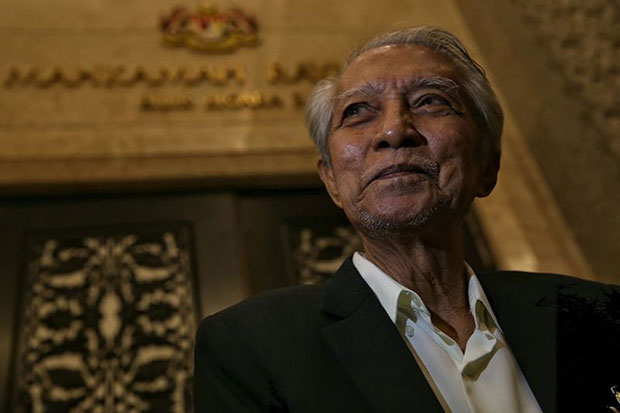
The only time I crossed paths with him was in and outside courtrooms, where he would appear in a wheelchair with his trusty cane propped on his lap.
It was in 2014 that Jawi raided his home in Kulim, Kedah, before dragging him to Putrajaya just to charge him for allegedly insulting Islam and defying religious authorities in a speech he made prior to a Dr Mahathir Mohamad event — a return to the spotlight after years of relative solitude.
Kassim fought twice in the Court of Appeal in 2015, and later Federal Court in 2016 to challenge the transgression — he won both of them: Jawi’s prosecution was found invalid and illegal.
Yet still, Shariah prosecutors would not drop the charges, despite the findings. It was only in August this year that he was acquitted. The octogenarian could only find relief after three long years even when he won.
His family believes the relentless action by the prosecutors had driven him to his death. They will now seek compensation from Jawi for this.
Pak Kassim has always been a thorn in the side of some religionists who are boxed inside their own minds.
In 1960, his poem Sidang Ruh (A Session of Souls) enraged some for its final line “dan Tuhan sudah mati” (and God is dead). A thorough reading would show Kassim’s concern with the loss of humanity and godliness among society. But for literalists, it was just a mockery of their belief.
In 1984, he shook the country with perhaps his most famous masterpiece on the chronicles of Prophet Muhammad: Hadis: Satu Penilaian Semula (Hadith: A Re-evaluation). For that, he was called anti-hadith, and declared a heretic and apostate.
Nothing could be further from the truth. A reading of the book would irk even Christians and Jews -- Kassim had mocked their beliefs, and he was clear in his disdain for atheists and secularists for their faithlessness.
If anything, the book would only strengthen the faith of a rationalist Muslim. It not only expounded on the greatness and perfectness of Quran, but simultaneously erased lingering doubts over the incongruity of the religion, reconciling faith and reality.
The book was begging to be debated about. So much so that Kassim had included a clear rebuttal and criticism of himself and his thesis, by Cairo University professor and theologian Hassan Hanafi, as the foreword to the English translation.
Kassim also anticipated backlash from the traditionalists, showing how predictable they were.
“The traditionalists are a different breed. Open debate is not part of their tradition. In fact, they came into being in Muslim society by killing open debate.
“Authoritarianism is their culture. Thus, slander, threats and falsehood will be their methods,” he wrote, comparing this to a fair debate with secularists.
It was not as if Kassim’s argument was unassailable. For all his insistence of approaching the matter in a scientific way, he had based his premise on a logical fallacy.
The book had not abandoned Islam. It embraces it, but through a rational mind instead of blind faith.
If only the book was dissected and reviewed meticulously by Muslims here, Kassim may have been a driving force in reforming Islam, either a spark or a guiding light in an international movement. Alas, banning books is a much easier than intellectual endeavour.
The last few weeks have seen books banned for containing facts deemed “confusing” and “analysed with logic.” A renowned author was arrested just as he was flying home. A sermon continued the attack against “liberalism.” A laywoman who committed a medical crime was defended simply because she is Muslim.
On Friday, a lecture on numismatics during the early days of Islam had to be cancelled for fears of the presenter’s safety due to complaints. Even when a disclaimer was issued that it had nothing to do with religion.
Muslims in this country are in danger of going down the path of anti-intellectualism, seeing their religion through a narrow constraint that would restrict them from reaching greatness. Pak Kassim called it decades ago, and he would likely have wanted to be proven wrong.
“The Muslims must re-possess critical consciousness and discard prejudice and group fanaticism. We must avoid throwing slanderous accusations at what we may not like at first.
“God Himself has taught us to verify things before we accept or reject them,” he wrote in his book.
It is perhaps inaccurate to say that Pak Kassim was ahead of his time. It can be argued that his analytical questioning was part of an existing trait in our Malay society, and it continues to thrive even now, resisting pressure of all kinds.
Now Pak Kassim is gone. He left us his books, his thoughts, but first and foremost: a hunger to think. Rest easy now, Pak Kassim, we shall remember you. And continue exercising our freedom of conscience.