


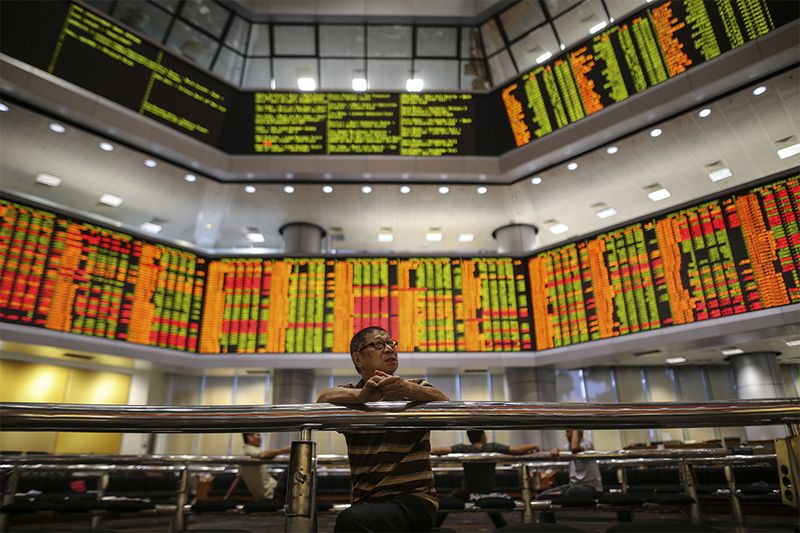
KUALA LUMPUR, May 15 — On the second day of post-election trading, the benchmark FTSE Bursa Malaysia KLCI (FBM KLCI) ended 2.2 points lower to close at 1848.20 today.
Trading activities remained high, albeit not as high as yesterday’s all-time record highs, with volume and value traded at 4.3 billion shares and RM4.4 billion.
The benchmark index was range bound between 1851-1857 points, before profit taking during the end of trading which brought the index to a lower close at 1848.20 points.
Two counters linked to the defeated Barisan Nasional, MYEG Berhad and George Kent Berhad, hit limit down after their share prices dove by 30 per cent.
MIDF Research head Redza Rahman said the top volumes were mostly dominated by big cap stocks led by YTL Power International Bhd, CIMB Group Holdings Bhd and Malayan Banking Bhd.
“Our concerns over YTL’s ability to meet its order book target rein in on the stock as cimb recovers from the decline yesterday,” he told Malay Mail.
Bank Islam Malaysia Bhd chief economist Dr Mohd Afzanizam Abdul Rashid said at this juncture, local factors would be the main driving force as the financial community are awaiting for further details on the economic policy front.
“From today’s session between Council of Eminents Persons (COE) and analysts, fund managers and economists at Sasana Kijang Bank Negara Malaysia, it was clear that the new government is focusing on improving the disposable income among the rakyat which was severely affected by the rise in cost of living. “
The COE explains that the reprioritisation of mega projects would result in massive savings on government finances, said Afzanizam.
“Such measures have been done in the past during 1990’s when there were several mega projects in the pipeline which were deferred.
“This, in turn, would offset from the lost in goods and services tax (GST) revenue. In addition, meetings with the international Credit Ratings Agencies (CRAs) has been held in order to explain the implementation of new government policies that are deemed credit sensitive such as GST and subsidies.”
Aside from that, Afzanizam said spending efficiencies as well as tackling corrupt practices and curbing wastages are the important initiatives that would help improve government finances.
He added the COE believes that with such measures, it will instill confidence among the investors and would drive ringgit to a stronger level.
“We believe the measures would improve consumer sentiment which would translate into further spending by the households.”
Meanwhile, Sunway University Business School’s Professor of Economics Prof Yeah Kim Leng said today’s marginally lower closing mirrored most of Asian stock markets is a good sign that investors have quickly discounted the risk posed by the change in government.
“Despite the shock win and momentous event, the dreaded sell-down did not happen and this is indicative of the smooth transition in power, market maturity as well as confidence in the new government,” said Yeah.


