


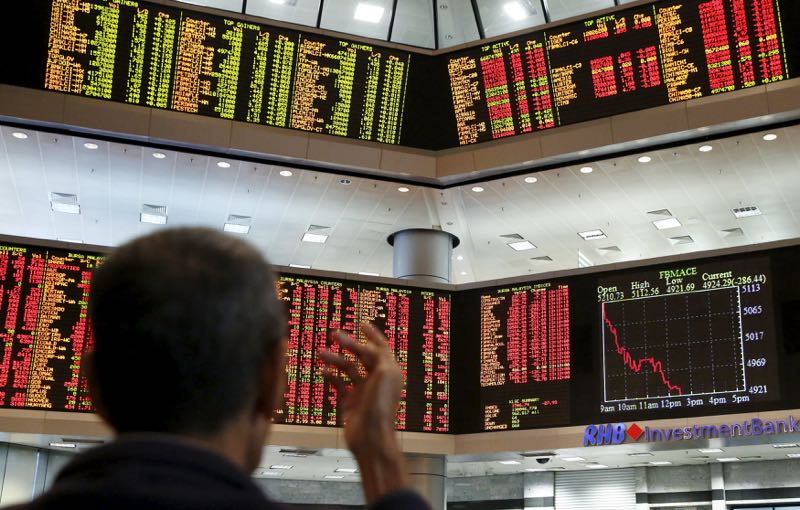
KUALA LUMPUR, Dec 31 — Bursa Malaysia is likely to see cautious trading in 2016, a spillover of domestic and global headwinds this year, said Inter-Pacific Research Sdn Bhd’s Head of Research, Pong Teng Siew.
Pong said a recovery path, however, is set in the horizon in anticipation of a stable economy moving forward.
He said the global stock markets will be entering a tighter monetary cycle as the US Federal Reserve (Fed) gradually increases interest rates in line with the stabilised economy.
“The ability of the US to continue supply liquidity to the rest of the world is somewhat less than recent years. That is why we feel tighter liquidity is in place.
“Also, other development globally is the slowdown of growth in China (that would affect the market),” he told Bernama.
The local market barometre, FBM KLCI, has been battered by formidable macro headwinds throughout 2015 — the sliding crude oil prices, global stock volatility, in particular China, capital outflows in the run-up to the US Fed interest rates lift-off as well as weak earnings momentum.
The FBM KLCI fell 12 per cent from its high of 1,893 points in 2014 to a current average of 1,664, hit by threats to global growth in 2015 and overhang surrounding the Fed rate increase.
It was reported that foreign funds had pulled out RM16.4 billion from Malaysia during the year in comparison to the RM6.9 billion outflows in 2014.
On December 16, the Fed raised the range of its benchmark interest rate by a quarter of a percentage point to between 0.25 per cent and 0.5 per cent, a move hinting that the world’s biggest economy had largely overcome the wounds of the 2007-2009 financial crisis.
The US economy grew by two per cent in the third quarter of 2015 after running well below the historical norm for more than six years into recovery.
It expanded by 2.2 per cent in the first nine months of the year and is projected to grow at a similar pace in the fourth quarter.
Meanwhile, the benchmark Brent crude oil prices dropped below US$40 (US$1 = RM4.29) per barrel towards year-end, the lowest level in more than six years, as negative sentiment surrounding the oversupply situation intensified, and this was compounded by a stronger US dollar.
These factors were visible in Malaysian economic growth and the ringgit had been affected more by these events than has been the case in other Asian countries.
The ringgit has been the most hit among Asian currencies, reaching a record low of 4.46 versus the US dollar in September 2015 and similarly, the Malaysian stock exchange too has been relatively hard hit compared to other Asian markets.
“Export-oriented companies enjoyed the ability to export with weaker ringgit. The ringgit has now stabilised and this factor is no longer present,” said Pong.
He expects the ringgit to trade between 4.20 and 4.40 against the US dollar next year.
“But that doesn’t mean that the ringgit will not weaken again. The ability of the ringgit’s weakness to boost the profits of export-oriented companies will gradually ease and disappear,” he said.
Meanwhile, to reduce further risk of capital outflows, the government had revived the defunct equity fund, ValueCap, to help boost underperforming shares and stabilise the financial market in September 2015.
For the purpose, RM20 billion will be injected into the fund, which was set up in 2002 to provide a lifeline to the capital market.
Sharing his view, Senior Economist for Netherlands-based ABN AMRO Bank NV, Arjen van Dijkhuizen, said the drop in commodity prices has put additional strains on public finances.
He expects Malaysia’s budget deficit to rise above the three per cent target to about 3.7 per cent to the gross domestic product (GDP) in 2015.
van Dijkhuizen said the public debt ratio was also likely to increase to an estimated 53.5 per cent of the GDP this year.
Nevertheless, van Dijkhuizen said, oil prices were expected to recover in 2016 within an environment where oil prices would remain low longer, as global demand of the commodity grew moderately, with a slowdown in production growth and the closure of speculative short positions.
“A year ago, our 2016 growth forecast for Malaysia was 5.5 per cent. For this year, we have lowered this to 4.5 per cent while for 2017, we expect growth to reach five per cent again,” he said.
Meanwhile, Affin Hwang Investment Bank Bhd said global growth looked benign in 2016 while domestic activities seemed stable with inflation to be steady at two-three per cent.
“Hence, the environment seems conducive for firms to recoup some of the values from households by raising selling prices, though partly tempered by a moderate rise in the minimum wage level.
If this happens, it will be good for company earnings and the FBM KLCI next year, the research house said.
“As we approach 2016, the improvement of macro parametres is not a prerequisite. We are instead looking for stability in the current reality. These include global growth, a Fed rate increase and steady Brent and crude palm oil prices,” it said in a research note.
Affin Hwang Investment Bank targets FBM KLCI to end 2016 at 1,793 points based on the assumption of a recovery in earnings per share (EPS) next year.
“We envisage fully-diluted EPS to decline by 2.7 per cent this year but to rebound by 7.4 per cent next year,” it said.
On the last day of trading for 2015, the FBM KLCI fell 68.74 points to 1,692.51 from 1,761.25 in 2014.
The FBM KLCI reached its historic high of 1,862.80 points in April.
The local bourse ended the year with 13 initial public offerings (IPOs) compared to 15 the previous year.— Bernama


