


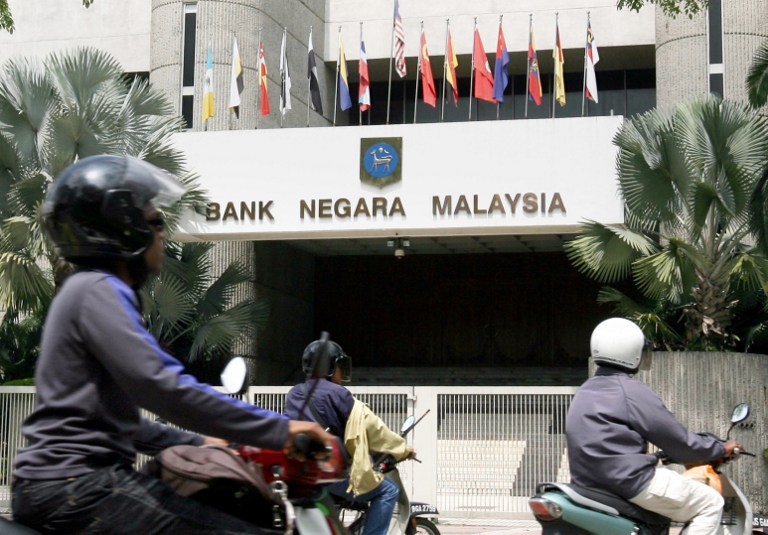


KUALA LUMPUR, Jan 26 — Malaysia's central bank will likely stand pat on interest rates at its policy meeting on Wednesday due to mounting economic risks from sliding oil prices and a fragile ringgit.
Economists in a Reuters poll were unanimous in their forecasts for Bank Negara to keep its overnight policy rate unchanged at 3.25 per cent, after it raised the rate by 25 basis points in July 2014.
Southeast Asia's third-largest economy grew a robust 6.3 per cent in the first half of 2014, before global oil prices tumbled in the last quarter of the year. The country relies on energy sales to fund its debts.
The unexpected oil price slump and the ringgit's poor performance led the government to revise its growth forecast to between 4.5 and 5.5 per cent for 2015, from five to six per cent.
Analysts said interest rates would likely be kept steady until the end of 2015 unless the economy performs better than forecast in the second half of the year.
Prime Minister Datuk Seri Najib Razak reduced the country's budget and widened its fiscal deficit target last week, but the economic outlook is not likely to improve if there is a prolonged slump in oil.
Public spending
Analysts said the government may seek to reduce spending if oil prices continue to fall or if the ringgit drops significantly.
"Historically, the measures that have been done by the government were to ask pension funds, EPF and KWAP not to invest overseas," said Michael Wan, an economist at Credit Suisse, referring to the Employees Provident Fund (EPF) and Retirement Fund Incorporated (KWAP).
Wan said the government may also ask state-linked firms such as Petronas to increase the inflow of currency and spread out investment projects to decrease the demand for imports.
A possible second round of inflationary pressure in the latter half of 2015, following on from a consumer tax hike that goes into effect in April, could also be a factor for monetary policy, said Kristina Fong from Ratings Agency Malaysia.
If that happens, Fong said that "some tightening is warranted" to adjust key interest rates.
Malaysia is seen as the region's riskiest market over concerns that the country would have difficulty financing its debt following weaker economic growth.
With negative sentiment arising from a weakened ringgit, private spending could fail to meet expectations as consumers and businesses turn cautious, said Julia Goh from CIMB Bank. — Reuters


