


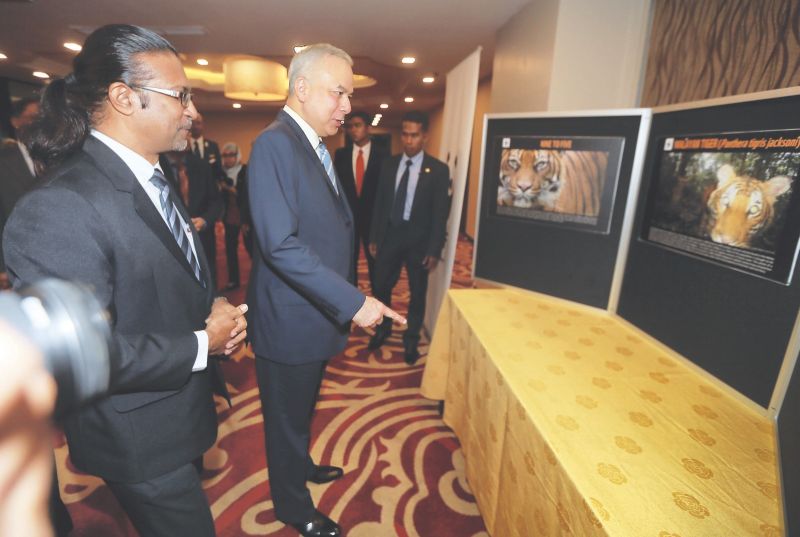
IPOH, July 25 — Government agencies and stakeholders involved in the conservation of the Malayan tiger have set a target of zero-poaching in the Belum-Temengor Forest Complex by 2020.
Over a dozen government agencies and stakeholders, including the Malaysian Armed Forces, the Royal Malaysian Police, the Forestry department, and WWF-Malaysia agreed upon the target during a high-level dialogue here recently.
They also agreed to set up a special secretariat to coordinate efforts to protect tigers and tackle the illegal wildlife trade, which is the most urgent threat to the country’s tigers.
WWF-Malaysia executive director Datuk Dr Dionysius SK Sharma said the secretariat would be led by the Economic Planning Unit (EPU) and they would meet every one or two months.
He said the 3,000 square kilometre Belum-Temengor Forest Complex was one of three priority sites for tigers in the country listed in the National Tiger Conservation Plan, along with the Endau-Rompin Forest Complex and the National Park.
Depending on the success of the plan, Dionysius said the zero-poaching target could be expanded to the whole of Perak and subsequently Malaysia in the future.
“The EPU will bring the agencies together and expand our initial proposals into well-laid plans. The meetings will determine the necessary resources, training, and budgetary needs,” he said.
“The Belum-Temengor complex will be a starting point, where we will see the required resources and work needed to succeed. We will flesh out the details and see what is realistic.
“For instance, we could solve manpower issues by using more technology. We’ll learn a lot from this journey but we’ll need to work hard,” he added.
Zero poaching is achieved when there are no detectable traces of poaching activity in a landscape over a certain time period, with no discernible impact on a species to recover and sustain a population increase.
One success story is Nepal, which achieved zero poaching twice: In 2011 for rhinos, and for a 12-month period up to 2014 for rhinos, tigers and elephants.
Dionysius explained that the secretariat would focus on eliminating poaching for larger animals like elephants, tigers and deer that were being targeted for illegal trade.
The dialogue was held in the presence of the Sultan of Perak, Sultan Nazrin Muizzuddin Shah. Also present was Raja Di Hilir Perak Raja Iskandar Dzulkarnain Sultan Idris Shah and Perak Menteri Besar Datuk Seri Zambry Abdul Kadir.
During the dialogue, Sultan Nazrin suggested that the authorities find ways to engage the 5,000 Orang Asli who live in the Belum-Temengor area — an idea that Dionysius applauded.
“We will attend to the Sultan’s suggestion. People are an important part of the environment and they can’t be involved peripherally,” he said.
“It’s important to educate the people around there about how their actions affect the environment. We need to understand them and design programmes catered to their mindset.”


