


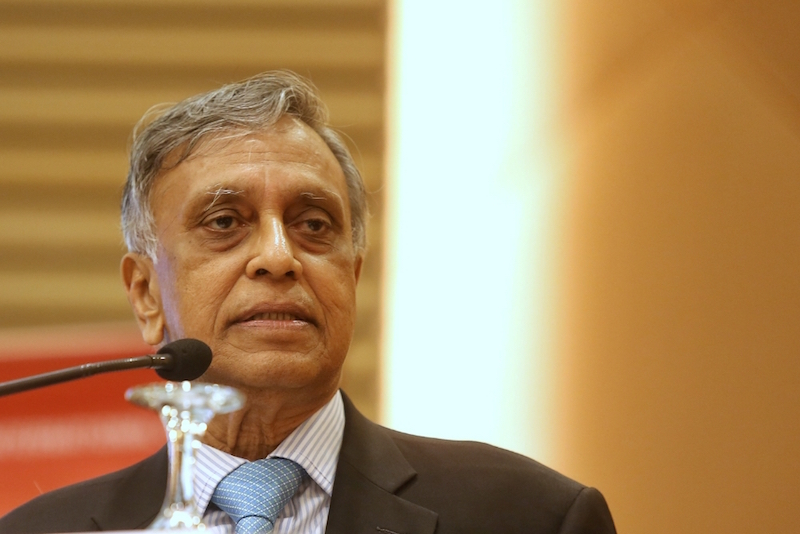
KUALA LUMPUR, Nov 7 — Malaysia’s economy has been repeatedly saved by the government’s “unorthodox” policies that are grounded in pragmatism, Tan Sri Nor Mohamed Yakcop said today.
The chairman of state think tank Khazanah Research Institute (KRI) held up the government’s approach to peg the ringgit during the Asian Financial Crisis in the late 1990s to show how Malaysia not only survived the gloom but became more robust for not following the advice of the Western bodies then, such as the International Monetary Fund and the World Bank.
“The IMF and World Bank intervened during the 1997-1998 crisis and advised us. But we came up with pragmatic reasons to do the opposite to what IMF and World Bank told us and all our problems were solved.
“We fixed the exchange rate at 3.80. We made sure that currency speculators had no access to the ringgit to speculate. The economy recovered and we also took the opportunity to spend our way up,” he said in his opening speech at KRI’s conference titled “Malaysian Capitalism, in Comparative Perspective” here.
The economist said that Malaysia’s capitalism economic model is “unique” as it is not constrained by any political ideology, allowing it to be fluid, which has helped the country better manage its finances.
“The Malaysian capitalism model is quite unique in the world and so far it has worked,” he said, adding that the model will continue to work so long as one has “the guts” to adopt unorthodox policies.
“We came up with an unorthodox policy at that time, the NEP. We also said at that time, we want growth with equity and fair distribution,” he said, referring to the New Economic Policy introduced by the Razak administration in 1971 that aimed to narrow the social and economic gap between the Malay majority and other races within 20 years.
The former minister in charge of economic planning said the affirmative action model worked to level the wealth between those in the rural areas and urban centres.
“Today we see that this has worked. Poverty which was at 49.3 per cent has been reduced. Today there is no hardcore poverty,” he said.
He also said the affirmative action policy has helped to provide education opportunities that have given birth to professionals of all races in Malaysia.


