


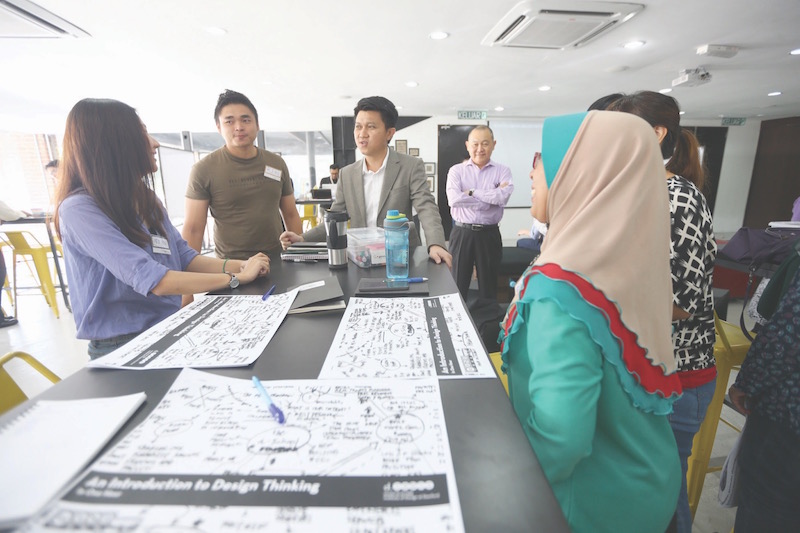
PETALING JAYA, Oct 7 — Fresh approaches and creative solutions are needed to breathe new life into the country’s education sector and stave off stagnation.
Deputy Education Minister Chong Sin Woon said there needed to be an injection of new ideas into the way educators approached their work.
During a walkabout at Genovasi Malaysia here yesterday, he said: “Conventional ideas have brought us to this point, but what we need to move ahead as a nation are unconventional ideas.
“Design Thinking is an example of this. Rather than launch projects and have them run into trouble, we need critical thinking to be employed in the initial stages, with the efficient use of resources and changing the way people think to optimise performance and take new fresh approaches towards policy making.”
Genovasi Malaysia is the region’s premier design thinking institution and is a regional partner of the Hasso-Plattner Institute School of Design Thinking and a collaborative partner of the Stanford Centre for Professional Development.
Chong, who is also the MCA Youth chief, dropped by to share a few words with participants of this year’s National Blue Ocean Strategy Competition for the civil service category.
He said there was a pressing need for different agencies to get out of their “silo mentality” and embrace greater integration, recounting the experience of a friend overseas.
“This friend sought help at a government institute overseas. Rather than send him off to one counter after another, the person serving him took him to the necessary department,” he said.
“In the same way, we as civil servants must not forget our first responsibility, which is to serve civil society and do what is within our power to help.”
Chong said the upcoming Budget 2017 allocation for education needed to at least be retained, if not expanded, to ensure important infrastructure would be maintained.
“We are building schools every year, but maintenance is lacking. The upkeep of our schools is inadequate and there is a vast gap between the quality of schools,” he said.
“Typically, urban schools are built to high standards with air conditioning and computer facilities, but some rural schools are simply not equipped.”


