



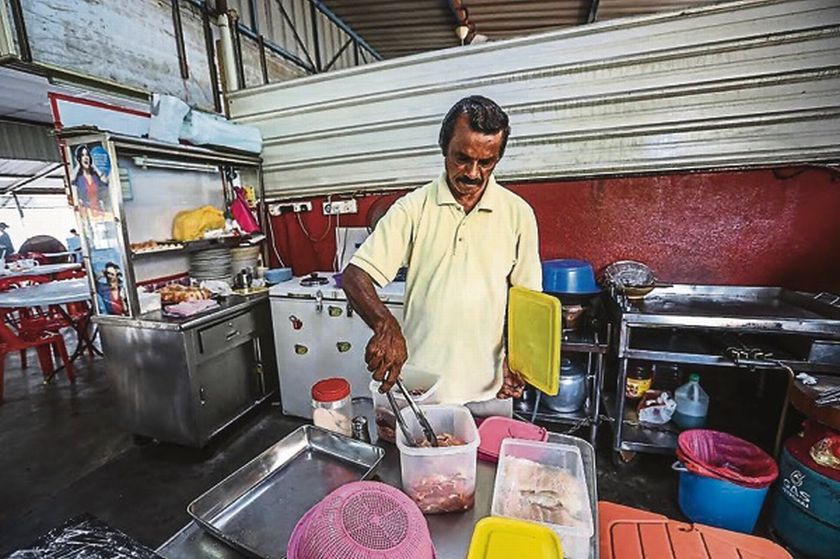
KUALA LUMPUR, Oct 1 — If you were a resident of the Jalan Duta-Segambut areas in Kuala Lumpur from the mid-1970s through to the early 1990s, and if you happened to be up and about rather early, chances are you would have encountered a lone determined figure, wreathed in perspiration, walking briskly by the side of the road heading towards Jalan Duta.
The early morning ritual of national walker V. Subramaniam would have begun at around 4.30am from his home in Batu Caves to Jalan Duta where the Examination Syndicate was located in the days when that area was a secluded stretch punctuated by a few government buildings.
The monotonous regularity of the ritual — absent only when it rained torrents which was seldom — the obvious determination of its performer, and the harvest of medals it brought him, established Subramaniam as the national athlete with a peerless work ethic.
Which is why these days you would be surprised to see the man taking your order for Western food and serving you at a food court in Taman Mewah in Ampang.
Sadly, the 67-year-old has fallen on bad times after he lost his job of 11 years in August last year as national walks coach with the National Sports Council.
The Malaysian Athletics Federation (MAF) made a bold move to remove old coaches in their revamp of the coaching set-up in preparation for the 2017 Kuala Lumpur Sea Games.
Dropped by MAF, Subramaniam tried to get a job as coach with state athletics associations, like Federal Territory and Terengganu, but failed.
Although KLFTAA promised to use him for walking clinics, the move is still in planning stages.
“I had to make ends meet because there was little I could do with my RM320 pension I get from my 11 years’ service with Telekom Malaysia, although I worked there for 30 years as it was privatised after that,” said Subra, as he is more popularly known, when interviewed at his stall.
“Although my children are all grown up and support me a little, but I have eight grandchildren. I want to be independent to be able to buy a few things for them and also for my daily expenses,” said Subra, whose wife Krishnaveny passed away last November at the age of 64.
Life has been a relentless struggle for Subra.
He won his first race in 1969, a triumph in a 10km race, and went on to finish second over two other distances at the same meet.
An employee then in the private sector, he was not given time-off for training or competition, forcing him to put on hold his goal of being a national athlete.
It was only 10 years later, at the relatively old age for an athlete, advanced age of 26, after landing a job with Telekom Malaysia in 1975, that his athletics career finally took off.
With support from his employer, Subra got his 14 years as a race walker off to a start, with wins in almost all walk events such as the Malay Mail Big Walk, state meets, and a walking circuit organised by a private company, Wings, before competing in his first international — the 1977 SEA Games in Kuala Lumpur where he won the 10km gold medal and 20km silver medal.
He went to win six gold medals and five silvers in five SEA Games, and qualified for the 1980 Moscow Olympic Games but had to skip it because of a boycott by Western and Islamic nations.
At the 1978 Bangkok Asian Games, Subra heartbreakingly had to settle for silver in the 20km when Hakam Singh came from behind to beat him in the finishing lap at the stadium, the lanky Indian manifestly floating to the tape in an era when the officiating of walks suffered from inconsistent application.
Subra came away with two bronze medals in the Asian Track and Field in 1979 and 1981. He was named Selangor Sportsman for two consecutive years — 1978 and 1979 — and was also chosen National Sportsman of the Year in 1978.
At every step of the way, he had to make sacrifices and anyone else in his shoes would have long given up.
But not this redoubtable father of three boys — the late Saravanan, Rajinikanth (41) and Sundhar (38) — and two girls Uma Sunthary (41) and Shanti (39).
Even the death of Saravanan in 1992, when he was 21, in a motorcycle accident, did not see Subra hang up his walking shoes.
Subra said it was former walker B. Thirukumar who told him about the stall in the Ampang area and knew a woman who cooked Western food looking for an opportunity to do business.
“I managed to find this stall and got the woman (Siti Zubaidi) who had worked with a Chinese stall owner for nearly 10 years assisting in preparing Western food to team up with me,” said Subra, who has been operating the stall since last October.
Initially, he ran the stall from morning to night and paid a rent of RM800 a month. Business was good at first.
“But since last month it has been bad. I decided to operate only from 4pm to 10pm and pay a reduced rent of RM540.”
Subra had to come up with a start-up capital of RM7,000 and spends between RM50 and RM200 a day to buy meat and groceries.
“These days I make about RM1,200 a month after deducting expenses and share it 50-50 with Siti.
“I am looking forward to getting back to coaching and will go to the national championships this weekend at Universiti Malaya to approach a few states including Selangor,” he said.
“Hopefully, I will land a job soon as I am yearning to get back to coaching, especially in developing walkers to become top notch athletes.”
Among the walkers he had nurtured were Annastasia Karen Raj, Mohd Shahrulhaizy Abdul Rahman, Narinder Singh, Loo Choon Sieng, and 2015 SEA Games bronze medallist Khairul Harith Harun.
Apparently, the fighter in Subra will not yield in the face of life’s vicissitudes.


