


PUTRAJAYA, March 24 — Parliament never had any intention that only Muslims could act as counsel in Shariah courts when it enacted legislation for the religion’s administration in the Federal Territories, Federal Court judge Tan Sri Suriyadi Halim Omar said today.
Suriyadi and fellow dissenting judge Datuk Zaharah Ibrahim revisited the 1995 Hansard records of a Parliamentary speech to quote then-minister Datuk Abdul Hamid Othman for their minority judgment on today’s controversial challenge by a non-Muslim lawyer to be admitted as counsel in the Federal Territories Shariah courts.
“On the matter of Shariah lawyers, with this amendment, a lawyer in the Federal Territories can represent his client even if he is not a Muslim,” the then-minister in the Prime Minister’s Department was quoted as saying in Malay in his winding-up speech on August 14, 1995.
“This is in line with our desire today that the practise of law and justice in our country must be betul dan lurus (true and straight) and this is also fitting with the International Islamic University giving courses on Islamic laws to non-Muslim undergraduates,” the then-minister said, having noted that such non-Muslims Shariah lawyers must have passed the relevant examinations or tests.
Suriyadi said the Muslim-only rule had not only gone against Parliament’s intentions, but had also effectively “rewritten” Section 59(1) of a 1993 Act which had said “any person having sufficient knowledge of Islamic law” may be admitted as Shariah lawyer.
“With the Hansard report clearly evincing that it was never the intention of Parliament to shut the doors to academically endowed non-Muslims having sufficient knowledge of Islamic law to appear in any Syariah Court, and Section 59(1) in its ordinary and natural sense easily understood, it is thus the primary duty of the court to give effect to the intention of Parliament,” he wrote in his 52-page judgement that was agreed to by Zaharah.
Parliament could have itself inserted the Muslim-only requirement into Section 59(1), if it was its intention to only allow Muslims to be Shariah lawyers, he said.
He said the rule allowing only Muslims as Shariah lawyers was an additional “restrictive and draconian qualification” that is inconsistent with and had went beyond the limits of the Administration of Islamic Law (Federal Territories) Act 1993.
He added that the Muslim-only condition in Rule 10 of the Shariah Lawyers Rules 1993 meant that it could be declared as null and void.
But Suriyadi and Zaharah’s view on this point of law is part of the minority judgement, with the three other judges in today’s Federal Court panel saying that the Muslim-only rule is valid.
The majority judgement had said Section 59(1) must be read together with Section 59(2) of the 1993 Act, which it said gave MAIWP the power to introduce the additional qualifications of a Shariah lawyer such as the Muslim requirement, the minimum age of 21, and Malaysian citizenship with no records of bankruptcy or criminal convictions.
All five judges said the Muslim-only rule in Rule 10 for Shariah lawyers in the Federal Territories is constitutional as it did not breach Article 5, Article 8(1) and Article 10(1)(c) of the Federal Constitution.
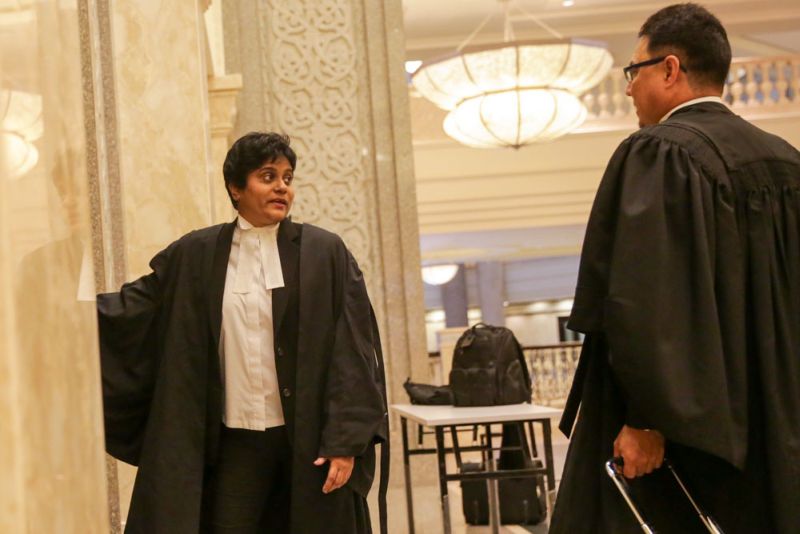
Non-Muslim lawyer Victoria Jayaseele Martin has been fighting in the civil courts for the past seven years to be admitted into the Islamic courts.
Victoria received a diploma in Shariah Laws and Practice from the International Islamic University of Malaysia in 2004, and also holds a degree which widely covers Islamic law — Masters in Comparative Laws — from the same university.
The Federal Court’s decision on the two points of law today means that Victoria cannot practise as a Shariah lawyer in the Federal Territories despite holding the relevant academic qualification, with other non-Muslims also caught by the Muslim-only rule which remains valid law.


