

KUALA LUMPUR, May 29 — Malaysia’s position as a country stuck in the middle-income trap has been reinforced by its middling scores in a major new report on the ability of 148 countries in creating well-being for its citizens.
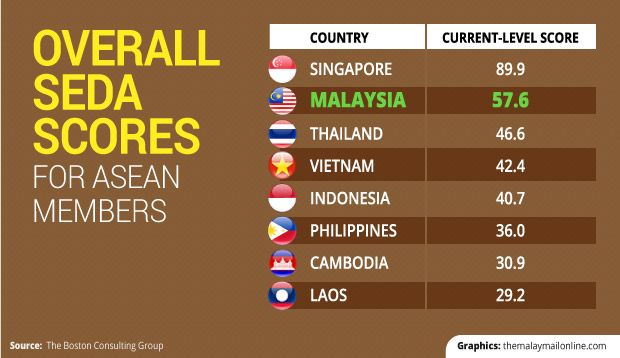
Released this week, the Sustainable economic development assessment (SEDA) by The Boston Consulting Group (BCG) measures well-being across 149 countries, with Malaysia scoring 57.6 on its snapshot of well-being created. (The best country gets 100 and the worst country gets zero)
SEDA defines well-being through fundamental elements, which includes income, economic stability, and employment, education, health, infrastructure, income equality, civil society, and governance dimensions.
Crucially, Malaysia also fared poorly in its ability to convert wealth and growth to well-being, an indicator which may suggest growing income inequality.
Malaysia's abilities to translate growth and wealth into a better life for its citizens were below average, producing improvements that are less than what is expected.
The country was also grouped into the cluster of oil-rich nations which in general perform below average at converting both wealth and growth into well-being — and governance is a major area of weakness.
The report said one potential reason for the connection is that substantial revenue from oil and gas relieves governments of the need to tax, thus reducing their obligation to be accountable.
Malaysia recently introduced reforms to the country's tax structures as signs point towards a shrinking reliance on oil as a major source of revenue.
Regionally, Malaysia had company in that Thailand, Indonesia and Philippines fared even poorer on all counts.
Unsurprisingly, Singapore had high scores on the report, coming in with 89.9 marks and it was also above average in converting wealth and growth into the well-being for its citizens.
Norway was judged the country where citizens have the best wellbeing in the world.
It was followed by Luxembourg and Switzerland. Singapore also made it into the top 10.
At the bottom of the rankings was the Central African Republic.
"Government leaders increasingly speak of boosting the well-being of citizens—rather than bolstering GDP growth—as their primary mission," the report's authors wrote.
"But the conventional yardsticks of per capita GDP and growth are too narrow to evaluate the full measure of well-being. What’s needed is a broad diagnostic tool designed specifically to help governments set priorities and formulate development strategies.
"SEDA’s design reflects the need of governments to pursue a balanced approach to raising the overall well-being of their citizens—one that is focused on economics, critical investments, and the social and environmental factors that ensure sustainability of progress over time."