


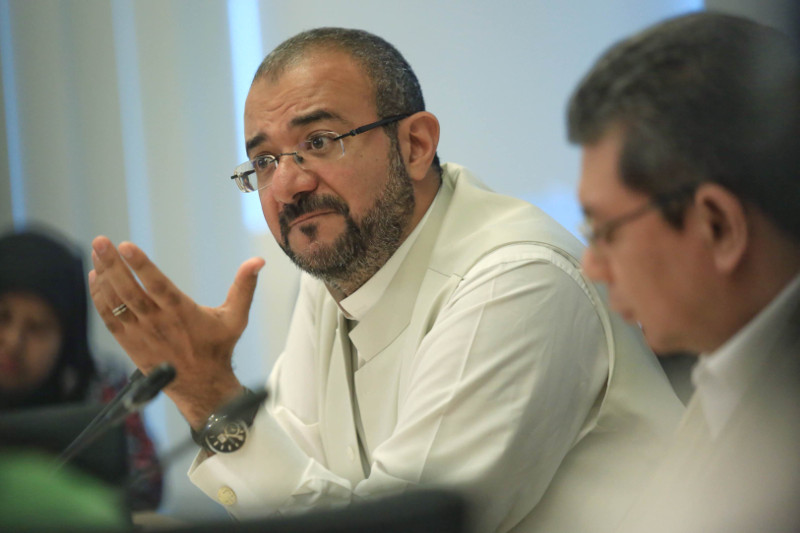


KUALA LUMPUR, May 25 — Doha-based scholar Dr Jasser Auda scoffed today at Muslims who protest against churches and temples in Muslim-majority areas, saying that converting out of Islam is a matter of faith and not caused by buildings.
The Islamic Studies professor said government should not regulate places of worship as long as they do not harm the public or disrupt public order.
“I come from Egypt. In Egypt, we have churches besides the mosques everywhere,” Jasser told reporters after a roundtable of 'Maqasid Al-Syariah', or the higher intentions of Shariah, held by the Global Movement of Moderates Foundation.
“We’ve been living like that for the past 1,400 years. As a person who grew up in Cairo, I don’t see a problem having a church beside a mosque. The issue of conversion is a different issue. People convert according to their beliefs, it has nothing to do with building a church or not,” he added.
Jasser also said he was dumbfounded by Malaysian Muslims’ focus on “small issues”, such as places of worship, the use of the name “Allah”, and the push for the implementation of hudud.
The scholar said Muslims should instead be concerned with major socio-economic problems, such as matters of education, public health, and the rule of law.
Despite that, Jasser cautioned against building houses of worship in regions or areas considered to be holy to a specific faith, saying it might offend its adherents.
“I’m just calling for being sensitive in founding new places of worship. But every religion has the freedom to build houses of worship,” said Jasser, who is a founding member of the International Union of Muslim Scholars.
On May 17, between 300 and 500 Muslim residents at Puncak Alam, Kuala Selangor, reportedly protested against the planned construction of a Hindu temple in the Muslim-majority area.
Last month, about 50 residents at Taman Medan, Petaling Jaya, staged a protest against a new church in the area last month for putting up a cross on its façade, forcing it to later remove the Christian religious symbol.
The Muslim residents claimed that displaying the cross in a Muslim-majority area is a challenge to Islam and could influence young Muslims.
No case of conversion or proselytisation was reported against the church, with protesters only expressing worries that it could happen.


