


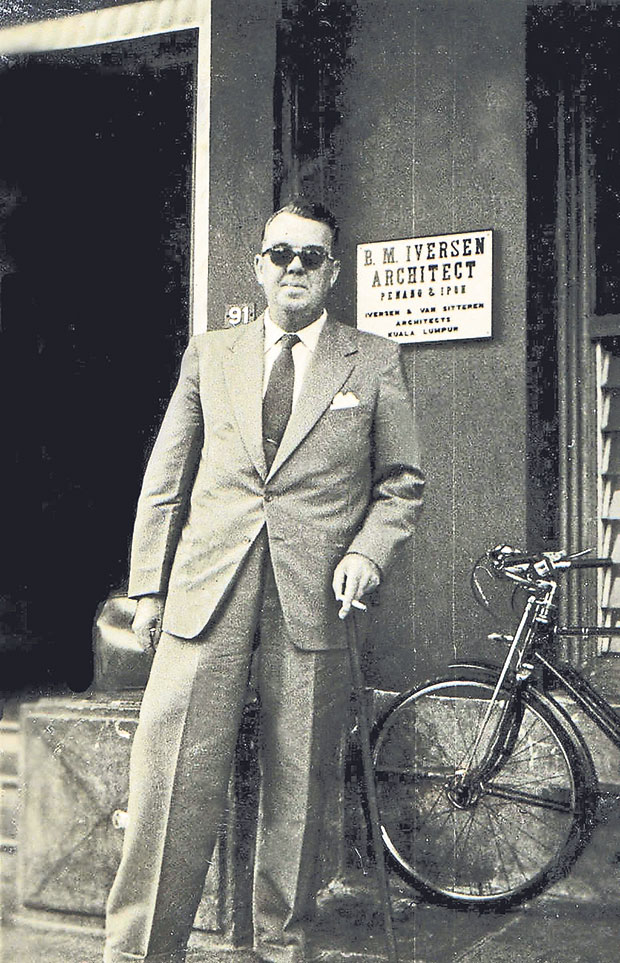


GEORGE TOWN, March 22 — Berthel Michael Iversen was born in Copenhagen, Denmark in 1906 but Malaya was always close to his heart as he started his architecture career here, met his wife and started a family here.
Iversen lived in then Malaya from 1928 and spent more than 40 years of his life in this country before he retired and went back to Copenhagen where he died in 1976 at the age of 70.
Today, few people have probably heard of Iverson and yet many of the buildings he designed and built all over Ipoh, Kuala Lumpur and Penang are still standing tall and proud.
According to his daughter Ruth Iversen Rollitt, these buildings are all like monuments that remind her of her father and his happy life in Malaya.
Among the famous landmarks Iversen designed were the grandstand at the Perak Turf Club, the Shaw Brothers cinemas — Majestic, Rex, Ruby, Cathay and Lido — in Ipoh, the Loke Yew Building in Kuala Lumpur and the Chinese Swimming Club in Penang.
Iversen documented his life here with beautiful, colourful sketches of himself and his family, his work and his life in four volumes of loose sheafs of paper that he left to both his children.
Rollitt also kept all of her father’s old photographs of the buildings he built, the various stages of construction and his many site visits to his projects.
She recently wrote a book about her father’s life and his work titled Iversen: Architect of Ipoh and Modern Malaysia which will be officially launched tomorrow.
Here, Rollitt shares her memories of her father, his life and his work.
In her own words:
- He came to Malaya because his big brother was a planter in Perak... it was 1928 when there were problems in Europe, when the slump was coming up.
- His father had died a few years before and he just wanted to get away from Denmark. So his brother said sure you can get a job in Malaya. He arrived in Penang in 1928 and drove down to visit his brother in Perak. Then he got a job in Singapore with an architecture company called Booty & Edwards. They didn’t have much to do but he built a very prominent building — the Chinese Assembly Hall in KL. Things weren’t going too well and he got an offer from another company, Keys & Dowdeswell, also in Singapore, and they had many more buildings going on.
- He was then sent to Ipoh to supervise the building of the Perak Turf Club grandstand. And then things went wrong for Keys & Dowdeswell in 1931 and he took over the company in 1934 and settled in Ipoh and stayed there forever. He got married in Penang at St Andrew’s Church and then had a son and then had me. And then the war came and we were evacuated to Australia. We lost everything. We lived in Australia for four years.
- He came back in 1946 after the war. Instead of opening BM Iversen, he opened Iversen & Van Sitteren. Van Sitteren was a Dutch man. He was an old Dutch friend of my father’s from the Singapore days when they were very young. He had been a prisoner of war in Japan during the war. My parents found him in Holland and he was totally wrecked from being a prisoner of war, they brought him back here, and being an architect and very good friends, they then became partners. So, they had Iversen & Van Sitteren in Ipoh and Kuala Lumpur and in 1962, they expanded into Singapore.
- He drew about his time in Ipoh in the early days. He wrote…”in a cozy little house in Ipoh, Malaya, lived a young Danish architect, he was no beauty but he was happy and contented with a busy office and he worked hard. But he knew something was missing. Then one day, he met a Dutch lady…” and then there were more pictures and then, he drew a plan of the house, after my brother and I was born, he drew that four of us lived happily in a little house, that although father’s living space have been considerably diminished. There’s the children’s bathroom, children’s veranda, mother’s bathroom, dining area and here, this small little corner is for father. Still, he was a very happy man.
- Here is a picture of him… he was very ill, he had tuberculosis in his kidney, because during the war, he had worked in New Guinea, and he must have picked it up there. so he had to have his kidney removed in 1954 and he was ill and lying in bed for 18 months and my father had a bad leg. So he made a drawing of leg gone, kidney gone and while he was ill and in hospital, he sent in his entry for a competition and he won and here is a drawing of my mother who fainted when she heard the news. This is the building, the Federal House. (Iversen won $5,000 for his design for a post office savings bank in Malaya which was launched in 1954 as the Federal House in Kuala Lumpur.)
- He left in 1966 but the firm went on for several years. He went back to Denmark at the age of 60. During the war, he went to New Guinea for the Dutch Navy and he built a hospital from empty beer bottles. There were no bricks but the soldiers brought a lot of beer bottles. My mother, she was in the Navy too.
- When my father left, he hired a car and he drove all through Malaya. It was very hard for him to leave. My father was also a painter. All these drawings he made, it was in loose leafs in a book. And then what he did, this was years ago before you had easy photocopies, he had them all photocopied, you know you had to go to a special architectural shop then, and he had them all copied but you couldn’t get colour copies so he coloured them all and made one set for me and one set for my brother.
- Those drawings…that was his life in Malaya. I have four volumes of these drawings, there were hundreds of pages. It started with the one of the little house in Ipoh, Malaya and it finished when he gave up two years before he died... He died in 1976, he gave up in the last two years of his life. He just lost interest in everything. He had esophagus cancer. He had been a man… he smoked a lot, 60 cigarettes a day, he drank a lot like everybody did during that day, he ate a lot, he loved life and then suddenly the last 18 months he could only eat food that was mashed up and they said he wants to smoke, he can smoke. So he smoked. But he went from a big man to a small angry man. But he just loved me because I’d sit close to him and said, tell me stories and he would tell me about his life and his family.
- These two old men I met yesterday, they were his former apprentices. They said he was a very strict boss but he was a wonderful man. There are letters from people who’d worked for him who said he was the most thorough person there ever was. They said he was very strict and he wanted them to do it correctly and if they didn’t, he’d yell at them, but he also taught them how to do it.
- My father walked on his toes, his right leg was slightly twisted because of an accident, but he still climbed up the scaffoldings and those days, the scaffoldings aren’t like today. They were just bamboo poles, he would climb up and down. He had a stick, he always had a stick and every night, he would go out and supervise the buildings that were being built and if they had not built a wall properly, he would take his stick and knock it down. Because everything had to be done to perfection.


