


MIRI, July 15 — When Miri recently bagged the Asean Clean Tourist City award for a second consecutive three-year term, some residents questioned if the accolade is truly deserved, particularly from the aspect of cleanliness.
That in mind, The Borneo Post conducted a ground-level observation across the city, particularly at tourist spots, and the findings revealed a mixed picture.
While many public spaces remain well-maintained, others are marred by overflowing rubbish bins, overgrown grass, and drains heavily clogged with discarded food packaging, plastic waste, aluminium cans, and stagnant water.
In Pelita and Boulevard Commercial Centres, which have the highest densities of popular restaurants, cafes, and coffee shops, a nauseating stench of rancid oil and stagnant water rises from the clogged drains, creating a pungent odour that lingers.
Another eyesore in commercial areas is the refuse collection points, some of which have turned into dumping sites. Rubbish bags, old furniture, and bulky waste left outside the bins contribute to foul odours and provide ideal breeding and feeding grounds for rats.
Chain of responsibilities
Councillor Kelvin Chia, chairman of Miri City Council’s (MCC) City Services Standing Committee, stated that cleanliness issues are rarely caused by a single factor.
Instead, they involve a complex chain of responsibilities involving contractors, businesses, residents, and the council itself.
“The public often sees the final outcome, whether a drain is dirty or a back alley filled with rubbish. Behind that are multiple parties whose actions affect the result,” he said.
He explained that one of the council’s biggest challenges is ensuring that contractors perform according to their contractual obligations.
“While contractors are hired to carry out their work whether it is grass-cutting, drain maintenance and public cleaning works, some struggle to cope with the size of the service areas assigned to them.
“There are cases where contractors fail to complete the required work and when that happens, we issue warning letters. If performance does not improve, the contract can be terminated after the issuance of three warning letters,” he said, adding that three residential maintenance contractors have recently been terminated due to unsatisfactory performance.
He stressed that contractor performance is only one side of the equation. Commercial areas, particularly eateries, are another major contributor to recurring cleanliness problems such as clogged and dirty drains.
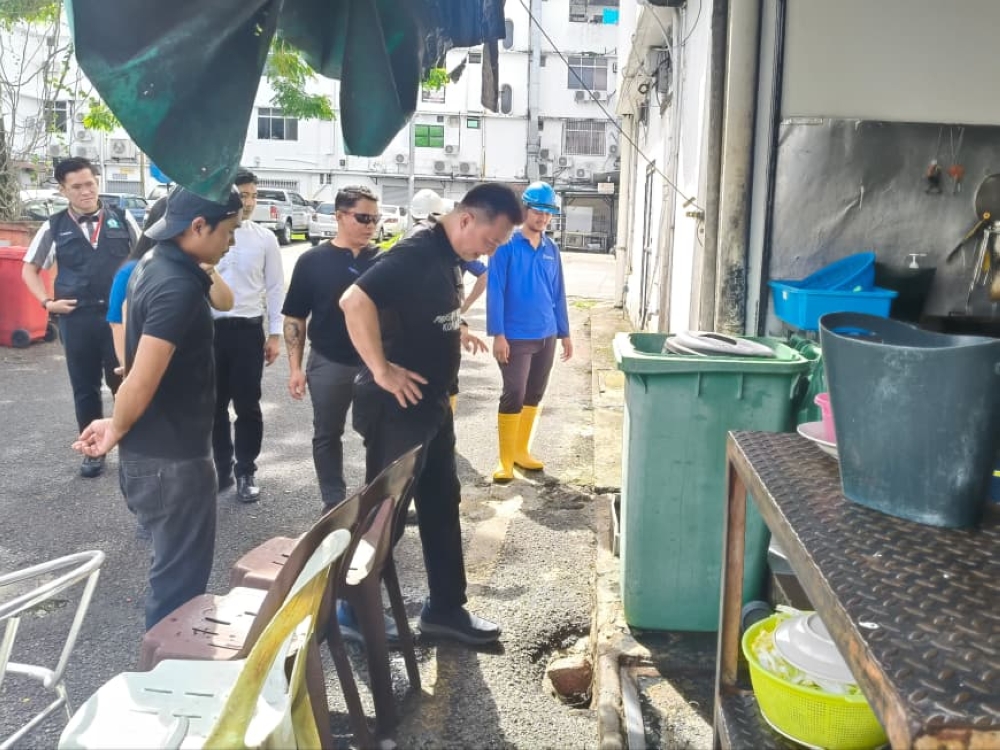
Chia during an inspection on the condition of the drain at one of the eatery shops.
Chia said many of the drainage issues are not due to a lack of cleaning. In fact, these drains are regularly flushed and cleaned, usually at night to avoid disrupting business operations.
“However, they become quickly clogged because grease, food waste and other residue continue to be discharged into the drains, a proof of operators’ incompliance to properly dispose waste and installing grease traps.
“Some premises do not install grease traps at all to save cost. Others install them but failed to maintain them properly. As a result, grease ends up in the drains and the cycle of blockage and cleaning repeats itself,” he said, admitting that stronger compliance and enforcement are needed to address root causes rather than merely treating symptoms.
Working with limitations
Chia also acknowledged that the council faces operational limitations, including a shortage of supervisory personnel responsible for monitoring contractors and ensuring maintenance standards are met.
“In some case one supervisor has to oversee multiple zones and several contracts simultaneously and that creates challenges in monitoring performance effectively,” he said, adding that many experienced supervisors have retired, and vacancies have not always been filled due to administrative decisions beyond the councillors’ direct involvement.
He also noted that the increasing population means more rubbish filling the landfill; at this pace, its capacity may soon be exceeded.
He identified food waste processing as the next challenge the city council seeks to address.
The city currently generates about 80,000 tonnes of waste annually, approximately 40 per cent of which is food waste.
MCC has identified 13 illegal dumping hotspots and has successfully cleared four. To deter further dumping, closed-circuit televisions (CCTVs) have been installed at some of these sites.
Chia said the council aims to tackle at least 60 to 80 percent of the remaining sites. It also intends to educate the public on the correct disposal of bulky waste, such as furniture, by using the Kuala Baram dumping site or hiring a council contractor for a fee of RM80.
“Clearing these sites means a waste of public funding and manpower that could otherwise be put into improving city facilities and services for the benefit of residents,” he said.
Bridge between local authorities
Councillor Leslie Lau Ik Chie told The Borneo Post that the City Infrastructure Standing Committee plays a central role in overseeing, planning, and monitoring infrastructure within the council’s jurisdiction, specifically focusing on roads, drains, and streetlights.
He explained that these three components form the backbone of urban infrastructure, requiring close collaboration with various departments and agencies.
Lau stressed the importance of inter-committee and inter-agency cooperation at both state and federal levels.
“We have to work together because one committee may have the idea on how they want to develop a place, but our role is to advise them on the practicality, maintenance requirements and engineering aspects.
“If there are no issues from the engineering side, then we will endorse the project and help ensure it is implemented properly,” he explained.
While Lau was not privy to the specific criteria that led to Miri receiving the Asean Clean Tourist City Award, he believed road infrastructure played a significant role in ensuring safety, accessibility, and efficient traffic flow.
“Roads are among the most important public infrastructures because everyone uses them. Continuous maintenance and timely repairs on potholes, caved-in and collapsed roads, are essential for the safety of road users and creating a smooth, comfortable and positive experience for visitors coming to Miri,” he said.
He added that maintaining infrastructure standards is an ongoing responsibility that requires consistent effort from local authorities and cooperation from contractors and agencies to ensure the city remains functional and welcoming.
Regarding the ageing drainage system, he pointed out that many areas are in dire need of upgrades. These drains were designed decades ago and lack the capacity to cope with current development levels and increasingly intense rainfall.
“Thirty years ago, the drain capacity might have been sufficient for that area. But today, we have more development, more commercial activities and higher rainfall. It resulted in collapsed drain walls, damaged drain bases, cracked concrete structures,” he said, adding that his committee has conducted site audits to identify drains that are no longer adequate.
To upgrade these drains, he explained, it wasn’t easy.
Upgrading these systems requires comprehensive planning of the entire drainage network. The City Infrastructure Standing Committee has begun assessing areas that require upgrades, evaluating existing capacities, and identifying locations for redesign, particularly in older commercial zones.
“Most importantly, we are studying the funding requirements needed to carry out these improvements, because large-scale infrastructure upgrades require significant financial commitments,” he said.
Open to constructive suggestion
Mayor Adam Yii said the council receives dozens of complaints daily regarding municipal services, infrastructure, and public facilities, reflecting the residents’ expectations for city management.
While acknowledging public frustration, he stressed that the council operates within strict financial, manpower, and procedural constraints.
According to Yii, projects are implemented following proper assessment, design, approval, and budget allocation within a structured framework.
“Every complaint requires proper assessment and follow-up. Some issue may need longer time due to the standard operating procedure.”
Yii welcomes constructive suggestions from the public to improve the council’s services.
Even so, he acknowledged room for improvement in complaint management, as delays can lead to public dissatisfaction and perceptions of incomplete follow-up.
“To address this, the city council is currently reviewing its complaint handling system to improve transparency and tracking,” he said.
Yii noted that the council provides multiple avenues for residents to lodge complaints, including the Miri Smart City Command Centre, Talikhidmat, and engagement sessions with councillors.
He encouraged residents to utilise these platforms, as constructive feedback is vital for identifying problems and improving service delivery. — The Borneo Post


