

KUALA LUMPUR, Oct 26 ― Have you ever wondered what it is like to drive an oil tanker or a coach? Well, today I was given the chance, and of all places to do it, at the Sepang F1 Circuit. It was all courtesy of Scania Trucks Malaysia, who organises a competition to find the best truck and coach driver from Malaysia. We have yet to receive the final results of that competition, which is interesting in its own way, so in the meantime, let me share my unique driving experience.
I have never driven a bus, let alone a coach, so it is a new experience. As a kid, I rode the bus to school and back each day ― it was only a two mile ride, but I actually did learn a little bit about how to drive from watching my bus driver. They were all manuals in those days, very noisy, and the drive sat practically on top of the engine bay. That is where I learned that there is a clutch, a brake pedal, and an accelerator. I didn’t know the actual names for the three pedals, but I knew what they were for. Every time I got onto the bus, I would fight to sit just behind the driver in the first row, and I would watch intently to see how he operated everything. In those days, there was hardly any sound-proofing nor was there much heat insulation, so the driver’s cockpit was noisy and quite hot ― one of the reasons I decided not to be a bus driver.
The last time I drove a truck, it was in 1983, and it was a 50 tonne truck carrying a 30 tonne crane on top of it. That was an 80 kilometre journey from Kuala Lumpur to Banting, which lasted only 30 kilometres, because somewhere near Kajang, the rocker arms all snapped (I may have done something wrong then), and I was stranded on the road for a good six hours before help came. Before that I had driven some tipper trucks on a construction site. These were usually de-commissioned lorries that had failed the JPJ road tests and the popular name for them was “condemned lorries”, which were relegated t o carry earth fill. If anyone can remember, the common brands then were Bedford and Thames trucks.
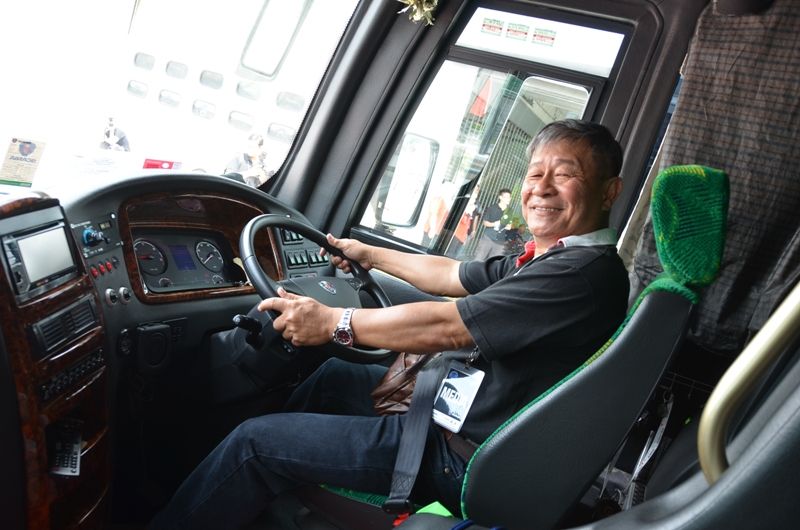
Today, I drove a Rapid bus, built from a Scania chassis and what a difference it is from those buses I knew back then. Everything is automated, and it is like driving a car. The transmission is automatic, and all you have to do is just put it into “D” by the twist of a simple lever, and go. There is a clutch pedal, which you only need to use when engaging “D”, and then you gently release it like in a manual transmission and you are off.
The only difference between a bus and a car is that the bus is about three times the length of a car, and if as in most vehicles the rear wheels do not track the front wheels, and so you have to take your corners carefully to ensure your rear wheels don’t climb the kerb or fall into the “longkang”, or hit a culvert stone. Besides that, you must also realise that a bus is about one and a half times the width of a car, and so you must make sure that your left wheels stay on the road. You keep track of your rear wheels and your left wheels by using the huge side mirrors. I didn’t do any reversing, but I have seen enough of tour coaches reversing in and around hotel lobbies and entrances to know that you need someone to guide you if you are reversing. The last thing you need to be aware of is that as a bus driver, you are sitting in front of the front wheels, so when you are executing a turn, the turning sensation is quite different. On the road, the driving part is very similar to driving a car, and it is actually quite easy.
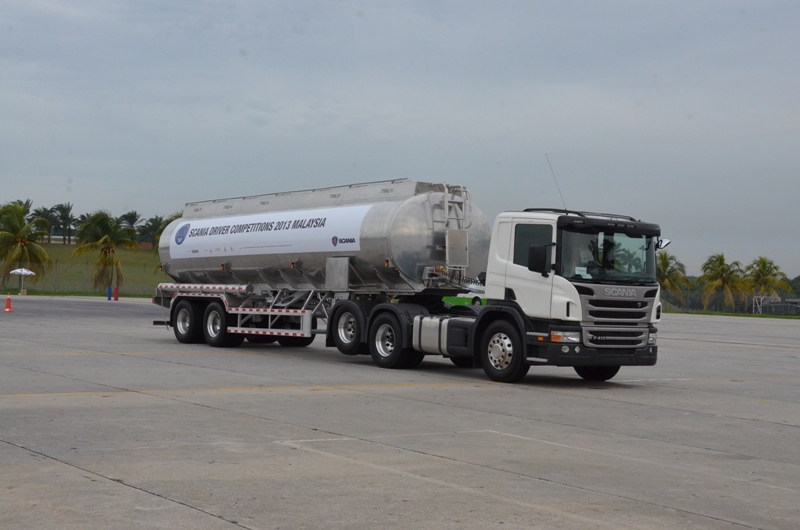
Similarly, when driving an oil tanker, the gear changes are also quite simple. Similar to the bus, the Scania prime mover pulling an oil rig is just as easy. With an automatic and twelve gears that shift up and down all automatically, it takes the guesswork out of driving.
Gear selection is again by a twist lever on the side of the steering column, in a cockpit with adjustable seats and adjustable steering to get you the most comfortable sitting position. In the prime mover, there is no clutch. Just release the handbrake and accelerate ― take-off is easy with 420 horses and in excess of 1,000Nm of torque. The rig I drove today was empty, of course, and it was real easy to drive ― I do wonder what it would be like with a full load of 9,000 litres of fuel, but who cares, I got to drive it.
Again, the thing to look out for is the extra width and the extra length, which is even longer than that of a bus. The saving grace is, the oil tanker is pivots around the front one third of the vehicle, and although the rear-most wheels do not track the front, it requires less room to manoeuvre than a bus does.
Finally, my conclusion is that anyone can be a bus or truck driver. To be a good driver, though, one needs to learn the do’s and don’ts of operating such a massive piece of machinery, the safety measures and procedures, and how to respect other users on the road who are smaller than you are.