


















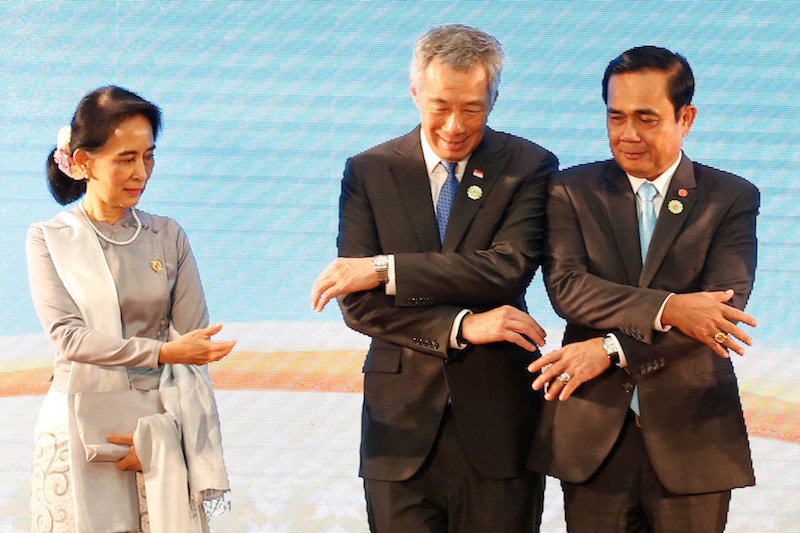


VIENTIANE, Sept 7 — There will be ups and downs in ties between the Association of South-east Asian Nations (Asean) and China, but both sides can turn a crisis into an opportunity to further strengthen ties, said Prime Minister Lee Hsien Loong.
Speaking at the Asean-China Summit in Vientiane as both sides celebrated the silver jubilee of dialogue relations, Lee noted that even in the strongest of relationships, issues will arise from time to time among parties and the South China Sea is one such issue.
“But every crisis presents an opportunity. And this issue can be turned to our advantage in pursuit of the common goal of regional peace and stability, which are prerequisites for continued economic growth,” he said.
The Prime Minister said the outcomes of the commemorative summit — including a protocol for unplanned encounters in the South China Sea and guidelines to set up hotline communications among the foreign ministries to respond to maritime emergencies — is proof that both sides can manage their differences.
He also said he was heartened by China’s proposals to formulate a framework on the code of conduct in the South China Sea by the first half of next year, adding that Singapore will work with China on its proposals to fast-track negotiations.
Chinese Premier Li Keqiang said during the Summit the successful relationship between Asean and China has played an important role in promoting regional development and stability.
Li recounted how he had heard from his Asean counterparts about how “among the various Asean dialogue partnerships, the Asean-China relationship is the most dynamic and fruitful”.
“Both Asean and China have been increasing political mutual trust over the past 25 years… China was the first to build a strategic partnership with Asean and the first to initiate a free trade agreement with Asean,” noted the Chinese Premier.
Commenting on the 25-year history of Asean-China relations, Lee said both sides have developed a dynamic and wide-ranging partnership, and this is reflected in the deliverables for the commemorative summit in Laos.
He said that the fruits of Asean-China cooperation “bear out most clearly in the economic realm”.
China is the top trading partner for almost every Asean member state. Two‐way trade has grown from US$8 billion (RM32.52 billion) 25 years ago to US$370 billion now, noted the Prime Minister.
He said that economic ties have kept pace with the times, with both sides upgrading the Asean-China Free Trade Area agreement — China’s very first free trade agreement signed in 2004 — last year.
The upgraded protocol will enter into force for more than half of the parties this October.
During yesterday’s commemorative summit, Asean and China also finalised a statement to optimise the distribution of excess production capacity in the region. Observers say China is keen to shift its excess production capacity to other developing countries.
Despite the success story for Asean-China economic cooperation, both sides have seen setbacks on the political front, notably on territorial disputes in the South China Sea.
Beijing claims almost the entire South China Sea, through which more than US$5 trillion in shipborne trade passes every year. Brunei, Malaysia, the Philippines, Taiwan and Vietnam also have claims in the sea, believed to be rich in energy deposits.
Beijing has conducted massive reclamation and construction in the disputed waterway, sparking fears of militarisation in the region.
An arbitration court in The Hague ruled on July 12 that China had no historic title over the busy waterway and had breached the Philippines’ sovereign rights there. The decision infuriated Beijing, which dismissed the court’s authority to rule on the matter.
Asean-China relations hit a low point in June when the bloc first issued a hard hitting statement on China’s assertive actions in the South China Sea during a Special Asean-China Foreign Ministers’ Meeting, only to retract it hours later for “urgent amendments” as several member states came under Chinese pressure.
Looking ahead, Lee said both sides can explore further economic complementarities towards the target of US$1 trillion of bilateral trade and US$150 billion in investments by 2020.
On socio-cultural cooperation, Lee said that there have been regular people-to-people exchanges with both sides holding a successful “Year of Educational Exchanges” in 2016, adding that he welcomes the designation of 2017 as the “Year of Tourism Cooperation”.
He said that all parties should continue to chart a positive trajectory for Asean‐China relations and prevent it from being overshadowed by any one issue.
“China’s success benefits the region; and it is also in China’s interest for Asean to succeed,” he said.
Mr Lee added he appreciates China’s longstanding support for Asean centrality and unity in regional affairs.
“As the Asean-China country coordinator, Singapore would do our part to advance this important relationship in all areas of mutual benefit.” — TODAY


