


JULY 15 — Every day across Malaysia, thousands of oil palm harvesters make one of the industry’s most important decisions.
Is this fruit bunch ready to harvest?
The answer may seem straightforward, but it carries significant consequences.
Harvest too early and the fruit contains less oil than it potentially could.
Wait too long and fruit quality begins to decline, increasing losses and reducing overall value.
Across millions of hectares of plantations, even small differences in harvesting decisions can translate into substantial economic gains or losses.
This challenge matters because palm oil remains one of Malaysia’s most valuable agricultural industries.
In 2025, the country produced a record 20.28 million tonnes of crude palm oil from approximately 5.7 million hectares of planted area, while export earnings reached RM112.43 billion.
Despite a slight decline in export volume, stronger prices helped the industry generate even greater revenue, underlining its continued importance to Malaysia’s economy.
Yet behind these impressive numbers lies a surprisingly traditional practice.
Today, the ripeness of an oil palm fruit bunch is still largely determined by human observation.
Experienced harvesters judge maturity by examining the fruit’s colour and counting the loose fruits that have fallen naturally to the ground.
Years of experience allow many workers to make remarkably accurate decisions, but the process remains subjective.
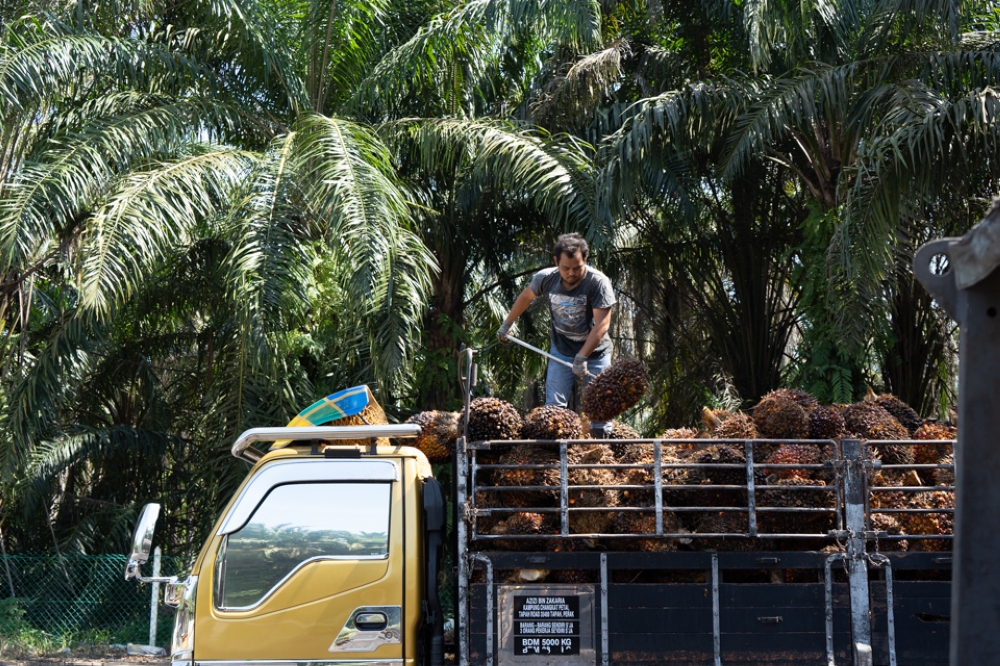
Different harvesters may reach different conclusions, particularly under varying weather, lighting and field conditions.
The challenge has become even greater as plantations continue to face labour shortages.
Inspecting thousands of trees across large estates is physically demanding and time-consuming.
Plantation managers are therefore looking for technologies that can support workers, improve consistency and help ensure that every fruit bunch is harvested at the optimal time.
This is where photonics offers an unexpected solution.
Researchers at the Photonics Research Centre, Universiti Malaya, have developed a laser-based system called BeImager that determines fruit ripeness without touching the fruit itself.
Rather than depending solely on what the human eye can see, the system shines carefully controlled laser light onto the fruit bunch and analyses the reflected signal using advanced imaging and artificial intelligence.
The principle is surprisingly simple.
Ripe and unripe fruits interact with light differently.
These subtle differences may not always be obvious to a person standing several metres away, but they can be detected and interpreted by optical sensors.
By analysing these light signatures, the system can determine the maturity of a fruit bunch with a high level of consistency.
Designed for practical use in plantations, BeImager can inspect fruit bunches from distances of approximately five to ten metres.
The device may be carried by a worker or mounted on a vehicle, allowing larger areas to be surveyed more efficiently while reducing the need for repeated manual inspection.
However, identifying ripe fruit is only part of the challenge.
Plantation managers also need timely information to organise harvesting operations across estates that may span hundreds or even thousands of hectares.
To address this, the research team developed BVMap, a digital plantation management platform that works alongside BeImager.
Data collected in the field is displayed on an interactive digital map, allowing managers to identify areas ready for harvesting almost immediately.
Instead of relying solely on manual reporting, supervisors gain a clearer overview of plantation conditions, enabling more efficient deployment of workers and better planning of harvesting schedules.
Together, BeImager and BVMap transform individual field observations into actionable management decisions.
The potential impact extends well beyond convenience.
Harvesting fruit at its optimum ripeness increases oil extraction while reducing avoidable losses.
Workers spend less time inspecting individual trees and more time harvesting productive areas.
For a plantation covering around 1,000 hectares, the technology is estimated to generate additional returns of approximately RM1.49 million, illustrating how small improvements in harvesting decisions can create substantial financial value.
These gains are particularly important as Malaysia seeks to maintain its competitiveness in an increasingly demanding global market.
Average fresh fruit bunch yields have continued to improve, while more than 209,000 smallholders are now certified under the Malaysian Sustainable Palm Oil (MSPO) standard, reflecting the industry’s broader efforts to improve productivity and sustainability simultaneously.
Technologies that enable more precise harvesting complement these initiatives by helping producers maximise the value of every harvested bunch.
The innovation is now moving beyond the laboratory through BeyondVISIBLE Malaysia Sdn Bhd, a Universiti Malaya spin-off company established to commercialise the technology.
Supported by funding from Cradle Fund’s MYHackathon programme and working closely with the Malaysian Palm Oil Board (MPOB), the company is validating the system under real plantation conditions before wider industry adoption.
More broadly, the project demonstrates how advanced photonics research can solve practical challenges outside traditional laboratories.
Technologies involving lasers, optical sensing and artificial intelligence are often associated with high-tech manufacturing or medical devices.
Yet the same scientific principles can also help improve agriculture, one of Malaysia’s oldest and most important industries.
In many ways, harvesting oil palm has always been about recognising the right moment.
Experienced harvesters have long relied on trained eyes and years of intuition to make that judgement.
By teaching lasers to recognise the subtle signals of ripeness, researchers are not replacing human expertise.
They are strengthening it with technology, helping Malaysia harvest one of its most valuable crops more consistently, more efficiently and perhaps more intelligently than ever before.
* Waldo Udos and Assoc Prof Ir Dr Lim Kok Sing are researchers from the Photonics Research Centre, Universiti Malaya.
** This is the personal opinion of the writer or publication and does not necessarily represent the views of Malay Mail.


