


FEBRUARY 8 — In international law, there is a principle referred to as uti possidetus juris, literally translating to “as you possess under the law”.
It is a Roman legal doctrine first cited in private municipal law.
Under this principle, newly independent states inherit the pre-independence administrative boundaries that existed under colonial rule.
The principle is primarily designed to ensure regional stability, prevent conflict, and prevent the challenging of frontiers after the withdrawal of a colonial power.
It is adhering to the principle that the land borders of Indonesia and Malaysia on the islands of Borneo and Sebatik are established as agreed between the two colonial masters in a series of British and Dutch treaties (collectively referred to as the treaties), namely:
- the 1891 Convention, which allocates the boundaries;
- the 1915 Agreement 1915, which demarcates the boundaries; and
- the 1928 Convention, which finalises the boundaries between the two colonialists. (Amin Nurdin et al, “Examining the Negotiation Model of the Disputed Boundary between Indonesia and Malaysia on Sebatik Island” Indonesian Journal of International Law (2024), Vol. 21 No. 2)
In simple words, both Malaysia and Indonesia inherit boundaries on the islands of Borneo and Sebatik that existed under colonial rules – all by reason of the treaties and uti possidetus juris.
To put it differently, the British and Dutch “bequeathed” the boundaries to Malaysia and Indonesia respectively.
However, it was not until November 26, 1973, that a Memorandum of Understanding (MoU) was signed between the two close neighbours and friends for the purpose of undertaking a joint demarcation and survey of the international boundary.
The demarcation and survey of the international land boundary commenced on September 9, 1975, and was completed on April 13, 1994, for Sabah — Kalimantan Timur (later known as Kalimantan Utara) and for Sarawak — Kalimantan Barat, the demarcation and survey commenced on September 10, 1975 and was completed on September 20, 2001.
The demarcation and survey of the international land boundary was jointly carried out by the Lands and Surveys Department Sabah, Lands and Surveys Department Sarawak and Department of Survey and Mapping Malaysia with the Indonesian counterparts.
The demarcation process left disputes in several segments, or Outstanding Boundary Problems (OBP). According to the Indonesian scholars referred to above, the disputes were caused by three things: firstly, differences in the interpretation of the treaties by Malaysia and Indonesia; secondly, the field conditions were not found in the contents of the treaties; and thirdly, the results of the demarcation were considered not to be in accordance with the contents of the treaties.
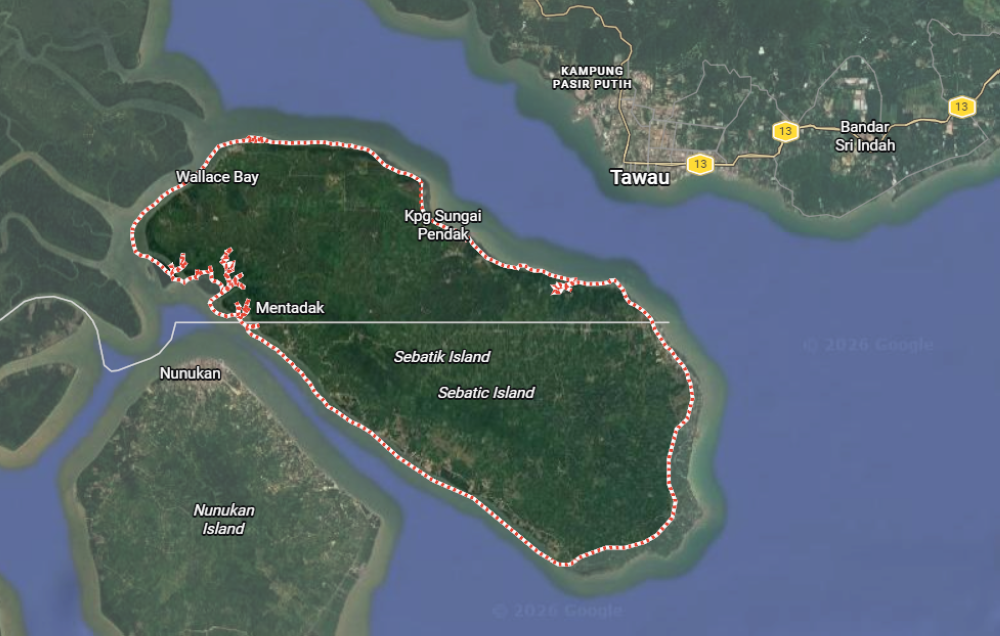
One of the OBPs is Sebatik Island. A 1983 joint survey by both countries on the island revealed that most of the 18 boundary pillars erected by the two colonial powers were incorrect.
Since then, the Sebatik Island OBP has never been resolved. This despite a 2018 re-demarcation agreement which was reached between the two neighbours leading to a 2019 memorandum of understanding (MOU) on the demarcation and survey of the international boundary between the two countries.
The two close neighbours and friends have seen a lengthy negotiation process to ratify the results of the re-demarcation.
According to the process, the results would have to be negotiated by the Team Leaders (TL) of the two countries in the field. They would also have to be negotiated by the Chief of Field Parties (CFP), who would then have to report to the Co-Project Director (CPD).
The CPD, in turn, would have to report to the Joint Chief of the Joint Border Technical Committee (JBTC) before the latter report to the Joint Chief of the Joint Boundary Committee (JBC).
The process should end with an MoU signed by the two countries.
According to Natural Resources and Environmental Sustainability (NRES) Minister Datuk Seri Arthur Joseph Kurup, an MoU was duly signed on February 18, 2025.
Instead of condemnation for allegedly handing over 5,207 hectares of land to Indonesia in return of far lesser hectares of land, the Madani government should be commended for finalisation of the land boundary measurement sealed through an MoU, after almost 50 years of “negotiations … carried out harmoniously between the two countries, in accordance with international law and existing boundary agreements, without being based on principles of reciprocity, compensation, or ‘profit and loss’.”
Past governments were part of the negotiation process for more than 40 years.
So why the condemnation from the very people who constituted past governments?
If the MoU leads to an agreement between the two countries, Insya-Allah, the future generation will not inherit what past and present generations inherit.
* This is the personal opinion of the writer or publication and does not necessarily represent the views of Malay Mail.


