


JANUARY 29 — Anthony Albanese’s visit to Timor-Leste on January 28–29 takes place in a regional setting that has shifted in quiet but consequential ways. Since October 26, 2025, Timor-Leste is no longer an Asean aspirant but a full member of the organisation. This does not transform the country’s regional position overnight, but it does alter the diplomatic frame within which Australia now engages Dili.
The visit, therefore, is about how Australia responds to a neighbour whose regional status has changed, even if the structural asymmetries in the bilateral relationship have not entirely disappeared. The significance of Albanese’s presence lies less in symbolism than in whether Australia recalibrates its assumptions about Timor-Leste’s role, as a regional participant rather than solely a recipient of assistance or a peripheral strategic concern.
This recalibration is reflected in the joint declaration signed during the visit, which frames the relationship as a “New Partnership for a New Era.” The language is deliberately forward-looking, emphasising mutual respect, sovereignty, and shared regional responsibility. Yet the declaration’s significance lies less in its aspirational tone than in what it implicitly acknowledges, that Timor-Leste’s regional standing has shifted, even if the underlying power imbalances between the two countries remain.
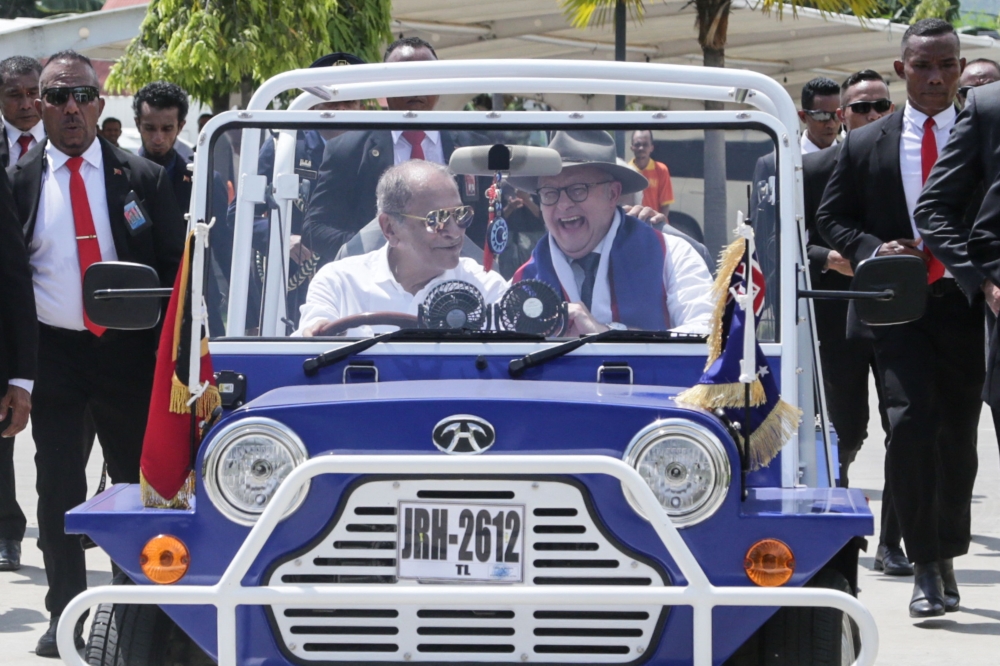
For Timor-Leste, Asean membership represents long-sought recognition of regional belonging, but it also exposes the country more directly to Asean’s internal contradictions. Membership has not resolved the organisation’s tensions between democratic norms and political practice, or between consensus and accountability. Instead, Timor-Leste’s accession has brought these contradictions into sharper relief, particularly for a small state whose political identity has been shaped by resistance, post-conflict reconciliation, and an explicit commitment to democratic institutions.
Albanese’s visit thus intersects not only with bilateral diplomacy, but with broader questions about Asean’s evolving political character at a time of democratic regression and geopolitical strain. Timor-Leste’s presence within Asean does not make the organisation more democratic by default, but it does introduce a different political vocabulary, one that occasionally sits uneasily with Asean’s preference for restraint and non-interference.
Notably, the joint declaration explicitly situates Australia’s engagement with Timor-Leste within this new Asean context, committing Canberra to support Dili’s effective participation as Asean’s newest member. This matters because it subtly shifts the diplomatic register from bilateral assistance to regional embeddedness. Australia is no longer engaging Timor-Leste only as a neighbour, but as a state whose regional voice now circulates through Asean’s institutional and political structures.
Australia’s relationship with Timor-Leste remains shadowed by history. From Canberra’s early recognition of Indonesia’s occupation, to the decisive but belated intervention in 1999, and later to the fraught maritime boundary negotiations, the relationship has oscillated between partnership and imbalance. The eventual settlement of the Timor Sea boundary marked a legal and diplomatic correction, but it did not erase accumulated mistrust. These historical episodes continue to shape how sovereignty, fairness, and power are perceived in Dili.
The declaration’s renewed commitment to advancing the Greater Sunrise project, framed as a cooperative and commercially viable endeavour consistent with the maritime boundary treaty, therefore carries symbolic weight beyond economics. For Timor-Leste, energy development remains inseparable from questions of dignity, delayed justice, and economic self-determination. For Australia, support for this agenda functions as both reassurance and test; whether past corrections translate into sustained political commitment rather than episodic gestures.
Timor-Leste’s Asean membership complicates this dynamic without overturning it. The country now operates within a multilateral setting that affords it greater diplomatic visibility, but not necessarily greater leverage. Albanese’s visit therefore raises a subtle but important question. Will Australia engage Timor-Leste as a regional actor whose voice now resonates through Asean, or continue to approach the relationship primarily through a bilateral and developmental lens?
From Canberra’s perspective, Timor-Leste’s Asean membership also has implications for how Australia conceptualises its neighbourhood. Asean’s geographical and political reach now extends closer to Australia’s immediate strategic environment, further blurring the long-invoked distinction between Southeast Asia and Australia’s “near abroad.” This reinforces a familiar challenge for Australian foreign policy: translating rhetorical commitments to Asean centrality into sustained, institutionally embedded engagement.
Australia’s relationship with Asean has long been pragmatic rather than transformative. While the Albanese government has shifted tone by emphasising respect, consultation, and listening, it continues to balance values-based language with strategic caution. That balance becomes more delicate when viewed through Timor-Leste’s position within Asean, particularly as Canberra navigates competing priorities related to security, economic integration, and regional stability.
Timor-Leste has, since joining Asean, shown a tentative willingness to articulate normative concerns around people-centred governance and human rights. These interventions have been measured rather than confrontational, reflecting an awareness of Asean’s political culture and the constraints facing a new and small member state. The question is not whether Timor-Leste will “democratise” Asean, but whether it can, over time, widen the space for normative conversation without being marginalised.
China remains an unspoken but ever-present backdrop. Timor-Leste has deepened ties with Beijing alongside its relationships with Australia, Japan, and other partners, reflecting a broader Southeast Asian pattern of strategic diversification rather than alignment. Since joining Asean, Timor-Leste’s engagement with China is increasingly mediated through regional frameworks, complicating any attempt to interpret its foreign policy through a zero-sum lens. The joint declaration’s careful language on regional peace and cooperation reflects this same sensibility, avoiding overt alignment while reinforcing Timor-Leste’s preference for balance and strategic autonomy.
At home, Asean membership has also raised expectations that will not be easily met. Economic diversification beyond petroleum revenues, youth employment, and sustainable development remain pressing challenges. Asean integration offers new pathways, but also exposes Timor-Leste to competitive pressures for which its institutions are still adapting. Australia’s engagement should therefore be assessed less by the optics of high-level visits than by whether it supports Timor-Leste’s long-term capacity to participate meaningfully within Asean.
Ultimately, Albanese’s visit to Dili marks less a resolution than a recalibration shaped by Timor-Leste’s new position within Asean. Membership has not elevated Timor-Leste beyond the structural limits facing small states, nor has it resolved Asean’s own tensions between normative aspiration and political practice. Instead, it has inserted Australia–Timor-Leste relations into a more complex regional setting, where bilateral gestures are increasingly filtered through multilateral expectations, constraints, and silences.
In this sense, the visit tests not only Australia’s neighbourhood diplomacy, but its understanding of Asean itself. Engaging Timor-Leste as an Asean member requires Australia to reckon with an organisation that prizes consensus over contestation, stability over accountability, and restraint over normative clarity.
Whether Canberra can support Timor-Leste’s cautious navigation of these contradictions without defaulting to a purely strategic or instrumental reading of Asean will shape how meaningful this “new partnership” becomes in practice.
* Khoo Ying Hooi, PhD is an associate professor at Universiti Malaya. This piece has benefited from recent conversations in Dili.
** This is the personal opinion of the writer or publication and does not necessarily represent the views of Malay Mail.


